
Carl in Michigan
Diamond Member
- Aug 15, 2016
- 65,881
- 50,638
- 3,615
Yes. Dealing with you is beating my head against the wall.Well, you just cannot teach people who do not want to learn, don't want to know what you know
Follow along with the video below to see how to install our site as a web app on your home screen.
Note: This feature may not be available in some browsers.
Yes. Dealing with you is beating my head against the wall.Well, you just cannot teach people who do not want to learn, don't want to know what you know

I am asking for specifics. What does 'call on his name' mean? Give an example.It means that His Church is not bound by organizations, that He is wherever His people are, and His people are all those who call on His name, not just who belong to a particular organization.
And how is that known? Again, specifics, please.It means, "if any man has not the Spirit of Christ, he is none of His"
As we all know from reading Scripture, to call on the name of the Lord is to cry out to Him, putting your faith in Him. I thought that was well known to all Christians. The Body of Christ, aka His Church, is in the hearts of all who call on His name and put their faith in Him. Do I have to spell out what it means to be a believer?I am asking for specifics. What does 'call on his name' mean? Give an example.
One would hope that you could follow what you're claiming. The bottom line remains, however, that you are claiming the Catholic Church is it, the one and only hope for salvation, while simultaneously claiming it has gone corrupt in the last few decades and you're following something else, but still claiming there is no hope outside of it, and stuff like that.It is not confusing to me.
So there's that...
you seriously think there are only Catholics in heaven.?The Catholic Church (no longer extant in the Vatican) has taught this (extra ecclessiam nulla salus [Outside the Catholic Church there is no salvation]) for 20+ centuries.
A priest named Father Feeney persisted in teaching this dogma in the 40s and 50s.
Vatican staff defied him and threatened him, finally "excommunicating him" but it was not a real excommunication for a plethora of reasons...
See this site for details
Modernists use Anti-Feeney Pseudo-Holy Office Letter to ‘justify’ Francis’ latest heresy
MHFM: It’s interesting that certain modernist defenders of the Whore of Babylon (i.e. the Vatican II Sect) are citing the pseudo-Holy Office letter, called Suprema Haec Sacra (dated Aug. 8, 1949), written against Fr. Feeney, [...]vaticancatholic.com
Another interesting (and at times accidentally comical-at least to me)
video on heresy
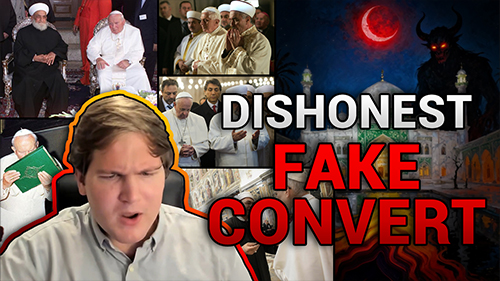
Christian Wagner’s Lies, Contradictions & Errors Exposed
This video contains many important quotes and facts that are relevant to many aspects of the current controversies. 0:00 Intro0:54 Wagner Falsifies Theological History On Loss Of Office2:12 Wagner’s Lies About Florence, Torquemada & Salvation3:31 He Says You Must Interpret Councils According To...endtimes.video
I fully expect to be rubbing elbows with people from all walks of life and all denominations when I'm worshipping before the throne. Those who expect only Catholics to be there are in for a rude awakening.you seriously think there are only Catholics in heaven.?
My point is when I need help, I can call on any number of people having faith that they will lend a hand. However, that is a very minimal part of our relationship, any relationship. Is that how some see Christ: That when they need help, they have faith he will lend a hand?As we all know from reading Scripture, to call on the name of the Lord is to cry out to Him, putting your faith in Him. I thought that was well known to all Christians. The Body of Christ, aka His Church, is in the hearts of all who call on His name and put their faith in Him. Do I have to spell out what it means to be a believer?
My perspective (based on Catholic teaching) that forkintheroad7 seems to overlook is that the Catholic Church (or any religion/faith) exists in a fallen world, run by fallen people, for a fallen people. Therefore, the Catholic faith has never been perfect, ideal, or without failings. However, where the Church has never failed is in guiding and pointing the way to Jesus through apostolic teachings and traditions. No Council, no changes by Vatican II, no pope digging up a the deceased predecessor and dragging him through the streets to put the corpse on trial changes any of that. Through all its failings, the Church points to--and follows--Jesus. Do I agree with everything Vatican II changed? No. The hope was to bring better understanding of the Church/Jesus into the modern world--assist the people to become even more engaged. Vatican II was well intended--and it followed Jesus just as sincerely (and perhaps more so) than past liturgical changes.One would hope that you could follow what you're claiming. The bottom line remains, however, that you are claiming the Catholic Church is it, the one and only hope for salvation, while simultaneously claiming it has gone corrupt in the last few decades and you're following something else, but still claiming there is no hope outside of it, and stuff like that.
This is not calling on Him because we need help, this is answering His statement that all who call on the name of the Lord will be saved. I will NOT call on anyone else to save my soul.My point is when I need help, I can call on any number of people having faith that they will lend a hand. However, that is a very minimal part of our relationship, any relationship. Is that how some see Christ: That when they need help, they have faith he will lend a hand?
And nor will you, yourself, work towards that end? Catholics follow The Way, Jesus' Way of Salvation. Jesus called upon us to discern the will of God and to follow it. In other words, in the Catholic life, Jesus calls us to action, and specific action at that. Life is not a matter of telling Jesus we have faith that he will save us--and then continue on our own merry way (or in my case, my Meri way).This is not calling on Him because we need help, this is answering His statement that all who call on the name of the Lord will be saved. I will NOT call on anyone else to save my soul.


We've been over this before. Salvation is whole and complete, Jesus finished it on the cross. His most well-known statement from the cross is, "It is finished", and that term in the original language means it's done, it's complete in every way. That means that no, my salvation does not depend on me modifying my behavior, trying to be good, or fighting temptation. It is complete and totally done. I can't add to it or take away from it.And nor will you, yourself, work towards that end? Catholics follow The Way, Jesus' Way of Salvation. Jesus called upon us to discern the will of God and to follow it. In other words, in the Catholic life, Jesus calls us to action, and specific action at that. Life is not a matter of telling Jesus we have faith that he will save us--and then continue on our own merry way (or in my case, my Meri way).
Protestants seem to believe there is very little they have to do (My yoke is easy; the burden light philosophy). Catholics seem to believe there is also discipline involved (discipline and disciple are from the same root philosophy).
I have never heard of "works based theology", and I doubt there is any such thing. My post was addressing purification/purgatory which has nothing to do with "works based" anything.A works-based theology insists that we have to follow Christ's commands out of fear, out of a desire to make ourselves worthy of salvation, thinking that we need to do something to complete salvation, that it's missing something that we have to provide.
A theology that claims you have to or even can do works to add something to Christ's sacrifice is a works-based theology. Purification/purgatory does exactly that because it says in essence that Christ's sacrifice is not enough, that you have to either suffer after death or do works to attain a state acceptable to God.I have never heard of "works based theology", and I doubt there is any such thing. My post was addressing purification/purgatory which has nothing to do with "works based" anything.
Why do you keep mistaking producing good fruit - which is a sign of God's good grace - with doing good works to get God's good grace?A theology that claims you have to or even can do works to add something to Christ's sacrifice is a works-based theology. Purification/purgatory does exactly that because it says in essence that Christ's sacrifice is not enough, that you have to either suffer after death or do works to attain a state acceptable to God.
I make the distinction when I see people claiming works will purify them or have to be added to Christ's sacrifice to complete salvation, etc. Have you not read where I explicitly went over why we do works and discipline ourselves? I thought I was quite clear. We CAN'T get God's good grace through works, we do them because we love Him intensely and know they please Him.Why do you keep mistaking producing good fruit - which is a sign of God's good grace - with doing good works to get God's good grace?


