Home made telescopes mirrors need to be smooth within 50 nanometers ... 1/4 of a wavelength of blue light ...
Wrong on all accounts Reiny, now you've stepped into an area that I know more than a little about. First of all, the Raleigh Criteria sets forth a quarter-wave threshold based on the Dawes limit of partial resolution of two airy discs at null frequency generally accepted to be around 550nm, the wavelength of yellow-green light where the eye's peak sensitivity is, since home made personal telescopes are used optically and not generally as some far off wavelength, thus, the strehl ratio for the blue and red generally fall well below 1/4wave accuracy (about 0.89 strehl) unless the instrument will be used for digital imaging where having it optimized farther into the red/IR may be a benefit due to CMOS and CCD sensors being IR sensitive.
Home made optical telescopes always perform worst in the blue end where (unless you are using blue-sensitive emulsion) the eye is poorly sensitive to anyway. Scotopic vision sucks in the blue. So why would anyone null out an optic to perform best at that wavelength?
So they generally set 1/4 lambda as a preferred minimal threshold whereas gains are often seen even up to 1/10th wave. I've owned 1/50th wave optics that approached 0.996 strehl in the yellow-green. And 50nm is not quarter wave of blue or green as blue is about 450nm and like I said, yellow-green is like 550nm. So how does 1/4 wave of any of them = 50nm?? Actually, a home made mirror that is only 1/4𝛌 accurate is a rather poor one. A good home made mirror is more around between 1/8th wave to 1/20th wave. Also, when it comes to mirrors, silvered or aluminized, their strehl intensity is not contingent upon wavelength anyway since they are not reactive to frequency as a glass lens is!
Also, keep in mind that an optical mirror must be twice as smooth as its intended final wavefront accuracy is because any reflected image involves TWO interactions--- first the photon is absorbed by the coating, then a new photon is released back in the original direction, as opposed to a glass substrate where the original photon is redirected through refraction in the same direction as the subtract itself then becomes involved in the image forming process as a reactive component.
... telescopes have to be below 200 nanometers or they won't work ...
200nm is well into the UV band.
I know you hate scientific papers ... because this one claims X-ray telescope mirrors are smooth at the atomic level ...
"Monocrystalline silicon is the preferred substrate material for X-ray mirrors, which highly demand atomically precise, ultra-smooth and damage-free surfaces."
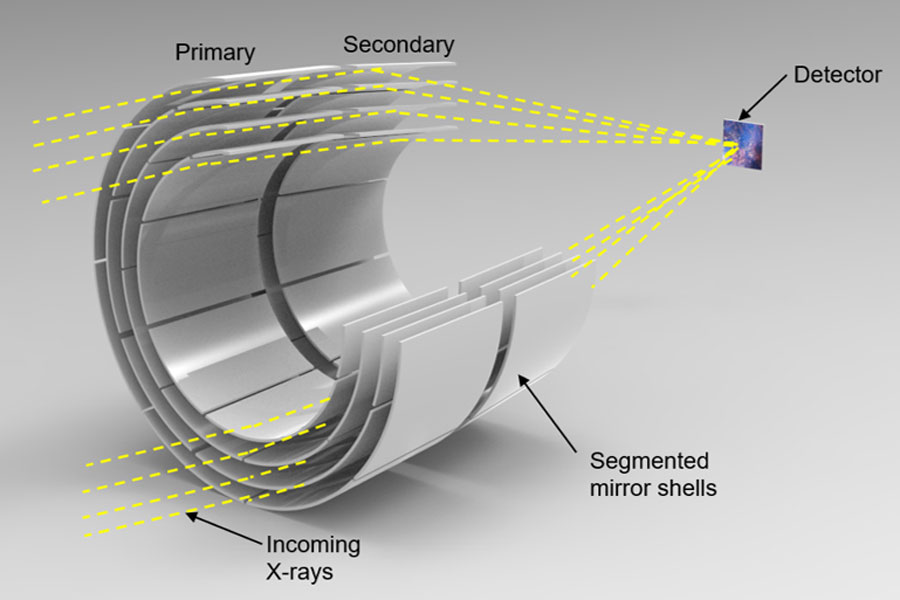
Actually, x-ray optics is a bit off from my experience, but generally, you don't grind a flat first surface mirror to form x-ray images--- for one thing, no matter how smooth the substrate is, what really matters is the smoothness of the final reflective overcoat, which is generally aluminum, silver oxide or gold, none of which will do you a damn bit of good in x-rays. X-rays are are too high energy to reflect as normal light, they are around 10 angstroms or around 1 nm in wavelength--- in my experience, telescopes designed for work in x-ray alone are not mirrors at all in the conventional sense but complex things which the x-ray photon strikes in a series of precision concentric rings such that the x-rays hit it at an extremely low grazing incidence so that it is only marginally deflected from its original path so that across an area, all x-rays can be deflected to a common prime focus to form an "image."
This all said, none of this has a thing to do with humanity being wiped out much less addresses what I think West's original point was about how primitives could grind huge, flat stones to a precision far beyond the technology of today where essentially they fit so well together that no mortar was needed.