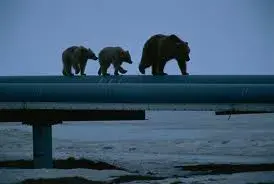
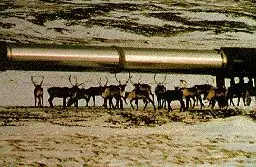
Do you have the same outrage over pipelines that disrupt migratory routes? Or fish habitats destroyed by industrial pollution? They're called "Green" energy sources because they have less environmental impact and therefore negatively affect the least number of species, not just humans.Let's see some real tears over this crises;
THE EXTINCTION CRISIS
Its frightening but true: Our planet is now in the midst of its sixth mass extinction of plants and animals the sixth wave of extinctions in the past half-billion years. Were currently experiencing the worst spate of species die-offs since the loss of the dinosaurs 65 million years ago. Although extinction is a natural phenomenon, it occurs at a natural background rate of about one to five species per year. Scientists estimate were now losing species at 1,000 to 10,000 times the background rate, with literally dozens going extinct every day [1]. It could be a scary future indeed, with as many as 30 to 50 percent of all species possibly heading toward extinction by mid-century [2].
Unlike past mass extinctions, caused by events like asteroid strikes, volcanic eruptions, and natural climate shifts, the current crisis is almost entirely caused by us humans.
LINK:
Time to act, not politicize
No, it's not. Thousands of new species are being found every year. Hardly the definition of "mass extinction". Go peddle your propaganda some place else.
"On remote forest tree-tops and in deep Arctic oceans, researchers spotted and identified a varied collection of new species in 2013. Among them: a "cocoa frog" from Suriname, a shark that walks, and a tarantula the size of a dinner plate.
Though this years haul of new species runs into the thousands, researchers estimate that there are about 8 million species still unidentified by science skulking in remote corners of the world, and sometimes hiding out right under scientists' noses.
And thats not including most of the microbial world. "When you throw in the bacteria and archaea and cyanobacteria and those early groups, all bets are off," Quentin Wheeler, incoming president of the SUNY College of Environmental Science and Forestry, and founder of the International Institute for Species Exploration, told NBC News.
Science is catching up with Mother Nature but slowly. About 18,000 species are discovered every year, and as of 2013, "were fast approaching 2 million named things," Wheeler said.
Yearly tallies of new species follow a predictable trend: "Bucketloads of insects is always a safe bet!" Wheeler said. Half the newly named animals are insects or related arthropods which makes sense because insects are the most populous group on the planet. Theyre also pretty darn small.
But this year held some big surprises, too. An oncilla a South American wildcat and a 240-lb tapir a relative of rhinos and horses were among the new species recognized by science.
"A 300 lb mammal running around unrecognized is pretty amazing," Wheeler said, adding that if we can still find large, new mammals, "There is hope in every group."
The scientific name for the olinguito, Bassaricyon neblina, comes from the Spanish word for fog."
Ode to Gaborn: 18,000 new animal species discovered every year - NeoGAF