Zone1 Why does anything matter?


Aside from God, what does anything matter?

Go!!


One important idea that can cause you or I or almost anybody to realize that EVERYTHING matters is the case that can be presented that we actually live within the context of Applied Multiverse Theory. Ezekiel chapter thirty seven can be fulfilled over and over and over again as Messiah Yeshua - Jesus in His resurrected and glorified body replicate moments in the past, [along with every human being who lived during that moment], and then spin off a new time line in which much of the horrors and injustices are at least decreased....... [and eventually they will all be solved]!


3. A Successful Apocalyptic Prophecy is One That Doesn’t Happen​

The goal of apocalyptic prophecy is to warn people to prevent it from happening. The reason prophecies are given to humanity is to change current trends and change enough people so that the prophecy will be diverted. Well-known prophecies that were foretold to occur around the millennium have not happened. Skeptics point out that this proves these prophecies to be false. But a better understanding of prophecy reveals that either (a) or (b) is true:

(a) The prophecy was successful in permanently diverting the outcome by the raising of the world’s consciousness.

(b) Because the prophecy gives an exact date, the prophecy may still be valid and the date may be wrong.

Prophecies from very credible sources rarely give an exact date. Even Jesus said he didn’t know the date and time when he would return. This should be a lesson to everyone who comes across a prophecy with an exact date.
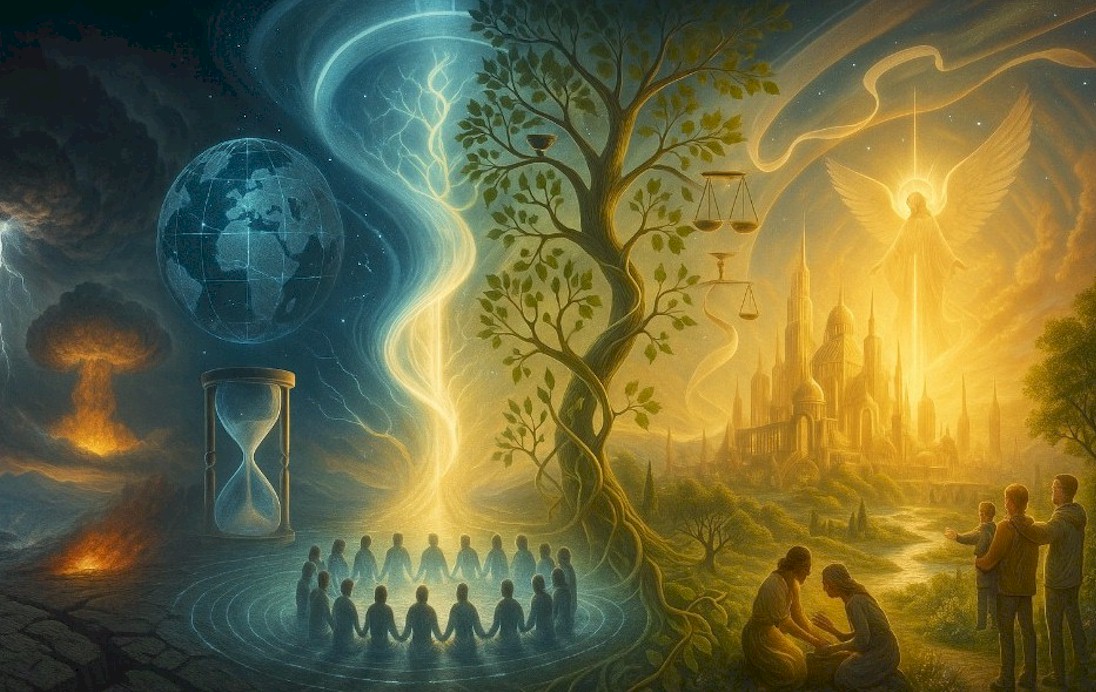


Theistic Evolutionary and Applied Multiverse Theory implies Eventual Universal Salvation?

 
No. I'm basing it on reality. Do you believe all behaviors lead to equal outcomes? Do you believe that choices have consequences? Do you believe that certain choices lead to better outcomes? Do you believe that certain choices lead to worse outcomes?

If so, how is that not existence providing feedback to you?
Stellar behavior is not outcome focused. Stars do not make choices.
 
Stellar behavior is not outcome focused. Stars do not make choices.
Never said either were. I said their formation was directed by existence through the laws of nature.

Are you afraid to answer the questions though?

Do you believe all behaviors lead to equal outcomes? Do you believe that choices have consequences? Do you believe that certain choices lead to better outcomes? Do you believe that certain choices lead to worse outcomes?

If so, how is that not existence providing feedback to you?
 
No evidence to show they are.
But your claim was that there is evidence to show the creator - which you are agnostic about - is not moralistic and providential.

I just showed you the evidence that the creator is moralistic and providential.

Where's your evidence to the contrary?
 
No evidence to show they are.
If you believe there is no evidence that shows the creator to be moralistic and providential but don't have evidence that it's not, then why do you default one way or the other? That's not very agnostic of you. It seems you have a definite bias.
 
Are you afraid to answer the questions though?
So you've swerved from stars to what? People?

Do you believe all behaviors lead to equal outcomes? Do you believe that choices have consequences? Do you believe that certain choices lead to better outcomes? Do you believe that certain choices lead to worse outcomes?

If so, how is that not existence providing feedback to you?
People can make the same choice and it could lead to good or bad outcomes. Hitler seized power in Germany and Stalin seized power in Russia. Their outcomes were very different.
 
But your claim was that there is evidence to show the creator - which you are agnostic about - is not moralistic and providential.

I just showed you the evidence that the creator is moralistic and providential.

Where's your evidence to the contrary?
Your claim of evidence is not supported by your posts.
 
If you believe there is no evidence that shows the creator to be moralistic and providential but don't have evidence that it's not, then why do you default one way or the other? That's not very agnostic of you. It seems you have a definite bias.
I avoid accepting things I have no evidence for. The Flying Spaghetti Monster is an example.
 
So you've swerved from stars to what? People?
I addressed both in post #135 when I said nature directed both stellar formation and biological life. Now we are talking about whether or not your version of a creator is moralistic and providential. Which is decidedly not related to stellar structures but human beings and the choices human beings make.

It's pretty clear to me that morals and providence are logical. That logically some choices are better than others. That logically the consequences of those choices reflect the quality of those choices. There are a couple of different ways you could have argued but arguing stars and galaxies aren't moral or providential isn't one of them.
 
People can make the same choice and it could lead to good or bad outcomes. Hitler seized power in Germany and Stalin seized power in Russia. Their outcomes were very different.
Which is why you have to look at distributions. When you violate a standard, often times you get away with it. Think about how you teach your children about right and wrong. Or how you teach them behaviors which lead to success. Surely you aren't telling your child that just because you can sometimes get away without putting in the proper effort that not making the proper isn't important. And that's just one example. I could pick almost anything and use it as an example.
 
Life is an incredible thing. Don't waste it, enjoy it. Family and friends are what I enjoy. And I enjoy doing the occasional good deed. And pickleball.
Yes but, what is life? Where does it come from? We really don't know, all we have is our own definition of life which is a living, functioning cell that no one has been able to replicate except the cell itself. There is an intelligence in that and I call it God.
 
Your claim of evidence is not supported by your posts.
But you believe your creator ISN"T moralistic or providential. What evidence do you base that upon? You are making an affirmative statement. You need affirmative evidence.

I believe the creator is moralistic and providential and I have shown you my reasons for believing that. Not all choices lead to equal outcomes and the universe provides feedback through consequences to teach you. Surely you teach your children to do the right things instead of the wrong things. Do you do that because society tells you to do that or because you know these are the choices that lead to success?
 
I addressed both in post #135 when I said nature directed both stellar formation and biological life. Now we are talking about whether or not your version of a creator is moralistic and providential. Which is decidedly not related to stellar structures but human beings and the choices human beings make.
I have no 'version' of a creator. He either exists or he doesn't, I don't know which.

It's pretty clear to me that morals and providence are logical. That logically some choices are better than others. That logically the consequences of those choices reflect the quality of those choices. There are a couple of different ways you could have argued but arguing stars and galaxies aren't moral or providential isn't one of them.
So people have morals. All living things have morals, a lion's morality is to kill existing cubs when he assumes authority over a pride.
 
I avoid accepting things I have no evidence for. The Flying Spaghetti Monster is an example.
If that were true you wouldn't believe the creator isn't moralistic and providential because you have no evidence that the creator isn't.

But you do have evidence that the universe was directed according to the laws of nature and that the universe does give feedback in the form of consequences of choices. This feedback is the universe showing you that existence is moralistic and providential. That not all choices have equal outcomes. That some choices have better outcomes and that providence is predicated on doing the right things.
 
Which is why you have to look at distributions. When you violate a standard, often times you get away with it. Think about how you teach your children about right and wrong. Or how you teach them behaviors which lead to success. Surely you aren't telling your child that just because you can sometimes get away without putting in the proper effort that not making the proper isn't important. And that's just one example. I could pick almost anything and use it as an example.
Morality is NOT universal, it is situational. The morality of a slave is not the same as yours.
 
15th post
I have no 'version' of a creator. He either exists or he doesn't, I don't know which.
You always make a big deal about it when I use God instead of creator so as far as I'm concerned when I converse with you, he's your version of a creator.

It's incongruent to say you don't know if the creator exists or not and then be certain the creator is not moralistic or providential. If you don't know the creator exists or not then you should not know any of the creator's attributes.
 
So people have morals. All living things have morals, a lion's morality is to kill existing cubs when he assumes authority over a pride.
Morality is an artifact or intelligence. You are comparing apples to oranges. Do you teach your children to kill their cubs?

Do you teach your children that they should do the right thing and that doing the wrong thing has consequences? Have you ever punished your child before? If so, you were teaching them that their choices have consequences. So whether you acknowledge it or not you were teaching morals and providence. Which is exactly what your creator is doing in a way so sublime you can't even discern it.
 
Morality is NOT universal, it is situational. The morality of a slave is not the same as yours.
Morals are effectively standards. Standards exist for logical reasons.

The universe is constantly giving us feedback on our choices. Why can't you see this?
 
Morality is NOT universal, it is situational. The morality of a slave is not the same as yours.
What would you have to see from the creator's creation to convince you that the creator was moralistic and providential?
 

New Topics

Back
Top Bottom