What Goes Down…
Thegreenhouse effectworks like this: Energy arrives from the sun in the form of visible light and ultraviolet radiation. The Earth then emits some of this energy asinfrared radiation.Greenhouse gases in theatmosphere'capture' some of thisheat, then re-emit it in all directions - including back to the Earth's surface.
Through this process,CO2and other greenhouse gases keep the Earth’s surface 33°Celsius (59.4°F) warmer than it would be without them. We have added 42% moreCO2, and temperatures have gone up. There should be some evidence that linksCO2to the temperature rise.
So far, the average global temperature has gone up by about 0.8 degrees C (1.4°F):
"According to an ongoing temperature analysis conducted by scientists at NASA’s Goddard Institute for Space Studies (GISS)…the average global temperature on Earth has increased by about 0.8°Celsius (1.4°Fahrenheit) since 1880. Two-thirds of the warming has occurred since 1975, at a rate of roughly 0.15-0.20°C per decade."
The temperatures are going up, just like the theory predicted. But where’s the connection withCO2, or other greenhouse gases like methane,ozone or nitrous oxide?
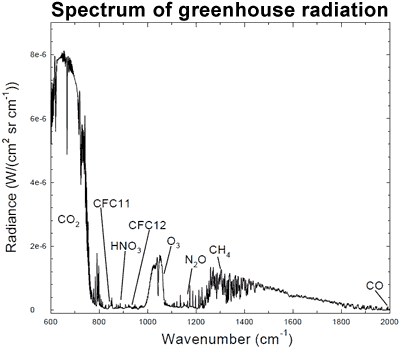
The connection can be found in the spectrum of greenhouse radiation. Using high-resolution FTIR spectroscopy, we can measure the exact wavelengths of long-wave (infrared) radiation reaching the ground.
Figure 1: Spectrum of the greenhouse radiation measured at the surface.Greenhouse effect from water vapour is filtered out, showing the contributions of other greenhouse gases (Evans 2006).
Sure enough, we can see that CO2is adding considerable warming, along with ozone(O3) and methane (CH4). This is called surface radiative forcing, and the measurements are part of the empirical evidence thatCO2is causing the warming.
How do we know more CO2 is causing warming?


 Only the AGW religion believes that.