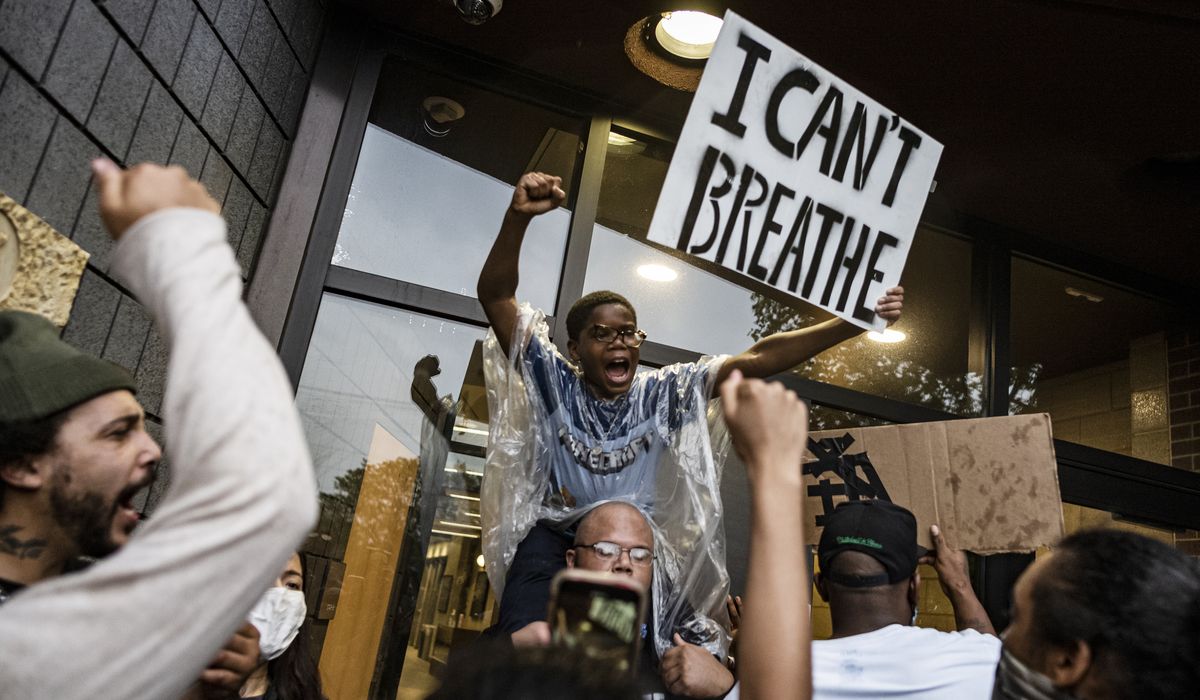
Almost everything we were originally told about George Floyd tragedy turning out not to be the case:
1. In fact, he did resist, at two locations.
2. In fact, the cop did not have his hand in his pocket
3. In fact, he dies of a heart attack, not strangulation or asphyxiation.
4. In fact, he was high on drugs.
5. In fact, he has long criminal history.
How big will the acquittal riot be?
In fact, 4 of your "facts" are irrelevant.
In fact, it doesn't matter if he didn't die of asphyxiation, because it doesn't prevent the knee on the neck from having caused his death.
In fact, the ex-cop won't be acquitted, no matter how much your primitive ass wants to cheer for police brutality.
It does matter, of course. Arrest the cop, try him and let jury decide his fate. That's how justice works.
It doesn't matter, actually, and the reason is in my post. What matters is whether the knee in the neck caused/contributed to his death, not whether or not the specific cause of death was asphyxiation.
And thank you for needlessly advocating "arrest the cop, try him, and let the jury decide" at me, as though I somehow suggested something else.
I does matter. If your attention span is bit longer than of a gold fish, you would notice that my post has nothing to do with a cop's action. Read the first sentence, dunce.
"Almost everything we were originally told about George Floyd tragedy turning out not to be the case". Every single thing I listed is correct, regardless of what cop did.
It doesn't matter. If your comprehension skills hadn't been deleted by your hormone rush, you would notice your post DOES have to do with the cop's action. Read your LAST sentence, dunce.
"How big will the acquittal riot be?" Every single thing you listed is irrelevant to whether the cop is acquitted, regardless of whether they're true or not.
Next time you start feeling manly and want to call ME dunce, make sure your own words aren't showing you for a fool.
I don't know, and neither you do if cop is going to be acquitted. My question is rhetorical, meaning... if blacks are capable of burning and destroying cities without all the facts are known, what are they going to do when cop is acquitted.
As of things I listed, they're still correct, and they'll be relevant during the trial. You don't want them to be, but that's just you being a dunce.
I can't swear it for a 100% certainty, no. I can tell you he'd have a better shot at winning the Powerball than he does of being acquitted, though. And no, four of the things you listed will not be relevant at trial, because they have very little to do with the validity of the core charge, and they have zero power to invalidate or even mitigate what the jury will see with their own eyes. The only one that might make a difference is the official cause of death, and since you have two medical examiners stating that the knee on the neck contributed to his cause of death, that's not ultimately going to be relevant, either.
I'm betting the DA does everything in his power to get this cop off. I was reading up on the 3rd degree charge as defined in that state and its a bogus charge. Basically the DA set it up for the defense attorney to hit a homerun. I was pissed off before but I was livid after finding out what the system did for this sociopath cop.
Yes, it does appear they are going to have an uphill battle convicting him now that the cause of death wasnt from asphyxiation. As usual, you people didnt wait for the facts to come out.
Not necessarily, since both MEs who did autopsies on him have stated that what happened with the cops was a major contributing factor to the cause of death.
Anyone who thinks that "he didn't die from asphyxiation" is a big AHA! moment doesn't really know much about anatomy and physiology.
And you know everything.
Again, I am not defending cops excessive use of force, I'm saying that all the fact are yet not knows.
Also, pressing on the neck is common way ti immobilize the threat. Police use it, special forces as well. Since you claim to know about anatomy, you should know it does not prevents you from breathing. It's just painful, but effective.
Now, since you ignored it last time, I am asking you again to provide a quote where am I cheering for police brutality.
You sound like a child now. "You just think you know EVERYTHING!!" *pout, pout*
I don't have to "know everything" to know some things, so stop acting the fool.
All the facts aren't known, that's true. However, none of the things you brought up are relevant to the central legal question, whether we know them or not.
Since I AM knowledgeable about anatomy, I know that all your assertions regarding "pressing on the neck" are bullshit that you THINK you know to be true, but aren't. If you'd like to SHOW us proof that what happened to George Floyd is "common to immobilize a threat, police use it", go right ahead (I don't consider it relevant whether or not the military uses it, because cops aren't the military). If you knew as much about anatomy as you think you do, you would know there's more at issue with pressure on the neck than merely "prevents you from breathing". It is NOT "just painful".
I already answered your last question, and I'm not interested in you making this all about "I demand to be considered a good person without having to act like one!"
What I am going to do for you, out of the limited goodness of my heart, is educate you on all the things you think you know and don't, so that you can be aware of what an arrogant fool you're making of yourself. No need to thank me; your humiliation will be enough.
In the years leading up to George Floyd’s death with his neck beneath the knee of a Minneapolis policeman, at least 58 people lost consciousness after the city’s officers put them in neck restraints, according to a CNN analysis of use of force data from the police department. Officers used neck...

ktvz.com
Officers used neck restraints on 428 people since 2012, and 14% lost consciousness, the data showed. That means the procedure,
which is restricted or banned in many large police departments around the country, was used an average of about once a week in the city over that time period.
Use of force experts told CNN that the procedure that officer Derek Chauvin used — pressing his knee into the back of Floyd’s neck for several minutes, as Floyd groaned that he couldn’t breathe —
wouldn’t qualify as a proper neck restraint under the city’s policy and procedure manual.
Seth Stoughton, an associate professor of law at the University of South Carolina who’s
written a book about police use of force, said
many large police departments banned neck restraints after protests in the 1960s, following criticism that similar chokeholds resulted in fatalities. He said he thinks Minneapolis should also prohibit it except when officers are facing a serious, imminent threat to their safety.
What Chauvin did to Floyd was “not a neck restraint,” Stoughton said, calling it “crazy inappropriate.”
George Floyd's death has raised new questions about a potentially dangerous method of restraint: the knee-to-neck maneuver.

www.stltoday.com
The knee-to-neck move is
banned by several major metropolitan police departments, but Minneapolis police allow police to restrain suspects' necks
if they're aggressive or resisting arrest. Floyd was unarmed and handcuffed when he was
pinned to the ground.
Depending on the way someone's head is positioned and the weight of the person applying pressure to their neck, the knee-to-neck maneuver can cause significant damage, said Seth Stoughton, an associate professor of law at the University of South Carolina.
Stoughton, co-author of "Evaluating Police Uses of Force," identified three ways officers can cause potential injury using the knee-to-neck method.
The first, he said, is keeping suspects in the prone position, meaning they lie face-down with their hands cuffed behind their backs, for an extended period of time. It's a dangerous position, Stoughton said, because it's known to cause what's called positional asphyxia.
Someone in that position can draw enough breath to gasp or speak in spurts, but they can't breathe fully, so they gradually lose oxygen and fall unconscious.
Stoughton, who is a former officer, said police departments emphasize keeping someone in the prone position just long enough to restrain them, then take them out of it either by rolling them onto their side, sitting them up or having them stand.
Another potential injury involves the placement of pressure. A great deal of pressure and weight on a suspect's neck can cause fatal damage.
To be continued . . .