I don't suppose you will take the time to read this entire article, but perhaps you should.
Bernard Bailyn, one of our greatest historians, shines his light on the nation’s Dark Ages

www.smithsonianmag.com
If you choose not to be enlightened by the Smithsonian here are a few excerpts that shouldn't take too long to read:
The Shocking Savagery of America’s Early History
Bernard Bailyn, one of our greatest historians, shines his light on the nation’s Dark Ages
Enter Bernard Bailyn, the greatest historian of early America alive today. Now over 90 and ensconced at Harvard for more than six decades, Bailyn has recently published another one of his epoch-making grand narrative syntheses, The Barbarous Years, casting a light on the darkness, filling in the blank canvas
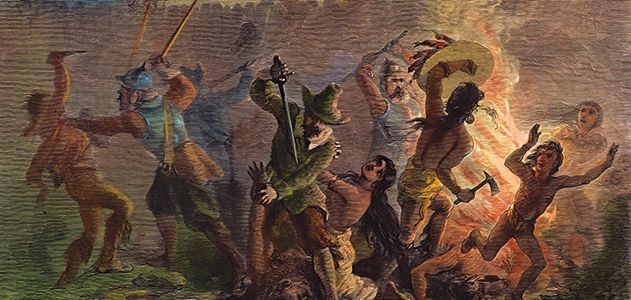
“Look at the ‘peaceful’ Pilgrims. Our William Bradford. He goes to see the Pequot War battlefield and he is appalled. He said, ‘The stink’ [of heaps of dead bodies] was too much.” Bailyn is speaking of one of the early and bloodiest encounters, between our peaceful pumpkin pie-eating Pilgrims and the original inhabitants of the land they wanted to seize, the Pequots. But for Bailyn, the mercenary motive is less salient than the theological.
“The ferocity of that little war is just unbelievable,” Bailyn says. “The butchering that went on cannot be explained by trying to get hold of a piece of land. They were really struggling with this central issue for them, of the advent of the Antichrist.”
The Antichrist. The haunting figure presaging the Apocalypse from the Book of Revelation plays an important part in Bailyn’s explanation of
the European settlers’ descent into unrestrained savagery. The key passage on this question comes late in his new book when Bailyn makes explicit a connection I had not seen before:
between the physical savagery the radical dissenting Protestant settlers of America wreaked on the original inhabitants, and the intellectual savagery of their polemical attacks on the church and state authorities they fled from in Europe—and the savagery of vicious insult and vile denunciation they wreaked upon each other as well.
But Bailyn’s “cosmic eye” saw even deeper. He wanted to capture not just physical movements but also “the interior experiences, the quality of their culture, the capacity of their minds, the patterns of their emotions.” He wanted to look inside heads and read minds. Bailyn’s voyage was a monumentally ambitious project, a voyage through unmapped oceans of data analogous to the Columbus-era explorers setting out on a vast uncharted ocean.
The opening section of his new book stands out for his profoundly sensitive appreciation of the sensibility of the original inhabitants whom he introduces simply as “Americans” rather than “Native Americans.”
He captures that sensibility as well as any attempt I’ve read: “Their world was multitudinous, densely populated by active, sentient and sensitive spirits, spirits with consciences, memories and purposes, that surround them, instructed them, impinged on their lives at every turn. No less real for being invisible...the whole of life was a spiritual enterprise...the universe in all its movements and animations and nature was suffused with spiritual potency.”
In person, Bailyn expresses an almost poetic admiration for this sort of spirituality. “All the world was alive!” he exclaims. “And the wind is alive! The mountains are alive!”
Then, he adds: “But it’s not a terribly peaceful world. They were always involved in warfare, partly because life would become imbalanced in a way that needed justification and response and reprisal. And reprisals, within their lives, are very important. But partly the onus is on the threats that they’re under.”
Bailyn does not let either of the two adversary cultures off the hook. He recounts little vignettes of the original inhabitants’ behavior such as this: Following the ambush of four Dutch traders, Bailyn quotes a report, one “had been eaten after having [been] well roasted. The [other two] they burnt. The Indians carried a leg and an arm home to be divided amongst their families.”
And, on the other side, consider that fixture of grade school Thanksgiving pageants, Miles Standish, an upstanding, godly Pilgrim stalwart who does not at all seem the sort of man who would have cut off the head of a chief and “brought it back to Plymouth in triumph [where] it was displayed on the blockhouse together with a flag made of a cloth soaked in the victim’s blood.”
TO WHICH I SAY, WELL, AT LEAST THEY INVENTED THE WHEEL!!!