Build a Hydrogen Powered Car
A Hydrogen Generator You Can Build | Fuel-Efficient-Vehicles.org
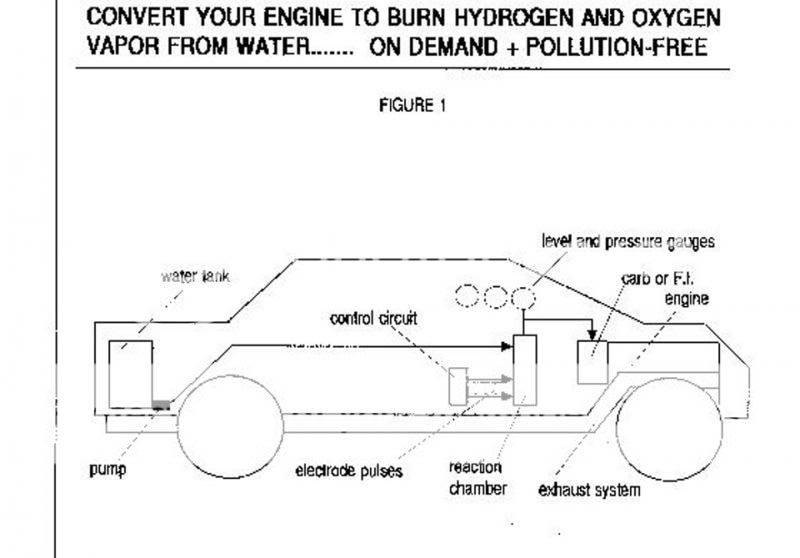
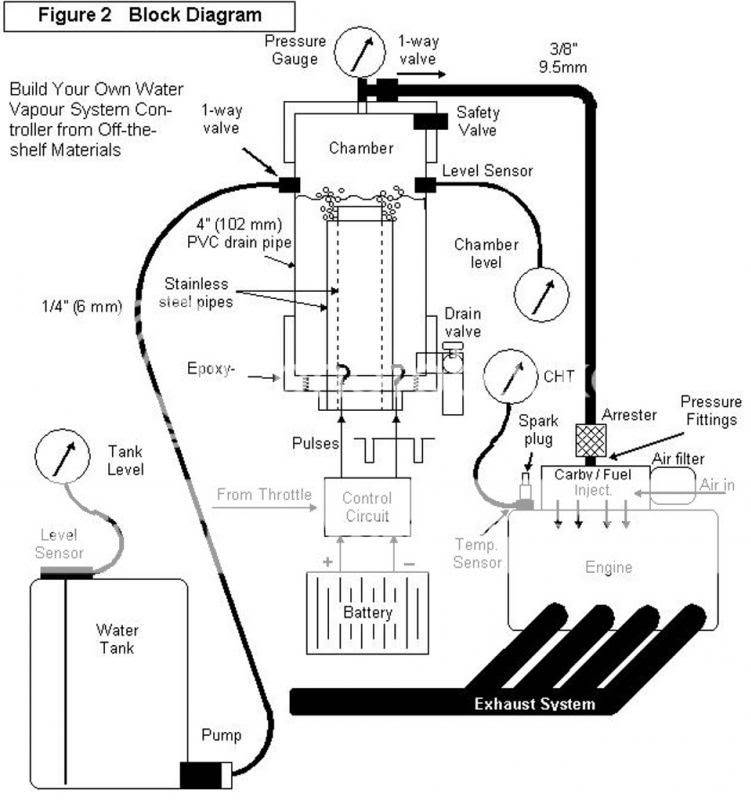
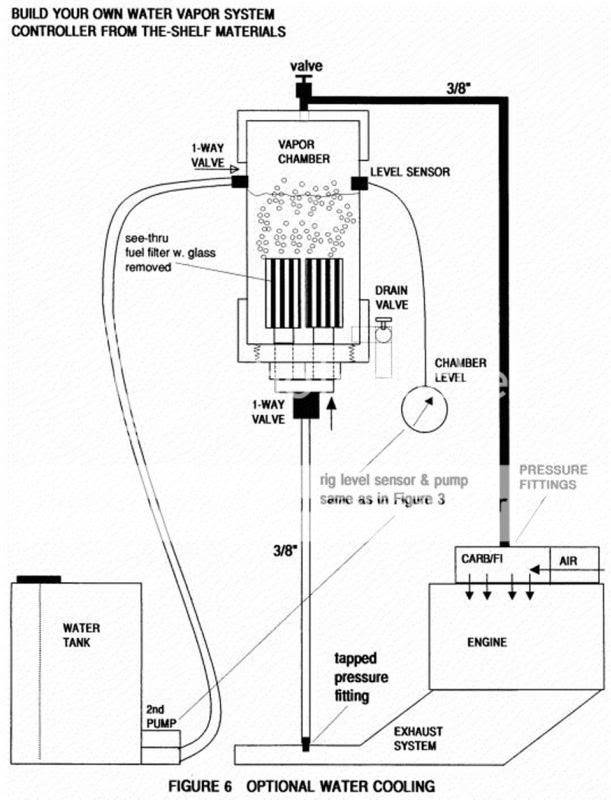
* A cannister, under the hood, containing electrodes (about 1.5 mm apart), is (almost) filled with water. The water is separated into hydrogen and oxygen, on demand, when the engine is started, and the hydrogen produced is directed into the engine through the air intake, which may or may not be mixed with gasoline, sprayed in, also. The hydrogen, a gas, explodes, completely, 100%, not just some small percentage like the liquid gasoline (or diesel) being sprayed in with it.
Gasoline, the liquid, does not explode in your engine, either. Liquid gasoline, or diesel, is sprayed into the engine. Of that, the small amount that vaporizes off the surface, (abt. 10-15%?) explodes with the force needed to move the pistons and turn the crankshaft. Of that small percentage which vaporizes and produces energy, 65% is wasted as heat. Additional small percentages are lost in the drive train, etc. Most of the gasoline, still a liquid, is now hot enough to vaporize, react chemically (the oxygen has been consumed, even creating carbon monoxide), cool, and go out the tail-pipe as smog: soot, toxic air pollution stuff that poisons us and overheats our planet....
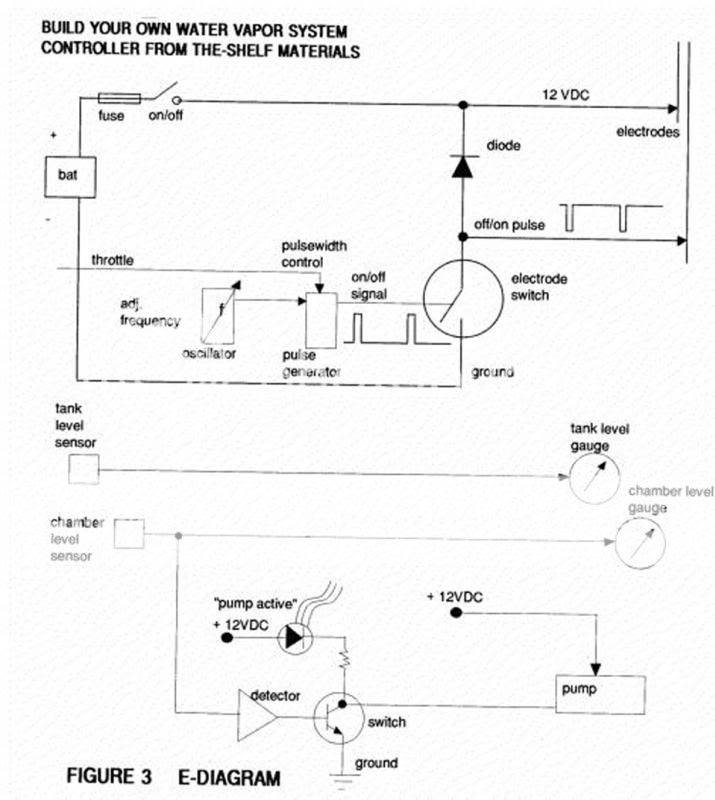
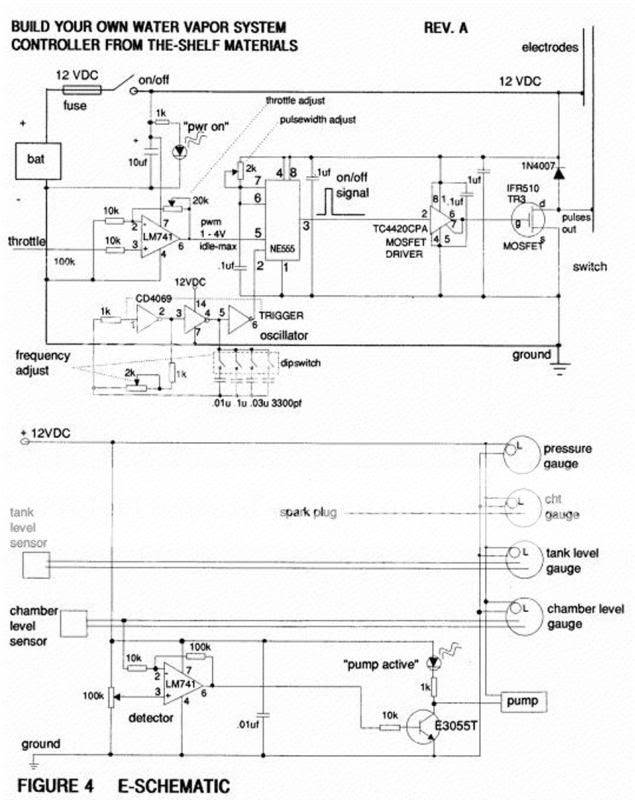
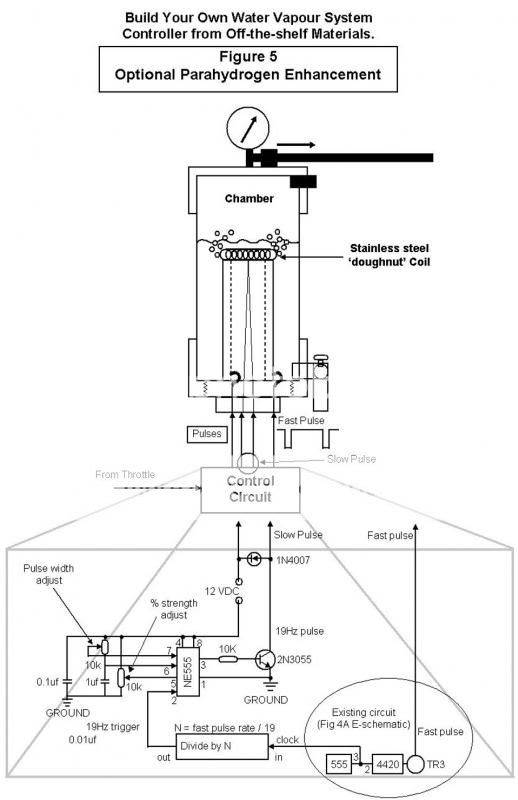
...The electrodes are vibrated with a 0.5 to 5 amp electrical pulse (depending on your speed and acceleration) which breaks 2(H2O) => 2H2 + O2. When the pressure reaches say 30-60 psi, you turn the key and go. When you step on the pedal, you send more energy to the electrodes, and thus more vapor to the cylinders; i.e. fuel vapor on demand.
An extract from the lecture given by Admiral Sir Anthony Griffin to the Maritime Division of the Southampton Institute, Warsash, UK, Sept. of 1993:
Electrical power with opposite polarities is applied in pulses to the inner and outer cylinders and at a power of 10 watts, i.e. 5 volts at 2 amps. A considerable quantity of gas immediately accumulates in the top of the vessel and, within 10 seconds, reaches a pressure of about 10 pounds per square inch. or . . . apply very high voltage (20,000+) pulses at a particular frequency, within positively and negatively charged voltage zones, at a very low current of less than 1 milliamp. The effect is
the covalent bonds between the hydrogen and oxygen atoms are broken and the two gases separated....
...Example: Dennis Klein went 100 miles on 4 oz of water. (25 mi./oz.) We should be able to go at least 1 or 2 mi on an oz. of gasoline, dont you think! (=128 mpg or =256mpg) We dont because it has not been converted to a gas first. See our pages here on super carburetors. [by the way, 1 gal. = 128 fluid oz. ! . . and . . . Anyone who remembers their basic chemistry knows that 1 gallon of a liquid equates to about 1,000 gallons of it as a gas - in the gaseous state. :: 1 gal of water = around 1000 gal of hydrogen gas at normal room temp. and pressure.]...
...1935 Inventor Henry Garrett patented a electrolytic carburetor and let a car run on tap water.
The late Henry Dad Garrett was a multi-talented Dallas inventor with a bent for electrical contrivances, and in 1935, he and his son, C.H. Garrett, patented and exhibited an automobile that ran on water actually, on hydrogen after the water was broken down by electrolysis.
Dad Garrett was already famous for his work. In 1920 he set up WRR in Dallas, the worlds first municipal radio station, and was its first announcer. He was the first man to build a radio in his car, and he developed radio transmission from the car for police use. He also invented an automatic electric traffic signal, possibly the nations first.
On September 8, 1935, The Dallas Morning News first announced that the water-fuel concept worked at least it worked for several minutes, the article reported. A few months later, Pathe News filmed the car driving along Garland Road with the driver stopping at White Rock Lake to fill the fuel tank with water before cruising off. ...
...It is suggested you try this out to begin with on a second vehicle you own, one that you dont need to live with everyday, until you perfect this technology.
In putting these plans into operation, you will be making use of your entire existing system except for the fuel tank and the catalytic converter. take a look at this video generating hydrogen gas with a small amp.
12V - 36V 65A PWM PULSE WIDTH MODULATOR HHO HYDROGEN GENERATOR PC BOARD (New Design Test) - YouTube