Again you guys can post all the graphs and charts and statistics you want, but you won't be able to disprove the simplest truths of the matter.
It's not a "truth of the matter" unless it actually has a real effect. There is nothing else but data, graphs of that data, and statistics that summarize the data. There isn't anything else.
I see no point in reading a table of data when we have such nice visualization tools at our fingertips. And obviously, a single data point is meaningless. It's always relative to the rest of it.
The measures of effects is an accounting of money, production, and employment (wages too.) If those change, it's a truth. If they don't change, it's not a truth. In the end, it's really that simple.
It's not a matter of disproving that tax changes cause changes in GDP. There is seldom such thing as disproving something.
Thankfully, we don't live in France and the burden of proof is on the prosecution. No one is found innocent in court. They are found "not guilty". The prosecution fails to prove guilt.
It's really a matter of failing to be able to prove it. It takes only one good piece of evidence to prove an effect. The problem is finding it.
Then we have to make sure it wasn't just random noise of caused by something else. That's why we like to have multiple instances. It makes it easier because the other effects tend to cancel out.
If we exhaust all possible manner of evidence for it, then we reject it on a high degree of confidence. That is how the scientific method works.
We could go with the "belief" method, which is that any random event proves it. That is how we do many things, personally. If I can accomplish something once, I can do it again. A single event proves it's possible.
It isn't, though, a "truth" if it doesn't actually happen. There are lots of things that seem as if they ought to be true, then in reality the magnitude of the effect is so little as to be meaningless. A "simple truth" based on no evidence is a belief.
The "simple truth" was that the earth was flat and was the center of the universe.
The problem with economics is that it isn't simple. There is no "simple economics". It's not rocket science, but isn't simple either.
Raising taxes in the right way can add money to treasury and, unless Congress and the President spend it, will reduce the national debt. Raising taxes in the wrong way can inhibit economic activity and net no difference to the national treasury or actually reduce the amount paid in.
Well, that's the hypothesis. That is actually two hypothesis, really, though they are tied together. One is that the right tax level maximizes output. The second is that it increases revenue.
That first one has like 32 possibilities of five sets of factors, raising and lowering taxes, the right way and the wrong way, increasing and decreasing economic activity, increasing and decreasing revenue, increasing and decreasing spending.
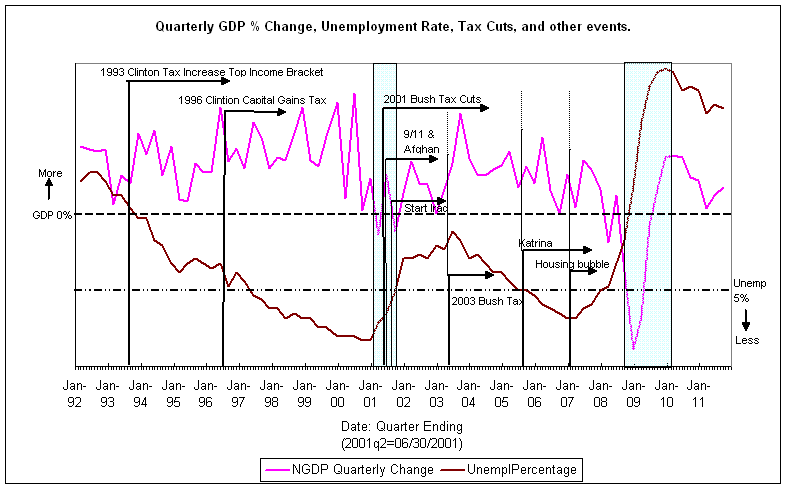
I think I will stick with just one at a time. I was following the thread of lowering taxes the right way raises economic activity. There are actually numerous taxes. The top marginal corporate rate is but one. There are all the other marginal rates, of which I've found up through 2002. Then there is income, estate, and capital gains. All this gets conflagrated by deductions and credits (loopholes?).
The Laffer curve is the second, that there is an optimal level of taxes that maximizes revenue. This isn't much different then the simple profit maximization for a company where [Profit] = [Quantity] * [Price] - [Total Cost]. And because quantity isn't inversely proportional to price, there is a peak.
And then, what really messes it up is that lowering taxes while increasing government spending is supply side and demand side at the same time. So if something does happen, we can't tell if it was one or both. It seems that is what Congress ends up doing in the end, both. I have to wonder why spend so much time fighting over it when, in the end, that's where it ends up anyways.
Raising taxes on the 'rich' in 1990 initially raised about 50 billion for the national treasury. But, it not only cost George HW Bush re-election, but it decimated the country's boat and private plane building industries at the cost of 50,000 jobs and drove large segments of our high end jewelry and metals industry off shore to places like Grand Cayman.
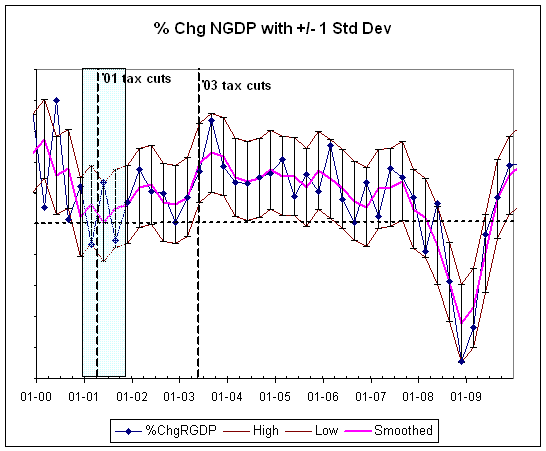
Oh, goody, now I have 1990 to add to 1998, 2001 and 2003.
In theory, tariffs help keep the price of domestic sugar up. Except it drove candy manufacturing to outside of the US. Yep, that's often a problem, in theory is should, if it wasn't for the secondary effects. That's why price caps and floors are generally a bad idea. It's like trying to squeeze Silly Putty in the palm of your hand, it leaks out between the fingers.
Sure, adding to the money supply should increase employment, unless unemployment is already at it's natural level in which case it just drives up prices. Sure, lowering taxes should raise GDP, except if the economy is already at full output in which case there is no place to go. Sure, increasing gov't revenue should lower the deficit, unless Congress decides, to spend more.
The resulting costs in unemployment payments and reduction in economic activity so that less money was generated for the national treasury no doubt wiped out that 50 billion and then some. PLUS, the Congress never produced promised spending cuts in return for the tax hike and spending actually increased.
Yeah, there's a problem. In the end, though, it becomes a real ***** of an issue when something would work. Then, in practice, it turns out that it doesn't because it causes some secondary issue that cancels it out. If everyone followed all the rules of driving a car then we wouldn't need car insurance. But that's a whole other problem.
There are so many such variables on all of these concepts and theories that making hard, fast suppositions on any one factor is almost impossible.
Absolutely agree. But it isn't infinite. And, all the inputs go towards one output or two output, increased economic activity and higher employment.
Yes a tax hike can generate treasury revenues and reduce the deficit IF there is no corresponding economic slow down, and IF there is no effect on employment, wages, benefits, and IF there is no significant reduction in disposable income circulated in the economy, and IF there is no hindrance to new business start ups, and IF there is no increase in spending justified by the increase in revenues.
Absolutely agree. Those damned conflagrating factors make it a tough issue. If it was easy, we wouldn't be asking the question. Still comes down to that final output. In the end, whatever the factors are, either GDP increases or it doesn't.
That last one is an interesting issue. Like OPEC should be able to control prices, and has tried, then someone goes and cheats. And there is, sometimes, how it comes to a balance. We could employ a ton of people in the military to audit the military expenditures for every outfit, but at some point, the cost of auditing just doesn't have the return. A balance gets struck where there are just enough auditors such that what they find offsets the cost of the auditors.
All of that has to be factored into the process.
Not really, either it does or it does not. A person exposed to a virus may get sick or not get sick depending on whether they were eating right, were not over-stressed, had been getting a little exercise, how much exposure they had, and if they were sleeping well, whether they were wearing a mask, if they washed their hands regularly, etc.. But in the final measure, they either got sick or they didn't get sick.
And there is absolutely no way that government collecting taxes, swallowing up a great deal of the revenue into the bloated bureaucracy, and then returning a portion is going to have anything but a negative effect in the long run and probably the short run.
That's the "theory", correctly called a hypothesis.
Still, it remains a hypothesis until 1) it can be proven deductively and 2) demonstrated empirically.
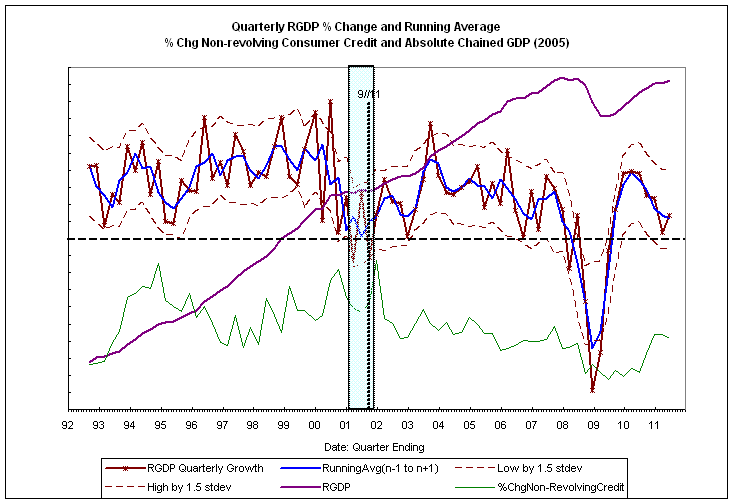
In the end, it is whether unemployment goes down while RGDP goes up.
And we can say we have a "theory"(hypothesis) of how lowering taxes increases output but it means nothing if it doesn't actually happen.
Obviously, if we reduced the government to zero, we have no contract enforcement, no money supply at all, and we are back to bartering and anarchy. Efficiency goes to shits and we've got nothing. So there is some level above zero where it is just right. And, it's reasonably apparent that if we ran all taxes up to 100%, all other things being equal, there wouldn't be any demand.
That is more like "the simple truth".
Some information on sampling error in the GDP survey. It's really low in the final estimate, about .03 for 1983.
Reliability and Accuracy of the Quarterly Estimates of GDP
Table 5.—Bias in the Quarterly Changes in GDP and Its Components
EconPapers: Measurement Error in U.S. National Income and Product Accounts: Its Nature and Impact on Forecasts