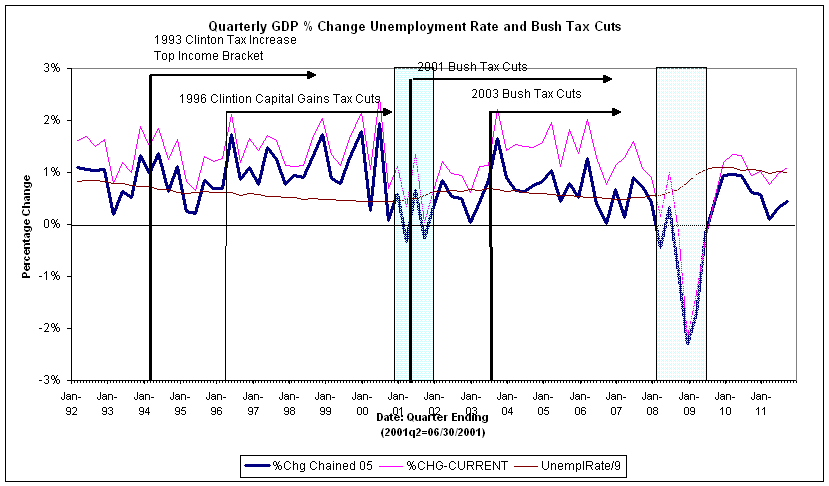
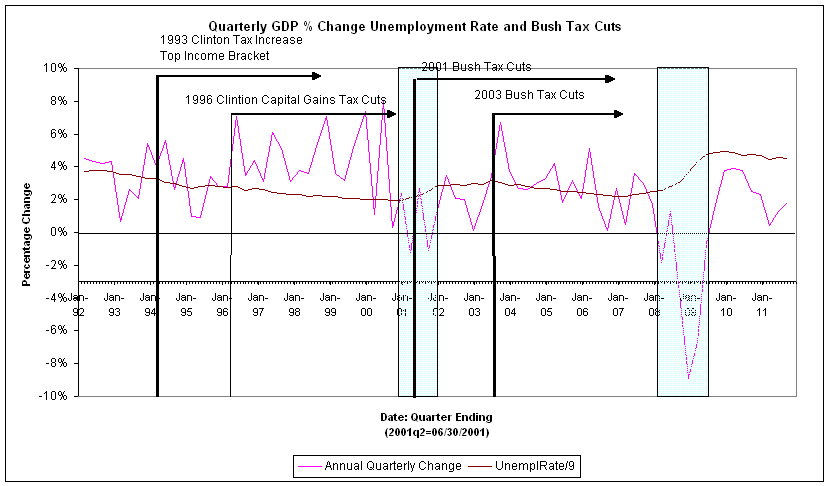
Well, there you go then, that's the answer, the data is wrong...
Do you recognize this file name "gdplev.xls"?
Where do you suppose GDP data comes from? The GDP fairy?
Obviously you don't know where I got it. If you did, you would know that the GDP doesn't change by 6% in a quarter.
What is the difference between non-seasonally adjusted quarterly growth and seasonally adjusted annual rate?
What does "IN 2003 Q3" mean?
If it was 6% IN a quarter, how much would that be IN a year?
How about these numbers?
Quarter___GDP Cur___GDP Chained 2005
2002q1___ 10,498.7___11,467.1
2002q2___ 10,601.9___11,528.1
2002q3___ 10,701.7___11,586.6
2002q4___ 10,766.9___11,590.6
2003q1___ 10,887.4___11,638.9
2003q2___ 11,011.6___11,737.5
2003q3___ 11,255.1___11,930.7
2003q4___ 11,414.8___12,038.6
2004q1___ 11,589.9___12,117.9
2004q2___ 11,762.9___12,195.9
2004q3___ 11,936.3___12,286.7
2004q4___ 12,123.9___12,387.2
How would you use these to get 6% for 2003q3?
What is the quarterly change, from 2003Q2 to 2003Q3?
And lastly, so? What difference would it make?
Well, there you go. Like I said, "the data lies". That's the answer. If you don't like the answer, then it must be a lie or the person is a moron. That's the answer.
What is the difference between "believe", "think" and "know"?
The question is, do you know or do you believe?
Obviously you don't know where I got it.
I don't care where you got it. It says Quarterly GDP change. I know for a fact that GDP grew 6.7% in Q3 2003, after the second round of the Bush tax cuts.
If you did, you would know that the GDP doesn't change by 6% in a quarter.
Let me help you out.
2002 Q1 3.5%, Q2 2.1%, Q3 2.0%, Q4 0.1%
2003 Q1 1.7%, Q2 3.4%, Q3 6.7%, Q4 3.7%
2004 Q1 3.4$, Q2 0.0%, Q3 3.2%, Q4 4.4%
2005 Q1 4.6%, Q2 2.0%, Q3 1.6%, Q4 4.4%
2006 Q1 2.2%, Q2 2.0%, Q3 2.0%, Q4 5.3%
http://www.bea.gov/iTable/iTable.cfm?ReqID=9&step=1
Those numbers are from the BEA.
How would you use these to get 6% for 2003q3?
It involves math. I guess it's over your head.
What is the quarterly change, from 2003Q2 to 2003Q3?
Using the numbers you posted, about 6.56%
And lastly, so? What difference would it make?
6.7% is a lot more than the numbers shown on your chart.
It means your chart is wrong.
That's the answer. If you don't like the answer, then it must be a lie or the person is a moron. That's the answer.
Yeah, you're pretty much a moron. That's the answer.
=====================
I don't care where you got it. It says Quarterly GDP change. I know for a fact that GDP grew 6.7% in Q3 2003, after the second round of the Bush tax cuts.
Perfect, that's the whole point. You don't care that it is from the BEA because you don't like it. You don't care that the GDP has never grown 6.7% in one quarter. It grew 6.7% IN THE PREVIOUS YEAR. It grew 2.21% in that quarter. That is not bad growth. But it's not 6.7%.
IF IT WAS 6.7% THEN IT WOULD BE LIKE A YEARLY GROWTH OF 29%. THAT WOULD BE THE GDP GOING UP BY A WHOLE THIRD IN ONE YEAR.
My numbers are also from the BEA. They are the same numbers that your table comes from. I included the raw data, the quarterly GDP. Anyone that wants to can just calculate the number from it.
Your link doesn't link to a table.
But I can guarantee it doesn't say simply "
Quarterly GDP change." I know because I know that the BEA is more precise than that. The BEA isn't stupid. And I know how they work. As well, I looked the annual seasonally adjusted change for each quarter before I even posted. I already looked at the graph of
Annual Seasonally Adjusted Changes By Quarter.
Rather, what you do is change the words.
Your not quoting the BEA. Your changing them because you don't like what it says.
It may say, "Percent Change From Preceding Period in Real Gross Domestic Product (A) (Q)" That is a quote from the BEA list of tables. And that (A) and (Q) is a big difference. One means annual and the other means quarterly. And the "preceding period" is important too.
You can pick and choose all you want, but the only one your lying to is yourself.
And anyone of moderate and reasonable mind knows the difference. People aren't stupid.
6.56% would be the
annual change, from 2002Q3 to 2003Q3.
If it was a quarter to quarter change, it would be
29% in a year. The GDP never has gone up by 29% in a year. We could use (1+.0656)^(4)-1 or we can just estimate it at 4*6.56% = 26%, close enough.
And, 2003Q3 for a seasonally adjusted annual change begins in 2002Q3 which is a date
BEFORE the 2003 tax cut bill was effective.
And in current dollars it's
2003Q2 to 2003Q3 is 100 * (11,255.1-11,011.6)/11,011.6 =
2.21% The quarterly change
2002Q3 to 2003Q3 is 100 * (11,255.1-10,701.7)/10,701.7 =
5.17% The ANNUAL CHANGE FROM A YEAR AGO.
We can do the same thing in chained 2005 dollars.
I know we don't use that stuff much after school, but anyone reasonable gets the idea of calculating % change. It's the change divided by where you started from times 100.
Even that doesn't tell us anything. The reason is because we don't know if it was 10% or -10% before and after. A single number doesn't tell us anything. And nobody is stupid enough to think otherwise.
The chart I posted is the quarterly change, as in from 2003Q2 to 2003Q3, and the rest of the quarters. I did it for me so I could see if it was true, about the tax changes. I included the unemployment as well. You can't get them both on a graph from the BEA. And what it clearly doesn't show is the GDP getting all warm an fuzzy because of any tax cuts, not Clinton's, not Bushes. It is like it doesn't really matter.
Even if we use your numbers, for the Annual Change, it was 6.7%, then it was followed by
Q4 3.7% 2004 Q1 3.4%, Q2 0.0%, Q3 3.2%, Q4 4.4%
So big deal, it went up for the quarter of implementation then crapped out after that. My data shows exactly the same thing. Your ANNUAL RATES don't show anything different. Four quarters after, it
0.0%.
Wow, how wonderful. Implement the tax cuts, get a spike, then the economy goes flat a year later. Big deal. What does that mean, that it might have been 3.7% the next year but it was overstimulated the previous year? Why didn't it keep on going up at 6.7%? Maybe that's the thing, it just does a momentary spike.
And really, if you have to use the Seasonally Adjusted Change for the Previous Year in order to get what you want out of it...well, what can I say. It reminds me of the global cooling guys that have to wait for an unusually cold winter to say, "SEE!!!".
If you don't like the quarter to quarter changes, then post the a graph of the yearly changes. Then line it up by the date that it becomes effective. Add in the unemployment data. Then we can discuss if using the average yearly change is more of less appropriate then using the quarterly changed.
Myself, I prefer to use the most precise data possible. Then it is what it is. So I use
www.bea.gov/national/xls/gdplev.xls This way, I can get the unemployment numbers lined up.
You're entire argument style is to ask leading questions, looking for something to argue with. Big deal. The reason it doesn't work with me is because I DON'T CARE! I am not trying to prove anything. I'm just pulling the information and seeing what it says. If it said that tax cuts worked, great. If it doesn't, that's just fine too. I DON'T CARE. If tax cuts worked, I'd be all for it. Why not? What, you know things that work and you try to convince people they don't? What, are you crazy?
You are trying to prove something. But, in the end, it still comes down to, "I don't like the data, so it's a lie", "I look for the numbers that I like, even though I don't know what they mean", and "Your a moron."
Go ahead, post a functional link that goes to the actual title of the data chart. Or, instructions to get there. That way, everyone can see if it says just "GDP Quarterly Change".
Better yet, here is a short list from the BEA website, which table is it?
Table 1.1.1. Percent Change From Preceding Period in Real Gross Domestic Product (A) (Q)
Table 1.1.2. Contributions to Percent Change in Real Gross Domestic Product (A) (Q)
Table 1.1.3. Real Gross Domestic Product, Quantity Indexes (A) (Q)
Table 1.1.4. Price Indexes for Gross Domestic Product (A) (Q)
Table 1.1.5. Gross Domestic Product (A) (Q)
Table 1.1.6. Real Gross Domestic Product, Chained Dollars (A) (Q)
Table 1.1.6A. Real Gross Domestic Product, Chained (1937) Dollars (A)
Table 1.1.6B. Real Gross Domestic Product, Chained (1952) Dollars (A) (Q)
Table 1.1.6C. Real Gross Domestic Product, Chained (1972) Dollars (A) (Q)
Table 1.1.6D. Real Gross Domestic Product, Chained (1987) Dollars (A) (Q)
Table 1.1.7. Percent Change From Preceding Period in Prices for Gross Domestic Product (A) (Q)
Table 1.1.8. Contributions to Percent Change in the Gross Domestic Product Price Index (A) (Q)
Table 1.1.9. Implicit Price Deflators for Gross Domestic Product (A) (Q)
Table 1.1.10. Percentage Shares of Gross Domestic Product (A) (Q)
Table 1.1.11. Real Gross Domestic Product: Percent Change From Quarter One Year Ago (Q)
Table 1.2.1. Percent Change From Preceding Period in Real Gross Domestic Product by Major Type of Product (A) (Q)
Table 1.2.2. Contributions to Percent Change in Real Gross Domestic Product by Major Type of Product (A) (Q)
Or we can use
Current-dollar and "real" GDP - BEA
www.bea.gov/national/xls/gdplev.xls
Current-Dollar and "Real" Gross Domestic Product, 2/29/12. 2. 3, Annual, Quarterly. 4, (Seasonally adjusted annual rates). 5. 6, GDP in ...
What the heck, here is the header from my table. The date is 12/20/2011. It is in 2005 chained dollars. Notice that the yearly is "Seasonally adjusted annual rates"? That is why I don't use yearly. It's adjusted using a formula to take out seasonal variation. Do you know what that does to the data? I don't now exactly, it kind of does a sort of regression that approximates the seasonal variation. Then they change the survey data to adjust for seasonal variations.
Current-Dollar and "Real" Gross Domestic Product 12/20/11
Annual Quarterly
(Seasonally adjusted annual rates)
GDP in billions of current dollars GDP in billions of chained 2005 dollars GDP in billions of current dollars GDP in billions of chained 2005 dollars