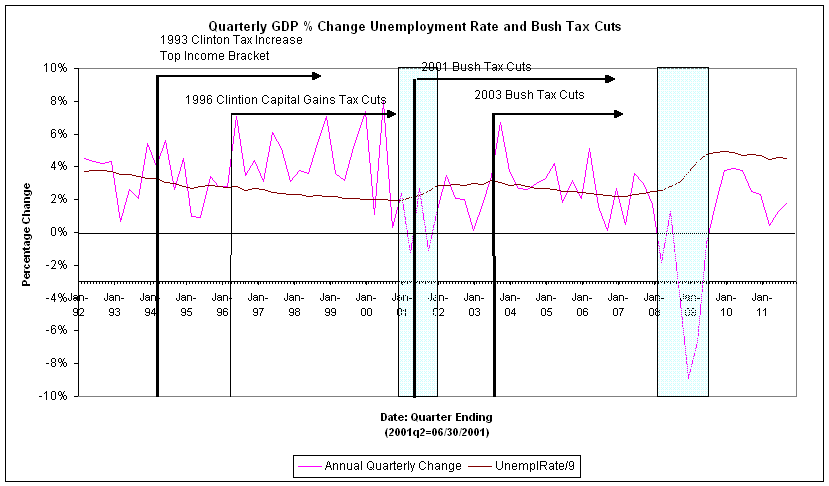
Here you go, the thing with your numbers, the ones you like better.
So point to it.
Do you think that Clinton '93 is in the right place?
Here you go, the thing with your numbers, the ones you like better.
Yeah, I like the correct numbers better.
That reminds me, what is your unemployment data based on?
Straight out of the NIPA Handbook
CONCEPTS AND METHODS OF THE U.S. NATIONAL INCOME AND PRODUCT ACCOUNTS
"Annual rates
Quarterly and monthly NIPA estimates in current and chained dollars are
presented at annual rates, which show the value that would be registered if the level of
activity measured for a quarter or for a month were maintained for a full year. Annual
rates are used so that periods of different lengthsfor example, quarters and yearsmay
be easily compared. These annual rates are determined simply by multiplying the
estimated rate of activity by 4 (for quarterly data) or by 12 (for monthly data)."
"Growth rates
Percent changes in the estimates are also expressed at annual rates, which show
the value that would be registered if the pace of activity measured for a quarter or for a
month were maintained for a full year. Calculating these changes requires a variant of the
compound interest formula,
r= ( (GDPt/GDP0)^(m/n)-1) * 100
where
r is the percent change at an annual rate;
GDPt is the level of activity in the later period;
GDP0 is the level of activity in the earlier period;
m is the periodicity of the data (for example, 1 for annual data, 4 for
quarterly, or 12 for monthly); and
n is the number of periods between the earlier and later periods (that is, t-0).
Thus, for example, if a component increases from $100 in the first quarter to $105 in the
second quarter (5 percent at a quarterly rate), the annual rate of increase is
(($105/$100)^4/1 1) x 100 = 21.6 percent."
So I can use quarterly non-seasonal data to get the quarterly % chg.
It doesn't matter, I get to the same place.
And the graph doesn't look any different, only the scale changes.