You realize, of course, the population and workforce continues to grow so absolute values are meaningless, they go up just because of population growth.
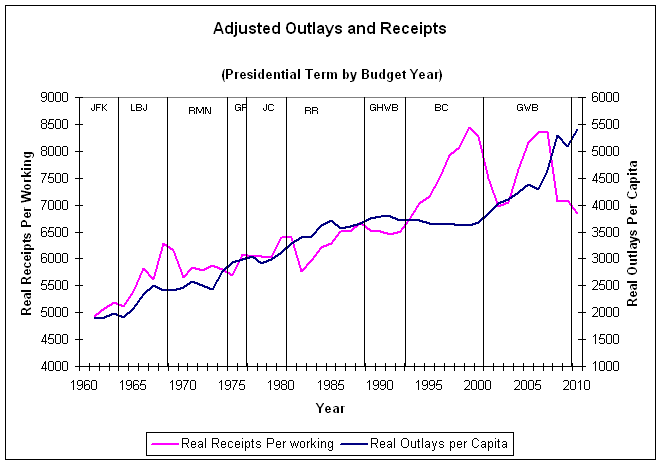
The only way to look at it is receipts per working person and outlays per capita. It's the only way to deal with the changing employment to population ratio and just changing population. And, of course, in real dollars.
Bush II spent more money, per capita and per working person, then any other president. (In all fairness, we can't include the bank bailout year). Bush II and Clinton did increase receipts per worker and per capita, and far greater then anything that Reagan did.
Reagan's was better then previous admins but his outlays per capita were also higher. If we can say anything simply about it, it is that he spent a crap load per person compared to any admin except Bush II.
That's the real pisser, there is outlays on the flip side of receipts. It's foolish to ignore the outlays.
Really, it seems that Clinton's receipts were very much a result of the dot com bubble. Congress had laid the ground work for before he took office so the tech boom had as much to do with the receipts as anything. He was the only one that lowered spending.
hmm....
Clinton lowered spending because he had a reform minded Republican Congress for six of his eight years. To his credit, he was sometimes dragged into that kicking and screaming, but he finally signed the bills to accomplish it. (He vetoed welfare reform three times? before he finally signed it.)
It isn't really fair to compare Bush 43 GDP performance with Reagan, Bush 41, or Clinton as Reagan, Bush 41, and Clinton had nothing to contend with to compare with a 9/11, a Katrina, or the housing bubble burst. The Dot.com bubble burst was an economic calamity, but small scale compared to the three main events of the Bush 43 administration.
But if you look at Reagan, Bush 41, and Clinton, Reagan comes out looking the best hands down.
A good discussion and comparison here:
Bush-Clinton: What Went Wrong? | Stephen Moore | Cato Institute: Daily Commentary
Here is the receipts and outlays, per capita and worker, over time.
In current dollars goes up exponentially. The real dollars looks about the same, per capita and per worker just makes it a bit flatter.
How we get to Reagan was somehow the best hands down I cannot imagine. Even if we look at % chg, it's pretty much just average.
Really, the dot com burst and the recession of '07 aren't anything but Katrina, 9/11 and the wars are for Bush.
So we are ignoring the effects of technology bubble booms and busts, which is the underlying problem that has plagued the economy since before the Great Depression. Perhaps the housing bubble was small scale compared to Katrina as well.
Why Clinton decreased spending is meaningless. It happened or it didn't. The point of the thread is "vindication of supply side economics". And supply side economics doesn't care why it happened, just that it did.
This isn't the "Who was a better president" thread. Putting in terms of the presidency is convenient because we organize things that way. And we name tax changes after the presidential term. Regardless of the president, they either had an effect or they didn't.
Katrina, 9/11 and the wars were a tremendous burden to Bush's presidency but Obama inheriting a massive recession doesn't go towards his credit. If were going to make excuses, then it's a sword that cuts both ways. We either credit each with the crap or we hold each responsible for what they have to deal with. Each event gets measured in terms of it's impact, in dollars and lives, and is either factored in or is not. Frankly, I'd factor them in.
As far as I'm concerned, Bush and the Fed did a great job keeping the economy just smoothly rising upward in spite of an economy that was ready to collapse as early as the '05-'06 time frame. That was when the first indications of people dropping of their keys and declaring bankruptcy on medical bills first appeared. That is when there were the first indications of the business credit market tightening up. And Bush also drove the outlays per capita higher then any previous presidency. In-spite of things, he implemented attempts as demand side stimulus and the massive bank bailout. And it doesn't matter if he did it because he liked or inspite of hating it. He did.
The problem that we have, the underlying cause of the repeated recessions, is far more fundamental then just tax cuts or increases. Changes in interest rates, tax rates, deficit spending all keep bandaging some underlying imbalance. And it seems perfectly reasonable that the right tax cut, during periods of less than full output, may help medium and small businesses accumulate enough capital to invest in materials and capital equipment. Hopefully, out of 7 million businesses, enough of them will tap demand. It really ought to be there, at the very least in terms of a short burst before the economy balances out again. But in the final analysis, it's either measurable or it's not. And if it's not, it doesn't exist.
What is really intersting, if you follow that tragectory of gov't outlays, inspite of the reduction through the Clinton admin, it's right back to where the tragectory would have it. It just smells like there is something underlying that requires it go the way it's going. When it comes down to it, buyers, sellers, Congress and presidents end up doing what they have to do, not what they say they want to do. It's supply and demand.
9/11 was meaningless, American's don't roll over and die because of an attack on a couple of skyscrapers. If anything, they buckle down and work harder. I'd sure like to see some data to suggest it had an effect. As far as I can tell, American's aren't a bunch of pussies. Whatever networks got broken because of it were bypassed and repaired by the end of the week. We wouldn't expect any less.
Katrina, without some evidence one way or another, is meaningless. A disaster can just as well increase GDP. Refer to the broken window fallacy. GDP and unemployment didn't even blip on it.
And increasing military and military spending is about as Keynesian as we can get. The military is the biggest public works program ever devised by man. It has been that way since the beginning of history, when the economy goes to shit, countries went to war. Everyone is pretty much in agreement that WWII was one of the major factors that ended the Great Depression. War doesn't cause GDP to decline though it may increase it, I highly doubt that the two police actions were significant. It may reduce unemployment as it reduces the workforce. And there is an interesting change to the rate of change of unemployment shortly after Afganistan began.
But without some measure to put them into context of scale, there all just stories.