
Toddsterpatriot
Diamond Member
maybe it's my lack of a businessworld education (in which case i'm asking for some explanations), but you just sowed the base of your own argumentation right out from underneath it
I sowed the base?
Follow along with the video below to see how to install our site as a web app on your home screen.
Note: This feature may not be available in some browsers.
maybe it's my lack of a businessworld education (in which case i'm asking for some explanations), but you just sowed the base of your own argumentation right out from underneath it

Sure, and in part because you say 'no' without reason, your hope can be ignored.

Here is my plan to pay off the national debts of Canada and the USA, [beginning this in Canada might be easier due to the fact that the foundation was laid in Bank of Canada policy from 1938 to 1974]?
Five hundred dollars per month...
for forty one million Canadian citizens and legal residents....
that is created in the same way as the Bank of Canada worked from
1938 to 1974.
Plus....NO INCOME TAX ON OVERTIME.... so that the twenty percent of our
population who do about eighty percent of the most valuable work in the economy have
an incentive to work extra!
No income tax on overtime would make the Canadian Dollar more valuable because
the Productivity of Canadians backs up the Canadian Dollar.
This exact same idea can work in the USA but you will have to go back to the time of
President Abraham Lincoln to find an economic precedent for this idea.
So.... if we give an Unconditional but Taxable Basic Minimum Income Supplement to all
forty one million Canadians regardless of what their income was in the last year, [or in the last month], then
this tends to break Canadians out from under the power of corrupt and greedy bureaucrats in Ottawa who want
more and more benefits...... more and more money for their services.... and more and more power over the lives
of ordinary citizens.
... IF this Basic Minimum Income was financed through the Bank of Canada in the manner that half of the money supply of Canada was created from 1938 to 1974?
So IF forty one million Canadians were all given five hundred dollars per month, from cradle to grave, that was financed by The Bank of Canada would this result in the federal deficit being paid down by roughly twenty billion Canadian Dollars per month?
Once money turns over in the economy three to four times it is taxed back into the coffers of the federal, provincial or municipal governments.
[Ms. Betty Krawczyk] ...
- DennisPTate
- Replies: 4
- Forum: Canada
This fits with the fact that Mr. Avi Lewis is the new leader of Canada's New Democratic Party.
Oh Canada Movie 6 - Banking - 5
Just after the 2:20 minute mark in this video interview:
Forty one million Canadians
X $500 per month = twenty billion dollars per month goes into the economy THAT DOES NOT PRODUCE COMPOUND INTEREST OVER TIME OWING ON THAT TWENTY BILLION..... WHICH WILL SOON CAUSE THE CANADIAN FEDERAL DEFICIT TO BEGIN TO DECREASE BY ROUGHLY TWENTY BILLION DOLLARS PER MONTH BECAUSE THAT MONEY IS TAXED BACK INTO THE TREASURY AFTER IT TURNES OVER THREE TO FOUR TIMES IN THE ECONOMY!
THREE COURAGEOUS ECONOMISTS POOLED THEIR EFFORTS TO EXPLAIN THIS BECAUSE THEY KNEW THAT THE CBC AND THE OTTAWA SWAMP WOULD EAT THEM ALIVE IF THEY HAD ACTED ALONE!
Sure, and in part because you say 'no' without reason, your hope can be ignored.

maybe i should've said 'cut the base'..I sowed the base?

maybe i should've said 'cut the base'..
ok, maybe not.Mentioning that printing new money and handing it out is inflationary "cuts the base of my claim"?

How do you pay down a debt by spending more money ? The math doesn't math.
A debt-money system
Why are all the countries in debt? It is quite simple: in the present system, all money is created, comes into being, as a debt.
To understand this, let us divide the economic system into two parts: the producing system and the financial system. The example is taken from Louis Even's parable, The Money Myth Exploded: On the one side, there are five shipwrecked people on an island, who produce all the necessities of life, and on the other side, a banker, who lends them money. To simplify this example, let us say there is only one borrower on behalf of the community; we'll call him Paul.
Paul decides, on behalf of the community, to borrow a certain amount of money from the banker, an amount sufficient for business in the little community, say $100, at 6% interest. At the end of the year, Paul must pay the bank an interest of 6%, that is to say, $6. 100 minus 6 = 94, so there is $94 left in circulation on the island. But the $100-debt remains. The $100-loan is therefore renewed for another year, and another $6 of interest is due at the end of the second year. 94 minus 6, leaves $88 in circulation. If Paul continues to pay $6 in interest each year, by the seventeenth year there will be no more money left in circulation on the island. But the debt will still be $100, and the banker will be authorized to seize all the properties of the island's inhabitants.
Production has increased on the island, but not the money supply. It is not products that the banker wants, but money. The island's inhabitants were making products, but not money. Only the banker has the right to create money. So, it seems that Paul wasn't wise to pay the interest yearly.
* includes interest due
[td]
$100 debt growth at 6% interest
[/td]
[td]
Year
[/td][td]
Original borrowed capital
[/td][td]
Debt at year end*
[/td][td]
Interest due at year end
[/td][td]
Money in circulation
[/td]
[td]
1
[/td][td]
$100
[/td][td]
$106.00
[/td][td]
$6.00
[/td][td]
$100
[/td]
[td]
2
[/td][td]
$100
[/td][td]
$112.35
[/td][td]
$6.36
[/td][td]
$100
[/td]
[td]
3
[/td][td]
"
[/td][td]
$119.10
[/td][td]
$6.74
[/td][td]
"
[/td]
[td]
4
[/td][td]
"
[/td][td]
$126.25
[/td][td]
$7.15
[/td][td]
"
[/td]
[td]
5
[/td][td]
"
[/td][td]
$133.82
[/td][td]
$7.57
[/td][td]
"
[/td]
[td]
10
[/td][td]
"
[/td][td]
$179.08
[/td][td]
$10.14
[/td][td]
"
[/td]
[td]
20
[/td][td]
"
[/td][td]
$320.71
[/td][td]
$18.15
[/td][td]
"
[/td]
[td]
30
[/td][td]
"
[/td][td]
$574.35
[/td][td]
$32.51
[/td][td]
"
[/td]
[td]
40
[/td][td]
"
[/td][td]
$1,028.57
[/td][td]
$58.22
[/td][td]
"
[/td]
[td]
50
[/td][td]
"
[/td][td]
$1,842.02
[/td][td]
$104.26
[/td][td]
"
[/td]
[td]
60
[/td][td]
$100
[/td][td]
$3,298.77
[/td][td]
$186.72
[/td][td]
$100
[/td]
[td]
70
[/td][td]
$100
[/td][td]
$5,907.59
[/td][td]
$334.39
[/td][td]
$100
[/td]
Let us go back to the beginning of our example. At the end of the first year, Paul chooses not to pay the interest, but to borrow it from the banker, thereby increasing the loan principal to $106. “No problem,” says the banker, “the interest on the additional $6 is only 36 cents; it is peanuts in comparison with the $106 loan!” So the debt at the end of the second year is: $106 plus the interest at 6% of $106, $6.36, for a total debt of $112.36 after two years. At the end of the fifth year, the debt is $133.82 and the interest is $7.57. “It is not so bad,” thinks Paul, “the interest has only increased by $1.57 in five years. We can handle that.” But what will the situation be like after 50 years?
The debt increase is moderate in the early years, but the debt increases very fast with time to unbelievably big numbers. And note, the debt increases each year, but the original borrowed principal (amount of money in circulation) always remains the same. At no time can the debt be paid off with the money that exists in circulation, not even at the end of the first year: there is only $100 in circulation, and a debt of $106 remains. And at the end of the fiftieth year, all the money in circulation ($100) won't even pay the interest due on the debt: $104.26.
All money in circulation is a loan and must be returned to the bank, increased with interest. The banker creates money and lends it, but he has the borrower's pledge to bring all this money back, plus other money he did not create. Only the banker can create money: he creates the principal, but not the interest. And he demands to pay him back, in addition to the principal that he created, the interest that he did not create, and that nobody else created either. As it is impossible to pay back money that does not exist, debts accrue. The public debt is made up of money that does not exist, that has never been created, but that governments nevertheless have committed themselves to paying back. An impossible contract, represented by the bankers as a “sacrosanct contract”, to be abided by, even though human beings die because of it.
Compound interest
The sudden increase in the debt after a certain number of years can be explained by the effect of what is called compound interest. Contrary to simple interest, which is paid only on the original borrowed capital, compound interest is paid on both the principal plus the accumulated unpaid interest. Thus, with simple interest, a $100-loan at 6% interest would give, at the end of 5 years, a debt of $100 plus 5 times 6% of $100 ($30.00), for a total debt of $130. But with compound interest, the debt at the end of the fifth year is the sum of the debt of the previous year ($126.35) plus 6% interest of this amount, for a total debt of $133.82.
Putting all these results on a chart, where the horizontal line across the bottom of the chart is marked off in years, and the vertical line is marked off in dollars, and connecting all these points by a line which traces a curve that illustrates the effect of compound interest and the growth of the debt:
The curve is quite flat at the beginning, but then becomes steeper as time goes on. The debts of all countries follow the same pattern, and are increasing in the same way. Let us study, for example, Canada's public debt.
Canada's public debt
Each year, the Canadian Government draws up a budget where are estimated the expenditures and the revenues for the year. If the Government takes in more money than it spends, there is a surplus; if it spends more than it takes in, there is a deficit. Thus, for the fiscal year 1985/86 (the Government's fiscal year runs from April 1 to March 31), the Federal Government had expenditures of $105 billion and revenues of $71.2 billion, leaving a deficit of $33.8 billion. This deficit represents a lack in revenues. (The Federal Debt has managed to balance its budget over the recent years, but it is simply because it downloaded its deficit on provinces and municipalities, forcing them to make cuts in health and other basic services. This does not prevent the overall debt of all public administrations to continue to increase.)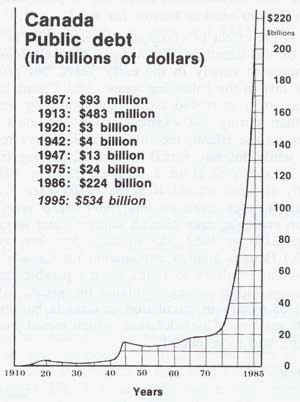
The national debt is the total accumulation of all budgetary deficits since Canada came into existence (the Confederation of 1867). Thus, the 1986 deficit of $33.8 billion is added to the debt of 1985, $190.3 billion, for a total debt of $224.1 billion in 1986. (By January, 1994, Canada’s public debt reached the $500-billion mark.)
When Canada was founded in 1867 (the union of four provinces — Ontario, Quebec, New Brunswick, and Nova Scotia), the country's debt was $93 million. The first major increase took place during World War I (1914-18), when Canada's public debt went up from $483 million in 1913 to $3 billion in 1920. The second major increase took place during World War II (1939-45), when the debt went up from $4 billion in 1942 to $13 billion in 1947. These two increases may be explained by the fact that the Government had to borrow large sums of money in order to take part in these two wars.
But how can be explained the phenomenal increase of these last years, when the debt almost increased ten times, passing from $24 billion in 1975 to $224 billion in 1986, in peacetime, when Canada had no need to borrow for war?
It is the effect of compound interest, like in the example of the island in The Money Myth Exploded. The debt increases slowly in the early years, but grows extremely fast in the following years. And Canada's public debt has even increased more rapidly during these last years than during the example given in Louis Even's parable: on the island, the interest rate always remained at 6%, while this rate varied in Canada, passing from 2% during World War II to a high of 22% in 1981.
Here is another explanation for Canada’s faster debt growth: contrary to Louis Even's parable, in which the money supply always remains the same, $100, the amount of money in circulation in Canada has increased many times since Confederation, which meant more borrowings... and more debts!
There is a big difference between interest rates of 6%, 10%, or 20%, when one speaks of compound interest. The following are the sums that $1.00 will amount to in 100 years, loaned at the rates of interest mentioned and compounded annually:at 1%............................$2.75
at 2%..........................$19.25
at 3%........................$340.00
at 10%..................$13,809.00
at 12%............ $1,174,406.00
at 18%............$15,145,207.00
at 24%..........$251,799,494.00And at 50%, it would eat up the world! There is a formula to know approximately the amount of time it will take for an amount, at compound interest, to double; it is the “Rule of 72”: You divide 72 by the interest rate. It gives you the number of years it will take for the amount to double. Thus, an interest rate of 10% will cause a loan to double in 7.2 years (72 divided by 10).
Another example of compound interest: 1 cent borrowed at 1% compound interest at the birth of Christ would amount (in 1986) to a debt of $3,821,628.40 ($3.8 million). At 2%, it is not only twice this amount that would be owed, but 314 million times this amount: 1.2 followed by 15 zeros (one billion millions of dollars!)
All this is to show that any interest asked on money created out of nothing, even at a rate of 1%, is usury. In his November 1993 report, Canada's Auditor General calculated that of the $423 billion in net debt accumulated from Confederation to 1992, only $37 billion went to make up the shortfall in program spending. The remaining $386 billion covered what it has cost to borrow that $37 billion. In other words, 91% of the debt consisted of interest charges, the Government having spent only $37 billion (8.75% of the debt) for actual goods and services.)
The public debt of the United States
The public debt of the United States follows the same curve as Canada’s, but with figures ten times bigger.
As was the case with Canada, the first significant increases in the public debt took place during war times: the American Civil War (1861-1865), World Wars I and II. From 1975 to 1986, the debt went up from $533 billion to $2,125 billion. (In 2004, this debt is over $7 trillion.) Therefore, during the same period (1975-1986), Canada’s public debt increased more rapidly than the United States’ (9.3 times in Canada in comparison with 3.8 times in the United States). The reason: interest rates were higher in Canada during the same period, reaching as high as a 3-point difference.
What is a billion?
When one speaks of millions and billions of dollars, one is talking about very huge sums, and it is quite difficult to figure out what a billion is. A few years ago this definition was circulated: A billion seconds ago, the first atomic bomb had not yet exploded. A billion minutes ago, Christ was still on earth. Spending a billion dollars at a rate of $100 a minute would take 19 years.
But when one speaks of the public debt of the United States, it is not a question of billions, but of thousands of billions, or trillions (1 followed by 12 zeros). In 1986, the public debt of the U.S.A. was $2 trillion. 2 trillion $1 bills placed end to end would stretch 186 million miles – from the earth to sun and back. A 2-trillion dollar spending spree – at a rate of $1,900 a minute – would last 2000 years. In 1981, when the nation’s debt approached $1 trillion, President Reagan illustrated that figure with this example: “If you had a stack of $1,000 bills in your hands only 4 inches high, you would be a millionaire. A trillion dollars would be a stack of $1,000 bills 67 miles hiThe Public-Debt Problem - Michael Journal
All the countries in the world are presently struggling with a debt problem. Third-World countries’ debt is over $1,300 billion (in 1986)www.michaeljournal.org
[Melvin Sickler] :
The Federal Reserve Act
There were changes in the money and banking laws for the next fifty years. Finally, in 1913, the Bankers were able to get their Federal Reserve Act passed through Congress which replaced the National Banking Act that had earlier replaced the Greenback Law. If the Government would have continued the policy of Abraham Lincoln, the warnings given in "The London Times" would have come to pass. America would be a debt-free nation, the most prosperous in the world. And the brains and the wealth of the world would have come to America.
But with this Federal Reserve Act being passed, Congress gave up Its power to create its own money that it was given in the United States Constitution, and gave this power over to private Bankers who called themselves the Federal Reserve. The Bankers had achieved their ultimate goal, for now the United States operated under a central bank that was privately owned. They now had the power to run the country by controlling the creation of the money, and were free to charge the interest they so desired.
As Mayer Anselm Rothschild once said: "Permit me to issue and control the money of a nation, and I care not who makes its laws..."
John F. Kennedy
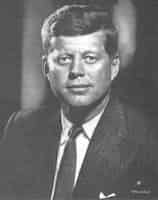
No United States president since Abraham Lincoln dared to go against the system and create his own money, as many of these so-called elected presidents were actually only instruments or puppets of the Bankers. That is until President John F. Kennedy came into office.
On June 4th, 1963, President Kennedy signed a presidential document, called Exec-utive Order 11110, which further amended Executive Order 10289 of September 19th, 1951. This gave Kennedy, as President of the United States, legal clearance to create his own money to run the country, money that would belong to the people, an Interest and debt-free money. He had printed United States Notes, completely ignoring the Federal Reserve Notes from the private banks of the Federal Reserve.
Our records show that Kennedy issued $4,292,893,825 of cash money. It was obvious that Kennedy was out to under-mine the Federal Reserve System of the United States.
But it was only a few months later, In November of 1963, that the world received the shocking news of President Kennedy's assassination. President Kennedy must have had It in mind to repeal the Federal Reserve Act of 1913, and return back to the United States Congress the power to create its own money.
It is interesting to note that, only one day after Kennedy's assassination, all the United States notes, which Kennedy had issued, were called out of circulation. Was this through an executive order of the newly installed president, Lyndon B. Johnson? Was President Johnson afraid of the Bankers? Or was he one of their instruments? At any rate, all of the money President Kennedy had created was destroyed. And not a word was said to the American people.
A lesson to learn
There is much that can be learned from our past history. Here we are in 2003, and the United States is still operating under the Federal Reserve System. It has already plunged this country over six trillion dollars into debt -- Federal debt, (the total debt, including that of individuals and corporations, is over 20 trillion) a debt it will never be able to pay, and has been responsible for every kind corruption imaginable. Yet, barely a peep of protest can be heard from the American people.
The population at large must be educated on the Federal Reserve, and then unite together to put pressure on the Government to get the Federal Reserve Act of 1913 repealed. Otherwise, it will spell disaster for the United States.
Abraham Lincoln and John F. Kennedy both had the courage to stand up for principles and to fight for justice. They have both gone down in history as being true patriots of the United States. But do we, as citizens, have the courage to follow their example?
Melvin Sickler
Abraham Lincoln & John F.K assassination
Abraham Lincoln and John F. Kennedy Two great presidents of the United States Assassinated for the cause of justicewww.cidpusa.org
You can not pay off debt by printing more money.Because Compound Interest Over Time is being used to turn all of us into allegorical "gerbils on an economic treadmill" but President Abraham proved that there was a better way to do this. President Lincoln was murdered in 1865 but we Canadians saw what President Lincoln accomplished and we came up with a way to do something similar from 1938 to 1974.
So who owns BigMedia as well as the universities?
The same people who use "Compound Interest Over Time" to rule over ninety nine point nine percent of us.
So don't be shocked if your favourite Professor of Economics did not explain this to you but this is actually an astonishingly simple mathematical principle. The USA government under Lincoln got around "Compound interest Over Time" and the Bank of Canada was used for thirty six years in a similar way.
Al Gore made a "hockey stick shaped graph" famous but there are two more important hockey stick shaped graphs in the quotation that I gave above that show the work of the people who own Al Gore and his Carbon Tax Theory that sets the stage for the application of Malthusian Catastrophe Theory through the Bill Gates "Innovating to zero" lecture that was given in 2010. Everything about MacroEconomics can be understood but it is a bit depressing I must admit.
The second part of how using a central bank that is owned by all the citizens, to create an "Unconditional but Taxable Basic Minimum Income Supplement" to pay down the federal deficit of the USA or Canada is that income tax takes all money back into the treasury after it turns over in the economy something like three or four times, [perhaps five times in the USA due to your lower levels of income tax in comparison to us Canadians].
President Abraham Lincoln set the Precedent for this and J.F.K. obviously wanted to follow the example set by President Lincoln. So what happened to both President Lincoln and J. F. K?

Money is considered a weak long-term motivator.Would you be interested in working more if there was zero income tax owing on OVERTIME?
Do you know skilled people who would be interested in working more if that was the case?
Because Compound Interest Over Time is being used to turn all of us into allegorical "gerbils on an economic treadmill" but President Abraham proved that there was a better way to do this. President Lincoln was murdered in 1865 but we Canadians saw what President Lincoln accomplished and we came up with a way to do something similar from 1938 to 1974.
So who owns BigMedia as well as the universities?
The same people who use "Compound Interest Over Time" to rule over ninety nine point nine percent of us.
So don't be shocked if your favourite Professor of Economics did not explain this to you but this is actually an astonishingly simple mathematical principle. The USA government under Lincoln got around "Compound interest Over Time" and the Bank of Canada was used for thirty six years in a similar way.
Al Gore made a "hockey stick shaped graph" famous but there are two more important hockey stick shaped graphs in the quotation that I gave above that show the work of the people who own Al Gore and his Carbon Tax Theory that sets the stage for the application of Malthusian Catastrophe Theory through the Bill Gates "Innovating to zero" lecture that was given in 2010. Everything about MacroEconomics can be understood but it is a bit depressing I must admit.
The second part of how using a central bank that is owned by all the citizens, to create an "Unconditional but Taxable Basic Minimum Income Supplement" to pay down the federal deficit of the USA or Canada is that income tax takes all money back into the treasury after it turns over in the economy something like three or four times, [perhaps five times in the USA due to your lower levels of income tax in comparison to us Canadians].
President Abraham Lincoln set the Precedent for this and J.F.K. obviously wanted to follow the example set by President Lincoln. So what happened to both President Lincoln and J. F. K?
President Abraham Lincoln set the Precedent for this and J.F.K. obviously wanted to follow the example set by President Lincoln.
Because Compound Interest Over Time is being used to turn all of us into allegorical "gerbils on an economic treadmill" but President Abraham proved that there was a better way to do this. President Lincoln was murdered in 1865 but we Canadians saw what President Lincoln accomplished and we came up with a way to do something similar from 1938 to 1974.
So who owns BigMedia as well as the universities?
The same people who use "Compound Interest Over Time" to rule over ninety nine point nine percent of us.
So don't be shocked if your favourite Professor of Economics did not explain this to you but this is actually an astonishingly simple mathematical principle. The USA government under Lincoln got around "Compound interest Over Time" and the Bank of Canada was used for thirty six years in a similar way.
Al Gore made a "hockey stick shaped graph" famous but there are two more important hockey stick shaped graphs in the quotation that I gave above that show the work of the people who own Al Gore and his Carbon Tax Theory that sets the stage for the application of Malthusian Catastrophe Theory through the Bill Gates "Innovating to zero" lecture that was given in 2010. Everything about MacroEconomics can be understood but it is a bit depressing I must admit.
The second part of how using a central bank that is owned by all the citizens, to create an "Unconditional but Taxable Basic Minimum Income Supplement" to pay down the federal deficit of the USA or Canada is that income tax takes all money back into the treasury after it turns over in the economy something like three or four times, [perhaps five times in the USA due to your lower levels of income tax in comparison to us Canadians].
President Abraham Lincoln set the Precedent for this and J.F.K. obviously wanted to follow the example set by President Lincoln. So what happened to both President Lincoln and J. F. K?

A zero hour contract, is everything overtime


