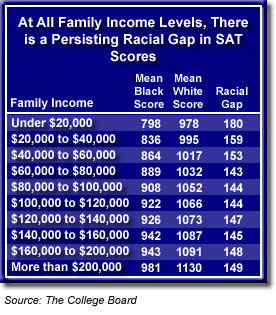
Deep in your heart-of-darkness it is likely you’ve noticed the well-publicized and continuous failure of African-American K-12 students to read and write as well as ‘real’ people. You may well have made note of black youths’ statistically undeniable proclivity for gun violence, unrepentant fashion, and bad TV. If so, you may have also ascribed these socially inconvenient attributes to some type of unspeakable genetic code. If that is the case, do be careful not to reflect on these matters in mixed company, that is unless, you are a Hell’s Angels biker babe or a neo-Nazi skinhead. In the unicorn world we live in, free thought is a luxury we cannot afford when the price is offending someone or a protected species. Nonetheless, there certainly seems to be some correlation between atrocious academic performance and skin color. If sub-par ACT and SAT test scores are not affected by skin pigmentation, then perhaps urban zip codes are the culprit. Those of you who secretly believe that black folk can’t learn too good, and I have encountered several K-12 teachers that do, take a look the data on true Africans, who’ve immigrated to the United States.
According to U.S. Census Bureau data, in an analysis performed by the Journal of Blacks in Higher Education, African immigrants here were more likely to be college educated than any other immigrant group. Not only that, but African immigrants are also more highly educated than any other native-born ethnic group including white Americans. (Gasp) The 48.9% of all African immigrants that have earned a college degree is slightly higher than the percentage of degreed Asian immigrants, twice the rate of native-born whites, and four times the rate of native-born African Americans.
Of the African-born population in the United States age 25 and older, 86.4% reported having a high school diploma or higher, compared with 78. 9% of Asian-born immigrants, and 76.5% of European-born immigrants, respectively. These figures contrast with 61.8% percent of the total foreign-born population. Immigrantgroups in general tend to have higher high school graduation rates than the native-born general American population which averages about 70%.
African immigrants out-graduate American Caucasians and Asians
Africans from
Ghana (96.9 percent),
Zimbabwe (96.7 percent),
Botswana (95.5 percent), and
Malawi (95 percent) were the most likely to report having a high school degree or higher. Those born in
Cape Verde (44.8 percent) and
Mauritania (60.8 percent) were the least likely to report having completed a high school education.
Of the
European-born those born in
Bulgaria (92.6 percent),
Switzerland (90.5 percent), and
Ireland (90.4 percent) were the most likely to report having a high school degree or higher. Those born in
Portugal (42.9 percent),
Italy (53.7 percent), and
Greece (59.9 percent) were the least likely to report having completed a
high school education.
Of the
Asian-born,
Mongolia (94.8 percent),
Kuwait (94.7 percent), the
United Arab Emirates (94.5 percent), and
Qatar (94.3 percent) were most likely to report having a
high school degree or higher. Those born in
Laos (48.1 percent),
Cambodia (48.4 percent), and
Yemen (49.9 percent) were the least likely to report having completed a high school education.
It stands to reason, as few things do anymore, that the personal incomes of African immigrants exceeds that of African-Americans. When stationed in East Africa, I found Kenyans, Ugandans, and Congolese to be both intellectually competitive and highly industrious. Unfortunately the economies of these countries provide little occupational opportunity for their citizens, and that is why nearly 900,000 have left the Dark Continent to settle in the States. There were times that it felt like half of that number personally asked me to help them secure a visa to America.
The actionable point I am making here is that this anecdotal evidence refutes the insinuations in the Bell Curve and suggests very strongly that skin color is not a causal factor in the perpetuation of the black-white academic achievement gap.
If not, then uh, what is?