The John Kennedy assassination ..who's who on the Grassy Knoll

The brilliant conspirators said to themselves,

"Say! We've got it! Here's the BEST plan EVER! Greer, you will undoubtedly be driving the limo. It will be an open air limo, of course. It will be in full view of the public. While you're driving, you will also have a handgun. Right? Ok. And as you're driving, in full view of the public and any cameras that might be out there, you will turn around and shoot the President of the United States at point blank range right in his head. Nobody will notice. It's a perfect plan, I tell ya. Nothing could POSSIBLY go wrong. Do any of you fellow-conspirators have any concerns about putting this obviously brilliant, well-conceived, flawless plan into effect? No? Fine. Then that's it. That's the plan. Greer, you're good with this, right? Ok, then. Let's do it."
 
LOL!! You took me to school alright. To bad you couldn't teach me anything.
You feel you have the facts because you have read a lot of the books published? Are you SERIOUS!? Because if it is published in a book, it is a fact?
Now I understand where you are getting these ideas. Reading books that were written by guys that read the reports written about someone's research. You are 3rd generation stupid!

Actually, I shouldn't say you didn't teach me anything. I have never heard that an "Oswald look-alike" was taken out of the Texas Theater. That's hilarious!!

Interesting how you consider yourself a winner in these debates. Last time I checked, the "official story" is still that Oswald did it. The only debate is Oswald alone or Oswald & a conspiracy. Why? Because all of that pesky evidence that points to Oswald. I understand that evidence isn't something you deal in. Only ideas that point to your conclusion are paid any attention. Your login name "9/11 inside job" screams close minded.

Is it at all possible that the evidence used to pin this on Oswald, could have been fabricated?? Or is something that is beyond the realm of decency for authorities to do?
Just wondering...:eusa_eh:

I wouldn't say that it is outside the realm of possibilities. Whether it be a government agency or anybody else. I just haven't seen the evidence that would point to that. There is evidence that he owned the rifle found on the 6th floor. Evidence that he handled it. There is "pretty good" evidence that he brought a brown paper bag, about the length of the broken down gun, with him that day, based on the testimony of his ride that day, Wesley Frazier.
Now there is no absolute evidence that proves he pulled the trigger.
I just think it is almost impossible for him to not have been involved at all. If there was a conspiracy that did not involve him but was to be blamed on him, then the people controlling the conspiracy would have to make sure he was out of sight at the time of the shooting. In other words, if he had absolutely nothing to do with it, it would be very likely that he would be with, or at least seen by, co-works at the time of the shooting. If that were the case, then it would be pretty hard to convict him. Even if his gun was to been stolen from his house, used in the shooting, left on the sixth floor, it would still be hard to put on him if he was sitting in the lunch room with a half dozen co-workers or standing out in front of the building with couple hundred people around him.

With all that said, I for the most part, believe he did it, and did it alone. But over the years, I have read and watched a lot of things that have made me wonder if there was more to it. Nothing that eliminates him entirely though.

Now, the theory that has dominated this thread, the one that claims that Greer, the driver did it, I believe is absolutely ludicrous. There is absolutely no evidence that shows this, not even the videos that are claimed to be "proof positive" that he did it. The videos show that he DID NOT do it. There is NOTHING that points to him as the shooter. And it absolutely defies all logic that he would.

I honestly have a hard time grasping this theory also.
I believe Oswald was set up to take the fall.
Maybe he thought he was the only shooter?
Perhaps he was told to shoot when the car reached a certain point or distance, and the real assassins did the deed earlier, before Oswald did, as was already planned, after that everything was ain place for the patsy to take the blame. Just like he said he was.
 
Is it at all possible that the evidence used to pin this on Oswald, could have been fabricated?? Or is something that is beyond the realm of decency for authorities to do?
Just wondering...:eusa_eh:

I wouldn't say that it is outside the realm of possibilities. Whether it be a government agency or anybody else. I just haven't seen the evidence that would point to that. There is evidence that he owned the rifle found on the 6th floor. Evidence that he handled it. There is "pretty good" evidence that he brought a brown paper bag, about the length of the broken down gun, with him that day, based on the testimony of his ride that day, Wesley Frazier.
Now there is no absolute evidence that proves he pulled the trigger.
I just think it is almost impossible for him to not have been involved at all. If there was a conspiracy that did not involve him but was to be blamed on him, then the people controlling the conspiracy would have to make sure he was out of sight at the time of the shooting. In other words, if he had absolutely nothing to do with it, it would be very likely that he would be with, or at least seen by, co-works at the time of the shooting. If that were the case, then it would be pretty hard to convict him. Even if his gun was to been stolen from his house, used in the shooting, left on the sixth floor, it would still be hard to put on him if he was sitting in the lunch room with a half dozen co-workers or standing out in front of the building with couple hundred people around him.

With all that said, I for the most part, believe he did it, and did it alone. But over the years, I have read and watched a lot of things that have made me wonder if there was more to it. Nothing that eliminates him entirely though.

Now, the theory that has dominated this thread, the one that claims that Greer, the driver did it, I believe is absolutely ludicrous. There is absolutely no evidence that shows this, not even the videos that are claimed to be "proof positive" that he did it. The videos show that he DID NOT do it. There is NOTHING that points to him as the shooter. And it absolutely defies all logic that he would.

I honestly have a hard time grasping this theory also.
I believe Oswald was set up to take the fall.
Maybe he thought he was the only shooter?
Perhaps he was told to shoot when the car reached a certain point or distance, and the real assassins did the deed earlier, before Oswald did, as was already planned, after that everything was ain place for the patsy to take the blame. Just like he said he was.

He may have been setup. That possibility is always there. But I wouldn't base that solely on him claiming to be a "patsy". Oswald was a proven liar, and very manipulative person. It is hard to take his word at face value but think everybody else is "in on it".
Another thing that points to his guilt, in my opinion (and it's just my opinion), is that he spoke with his brother while he was in custody. In an interview his brother discussed their conversation. At no point does he (the brother.......Robert I think) say that Oswald was claiming he was innocent. I don't remember the exact quote, but Robert said he was looking at Oswald trying to find "some sign". And Oswald told him that he's not going to find anything. Robert said, "he's right, I didn't". Sounds like a guilty man to me.............or at least a man that knows something. Definitely not the actions of a totally innocent man.
One of the pieces of evidence always talked about as being faked or planted is the "backyard photos". The trouble that I have with them being faked is that Marina Oswald, admitted to taking them. There does seem to be some confusion as to how many. Also, Ruth Paine's husband, Michael claimed that Oswald showed him the photos shortly after meeting him.
Another bit of evidence that I feel would be hard to fake is the "firing at General Walker" evidence. The bullet matched his rifle. And Marina admitted to knowing about it.

Now a piece of evidence that points to the conspiracy side is the finger print found on a cardboard box in the "snipers nest". The print had been excluded from anybody that was, or could have been, in that room. They even finger printed the ladies downstairs that didn't even handle the boxes. No match to anyone. It's never followed any further from what I understand. In 1998 (I believe) that finger print along with a finger print card was taken to a highly experienced finger print examiner. The examiner concluded that the finger print matched the left little finger on the finger print card. That finger print card belonged to a Malcolm Wallace. A supposed "lynch man" of LBJ's.
That, along with a few claims of people seeing more than one man on the sixth floor, makes a case for a conspiracy look pretty plausible.
 
:lol::lol::lol: again,great comeback when shown you are a liar and an idiot who doesnt know what he is talking about.I love it.:lol::lol:

LOL!! You took me to school alright. To bad you couldn't teach me anything.
You feel you have the facts because you have read a lot of the books published? Are you SERIOUS!? Because if it is published in a book, it is a fact?
Now I understand where you are getting these ideas. Reading books that were written by guys that read the reports written about someone's research. You are 3rd generation stupid!

Actually, I shouldn't say you didn't teach me anything. I have never heard that an "Oswald look-alike" was taken out of the Texas Theater. That's hilarious!!

Interesting how you consider yourself a winner in these debates. Last time I checked, the "official story" is still that Oswald did it. The only debate is Oswald alone or Oswald & a conspiracy. Why? Because all of that pesky evidence that points to Oswald. I understand that evidence isn't something you deal in. Only ideas that point to your conclusion are paid any attention. Your login name "9/11 inside job" screams close minded.

Is it at all possible that the evidence used to pin this on Oswald, could have been fabricated?? Or is something that is beyond the realm of decency for authorities to do?
Just wondering...:eusa_eh:

they are too afraid to look at any evidence that dioesnt go along with their beliefs like the fact that it took two days for the dallas police dept and the FBI to find any traces of oswalds fingerprint on the carcano gun which was obviously lifted from his body or that witnesses SAW a riflemen behind the picket fence firing a rifle and that all the dallas doctors said it was an entrance wound to the forehead and throat.ofcourse NONE of that means anything to them.lol and of course they obviously think Greer took his hand off the steering wheel to reach back to try and pick the bullet out of kennedys head.:lol:they love demonstrating how retarded they are.:lol::lol:
 
Last edited:
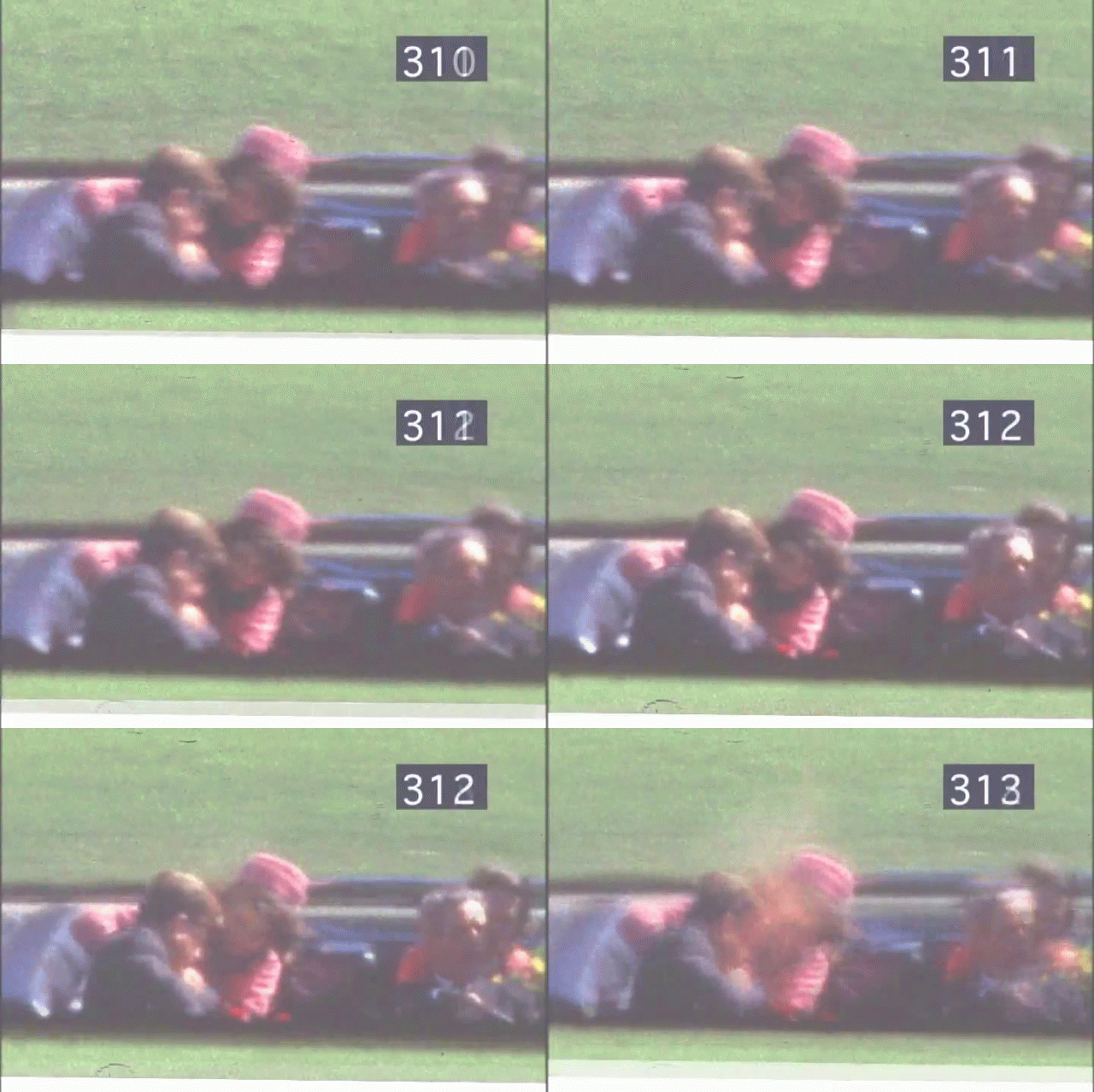
The fairy tale we are dealing with is the WC Fairy Tale. Nix shows Greer crossing his arm over to the right side of his body at the moment of JFKs execution. At the very least this film should arouse even a slight, fleeting, tiny curiosity that perhaps, maybe, possibly, Greer should have been handcuffed at Parkland, tried before a jury with a competent prosecutor, and swung on a rope for murder after being found guilty. The case against Greer, as presented here is solid as granite rock. If the rock is too hard for some people than perhaps its time to hear the WC Fairy Tale again and hit the pillow again as reality is becoming too challenging. Its OK ....the government prefers you this way.

Jay

Charlie-Sheen-Winning-.jpg

simple as pie to do with lone nut theorists.:lol: like i said,they are afraid of the truth so they wont look at the nix film or listen to witness testimonys and they have no interest in reading any other books except the warren commission report.:lol:
 
LOL!! You took me to school alright. To bad you couldn't teach me anything.
You feel you have the facts because you have read a lot of the books published? Are you SERIOUS!? Because if it is published in a book, it is a fact?
Now I understand where you are getting these ideas. Reading books that were written by guys that read the reports written about someone's research. You are 3rd generation stupid!

Actually, I shouldn't say you didn't teach me anything. I have never heard that an "Oswald look-alike" was taken out of the Texas Theater. That's hilarious!!

Interesting how you consider yourself a winner in these debates. Last time I checked, the "official story" is still that Oswald did it. The only debate is Oswald alone or Oswald & a conspiracy. Why? Because all of that pesky evidence that points to Oswald. I understand that evidence isn't something you deal in. Only ideas that point to your conclusion are paid any attention. Your login name "9/11 inside job" screams close minded.

Is it at all possible that the evidence used to pin this on Oswald, could have been fabricated?? Or is something that is beyond the realm of decency for authorities to do?
Just wondering...:eusa_eh:

they are too afraid to look at any evidence that dioesnt go along with their beliefs like the fact that it took two days for the dallas police dept and the FBI to find any traces of oswalds fingerprint on the carcano gun which was obviously lifted from his body or that witnesses SAW a riflemen behind the picket fence firing a rifle and that all the dallas doctors said it was an entrance wound to the forehead and throat.ofcourse NONE of that means anything to them.lol and of course they obviously think Greer took his hand off the steering wheel to reach back to try and pick the bullet out of kennedys head.:lol:they love demonstrating how retarded they are.:lol::lol:

Why don't you and 7forever get a tube of vasaline and a hotel room together.
 
Incoherent. I need four bong hits to comprehend what it is you're attempting to blather about. Drool on Shemp.

:lol::lol::lol: again,great comeback when shown you are a liar and an idiot who doesnt know what he is talking about.I love it.:lol::lol:

LOL!! You took me to school alright. To bad you couldn't teach me anything.
You feel you have the facts because you have read a lot of the books published? Are you SERIOUS!? Because if it is published in a book, it is a fact?
Now I understand where you are getting these ideas. Reading books that were written by guys that read the reports written about someone's research. You are 3rd generation stupid!

Actually, I shouldn't say you didn't teach me anything. I have never heard that an "Oswald look-alike" was taken out of the Texas Theater. That's hilarious!!

Interesting how you consider yourself a winner in these debates. Last time I checked, the "official story" is still that Oswald did it. The only debate is Oswald alone or Oswald & a conspiracy. Why? Because all of that pesky evidence that points to Oswald. I understand that evidence isn't something you deal in. Only ideas that point to your conclusion are paid any attention. Your login name "9/11 inside job" screams close minded.

you were taken to school major BIG TIME by me,you know it,I know it,your just too arrogant to admit defeat as we both know. Lone nut theorists are the only ones that scream close minded dumbfuck.:lol::lol: for the hundreth time,we both know,you have only read the warren commission and nothing else since the truth scares you.we both know you have no interest in what witnesses say or reading any books that have an opposing view on kennedy OR 9/11 as I have proven hundreds of times.bye troll. have fun talking to yourself and the government loves you for being afraid and believing in their fairy tale.so do disinfo agents LIAR ABILITY AND CANDYFAG.as I proved,you never even bothered to address a few of my posts since you knew you couldnt counter them.revel in your defeat as we both know troll and deal with it.have fun talking to yourself.
 
Last edited:
Is it at all possible that the evidence used to pin this on Oswald, could have been fabricated?? Or is something that is beyond the realm of decency for authorities to do?
Just wondering...:eusa_eh:

they are too afraid to look at any evidence that dioesnt go along with their beliefs like the fact that it took two days for the dallas police dept and the FBI to find any traces of oswalds fingerprint on the carcano gun which was obviously lifted from his body or that witnesses SAW a riflemen behind the picket fence firing a rifle and that all the dallas doctors said it was an entrance wound to the forehead and throat.ofcourse NONE of that means anything to them.lol and of course they obviously think Greer took his hand off the steering wheel to reach back to try and pick the bullet out of kennedys head.:lol:they love demonstrating how retarded they are.:lol::lol:

Why don't you and 7forever get a tube of vasaline and a hotel room together.

better question you need to ask is why do you only see what you WANT to see and are so afraid of the truth you can only come back with pitiful one liners when defeated?:lol: which is actually probably best since you make yourself look like a much less dumbfuck afraid of the truth than IRRATIONALIST does with his pathetic ramblings that have been shot down.
 
Last edited:
:lol::lol::lol: again,great comeback when shown you are a liar and an idiot who doesnt know what he is talking about.I love it.:lol::lol:

LOL!! You took me to school alright. To bad you couldn't teach me anything.
You feel you have the facts because you have read a lot of the books published? Are you SERIOUS!? Because if it is published in a book, it is a fact?
Now I understand where you are getting these ideas. Reading books that were written by guys that read the reports written about someone's research. You are 3rd generation stupid!

Actually, I shouldn't say you didn't teach me anything. I have never heard that an "Oswald look-alike" was taken out of the Texas Theater. That's hilarious!!

Interesting how you consider yourself a winner in these debates. Last time I checked, the "official story" is still that Oswald did it. The only debate is Oswald alone or Oswald & a conspiracy. Why? Because all of that pesky evidence that points to Oswald. I understand that evidence isn't something you deal in. Only ideas that point to your conclusion are paid any attention. Your login name "9/11 inside job" screams close minded.

Is it at all possible that the evidence used to pin this on Oswald, could have been fabricated?? Or is something that is beyond the realm of decency for authorities to do?
Just wondering...:eusa_eh:

well when your afraid of the truth like these lone nut theorists are,they ignore evicence and facts and witness testimony and experts in their fields and only read parts of posts and and ignore and dont even address half your points since it does not go along with their version of events.these dumbfukcs are not even aware that it shoots down their theory that only a carcano rifle was found since a MAUSER rifle which looks nothing like a carcano,was filmed by newsmen showing policemen carrying it off the rooftops which shootes down their theory that there was only a carcano rifle found.:lol::lol:
 
LOL!! You took me to school alright. To bad you couldn't teach me anything.
You feel you have the facts because you have read a lot of the books published? Are you SERIOUS!? Because if it is published in a book, it is a fact?
Now I understand where you are getting these ideas. Reading books that were written by guys that read the reports written about someone's research. You are 3rd generation stupid!

Actually, I shouldn't say you didn't teach me anything. I have never heard that an "Oswald look-alike" was taken out of the Texas Theater. That's hilarious!!

Interesting how you consider yourself a winner in these debates. Last time I checked, the "official story" is still that Oswald did it. The only debate is Oswald alone or Oswald & a conspiracy. Why? Because all of that pesky evidence that points to Oswald. I understand that evidence isn't something you deal in. Only ideas that point to your conclusion are paid any attention. Your login name "9/11 inside job" screams close minded.

Is it at all possible that the evidence used to pin this on Oswald, could have been fabricated?? Or is something that is beyond the realm of decency for authorities to do?
Just wondering...:eusa_eh:

well when your afraid of the truth like these lone nut theorists are,they ignore evicence and facts and witness testimony and experts in their fields and only read parts of posts and and ignore and dont even address half your points since it does not go along with their version of events.these dumbfukcs are not even aware that it shoots down their theory that only a carcano rifle was found since a MAUSER rifle which looks nothing like a carcano,was filmed by newsmen showing policemen carrying it off the rooftops which shootes down their theory that there was only a carcano rifle found.:lol::lol:

Speaking of not reading all of ones posts. Somehow you have managed to miss that I have said, more than once, that I think a conspiracy is very possible. I'm not as convinced of it as you are but definitely think it is possible. If you would spend less time misspelling curse words and actually read & comprehend what people are saying, you might actually be worth conversing with.
Like your Mauser "story". Yes, policeman where filmed coming off the roof with a gun. Filmed from way too far away to claim the make of the gun, which was a shotgun, not a rifle. Did you miss all the photo's of policeman caring shotguns?

Besides, aren't you claiming that no shots came from behind? That the shots came from the front and front right? What is your conclusion for a Mauser being on the roof if the conspirators are "planting" a Carcano on the sixth floor?
 
:lol::lol::lol: again,great comeback when shown you are a liar and an idiot who doesnt know what he is talking about.I love it.:lol::lol:

LOL!! You took me to school alright. To bad you couldn't teach me anything.
You feel you have the facts because you have read a lot of the books published? Are you SERIOUS!? Because if it is published in a book, it is a fact?
Now I understand where you are getting these ideas. Reading books that were written by guys that read the reports written about someone's research. You are 3rd generation stupid!

Actually, I shouldn't say you didn't teach me anything. I have never heard that an "Oswald look-alike" was taken out of the Texas Theater. That's hilarious!!

Interesting how you consider yourself a winner in these debates. Last time I checked, the "official story" is still that Oswald did it. The only debate is Oswald alone or Oswald & a conspiracy. Why? Because all of that pesky evidence that points to Oswald. I understand that evidence isn't something you deal in. Only ideas that point to your conclusion are paid any attention. Your login name "9/11 inside job" screams close minded.

you were taken to school major BIG TIME by me,you know it,I know it,your just too arrogant to admit defeat as we both know. Lone nut theorists are the only ones that scream close minded dumbfuck.:lol::lol: for the hundreth time,we both know,you have only read the warren commission and nothing else since the truth scares you.we both know you have no interest in what witnesses say or reading any books that have an opposing view on kennedy OR 9/11 as I have proven hundreds of times.bye troll. have fun talking to yourself and the government loves you for being afraid and believing in their fairy tale.so do disinfo agents LIAR ABILITY AND CANDYFAG.as I proved,you never even bothered to address a few of my posts since you knew you couldnt counter them.revel in your defeat as we both know troll and deal with it.have fun talking to yourself.
That is one of the funniest things I have EVER read. You've never been to school. Your run together sentences, lack of spacing and capitalization AND your inability to spell.:lol::lol::lol::lol::lol::lol:
 
still another fart from you candyfag.:lol::lol: Like i said,I know that you are very pleased that Irrationalist and warrior troll are afraid of the truth and only see what they want to see and are easily able to be brainwashed by your posts because of that.congrats I know your handlers that pay you are pleased with you for making sure they stay afraid.waiting for another fart from you.:lol:
 
Last edited:
Irrationalist,candyfag,Liar ability,warrior and the other lone nut trolls can only sling shit in defeat like the monkeys they are.uh huh.:lol::lol::lol:

The above is how Barry Ernest begins his interesting and unusual book, The Girl on the Stairs. The JFK assassination, like any historical event, had a ripple effect on the history of the country and, indeed, the world. And while many of these effects were foreseeable—for example, the expansion of the war in Vietnam—there were an infinite number of others that were not. Some of the most tragic stories that emerged in the wake of the assassination concern the deaths of those who became accidental players by hearing and seeing things they were not supposed to, and whose documentation began with Penn Jones in his Forgive My Grief series. Still others involved those who were not murdered, but instead were forced into a life of hiding and jumping at shadows.

Barry Ernest’s book tells two stories. One is about himself: his journey from being a believer in the Warren Report to that of being a fierce critic of that now, quite discredited, volume. Therefore he begins the book at a rather appropriate place and time. In fact, it is actually beyond appropriate. It is almost symbolic. Barry was a student at Kent State in 1967. This is the college where the expansion of the Vietnam War would, in three short years, lead to the infamous shooting of students by the National Guard and produce one of the most iconic photographs of that tumultuous era. The first scene of the book is him sitting outside the cafeteria. A fellow student named Terry approaches and asks him about a dialogue from a previous class where Barry actually defended the Warren Report. The student then asks Barry if he had ever seen or heard of the Zapruder film, and if he had read the entire 26 volumes of the Warren Commission. Barry said no to each. The student left him a copy of an interview by Mark Lane, and said, “Read this.” Barry did—right then and there. Hours later, in twilight, he then went to a bookstore and searched for Lane’s book, Rush to Judgment. This is how the first story—that of personal discovery and evolution—begins.

And it was through Lane’s book that Barry was introduced to the heroine of the second story he will tell. That second story is about the plight of one of these ordinary people who was swept up by events: Victoria Adams, the notable “girl on the stairs.” She was an employee who worked in the same building as one Lee Harvey Oswald. The problem caused by her presence is very simple and easily summarized. Adams, along with her friend Sandra Styles, stood on the fourth floor of the Texas School Book Depository at the moment of the murder. She testified to hearing three shots, which from her vantage point appeared to be coming from the right of the building (i.e., from the grassy knoll). She and Styles then ran to the stairs to head down. This was the only set of stairs that went all the way to the top of the building. Both she and her friend took them down to the ground floor. She did not see or hear Oswald. Yet, she should have if he were on the sixth floor traveling downwards. Which is what the Commission said he did after he shot Kennedy.

This is the first problem, in a nutshell. Why did Adams not see a scrambling Oswald, flying down the stairs in pursuit of his Coca-Cola? Because of the Warren Commission’s timeline, we know Oswald had to have gone down the stairs during this period in order to be accosted in time by a motorcycle policeman. In addition, as we are later to discover, Adams also reports seeing Jack Ruby on the corner of Houston and Elm, “questioning people as though he were a policeman.”

From here the parallel stories broaden out. For Barry began to read more books critical of the Commission. And he would then compare what was in these books with the testimony and evidence in the 26 volumes. Like many people before him, he found something rather disturbing: the evidence and testimony did not completely back up the summary conclusions in the Warren Report. The Commission had selectively chosen evidence to make their case. And they had deliberately tried to discredit witnesses and testimony that contradicted their guilty verdict about Oswald. And the witness that they did this to that really kindled Barry’s curiosity was Victoria Adams. As the author writes at the end of Chapter 1, “What if she was right?”

Adams did not find the government eager to hear her story. This is why they badgered her day and night: the FBI, Secret Service, Dallas Police, and the Sheriff’s Department. And Victoria noticed something discriminatory about all the attention she was getting: the other witnesses in her office did not receive it, e.g., Sandy Styles who ran down the stairs with her, or Elsie Dorman or Dorothy May Garner who watched the motorcade with her.

The attention didn’t stop. In fact, even when she moved to a different address these agents followed her. Even though she had left no forwarding address and her new apartment was not in her name. But they still found her. They followed her when she went to lunch. They followed her when she walked around town. When she sent a letter to a friend in San Francisco describing what she saw and did that day as a witness, the friend never got the letter. The question they posed was always the same: When did you run down the stairs after the shooting?

Then, another odd thing happened. When David Belin and the Warren Commission requested her to testify, it was her alone. Sandra Styles was not with her. In fact, Barry could find no evidence that the Commission questioned Styles at all. Further, during her appearance, Belin had handed her a diagram of the first floor of the Texas School Book Depository, the place where she and Oswald worked at that time. He asked her to point out where she saw two other employees (i.e., William Shelley and Billy Lovelady) when she arrived at the bottom of the stairway. When Barry went to look up this exhibit in the Commission volumes—Commission Exhibit 496—he discovered something odd. It was not the document in the testimony. It was a copy of the application form Oswald filled out for his job at the Depository.

Further, although Styles did not testify that day, or at all, both Lovelady and Shelley did. And as Barry read their testimony it appeared to him that the Commission was making use of them to discredit Adams. Commission lawyer Joe Ball made sure he asked Shelley when and if he saw Adams after the shooting. And when Barry read Lovelady’s testimony his mouth flew open. Lovelady brought up Adams’ name before Ball did! And he called her by her nickname, “Vickie.” Barry was puzzled as to what prompted this spontaneous reference to Adams. Did Lovelady know in advance that Ball was going to specifically ask about her?

Indeed, when she read her own testimony in the Warren Commission—and the Commission’s use of it—Adams was startled to find major discrepancies, including the time interval as to when she started down the stairs after she heard the shots. This began for her a lifelong burden of living in the shadows, avoiding any publicity dealing with her testimony or her treatment at the hands of the Commission. When her employer, publishing house Scott Foresman, offered her a chance to transfer out of Dallas to Chicago in 1966, she took it. (p. 35) While there, she actually now began to read the Warren Report. She now noted what they had done with Lovelady and Shelley. This stupefied her. Because she did not recall seeing either man after she and Styles arrived on the first floor. (p. 36)

However, although the book drops in on her from time to time—and it builds towards Barry’s hunt for her, discovering documents that bear out her veracity, and interviewing her in a climactic scene—the principle narrative is the journey of the author himself, who was a teen-ager at the time of the assassination, and went on to became acquainted with some of the earliest critics. He and Terry became working partners at deciphering the fraud of the Warren Report. They would visit each other’s dorms to discus the latest deception they found in the volumes, e.g., how the Commission cut corners and accepted false witnesses to place Oswald on the sixth floor at the time of the shooting; the dubious way they reconstructed his movements after he left the Depository; the quality of the witnesses to the Tippit shooting, etc. These all begin to fuel doubts in him about his former belief in the Warren Commission.

In fact, Barry became so obsessed with this mystery that he ignored his studies. He flunked out of Kent State. (p. 33)


II
Going home to Altoona, Pennsylvania, he could not find the 26 Commission volumes there. So he began to read the works of the first generation critics—every one of them. (Read about the first generation critics in John Kelin’s highly-acclaimed Praise from a Future Generation. See the first chapter of Kelin’s book here.)

He then decided to visit Dallas. There he met a man named Eugene Aldredge. Aldredge had found a bullet mark on the sidewalk near Elm, which showed a missed shot. He told the FBI about it, but they ignored it. (p. 37) He interviewed Roy Truly a manager of the Depository about the incident right after the shooting where he and policeman Marion Baker encountered Oswald on the second floor drinking a Coke. (p. 41) And he learned something odd during their talk: No one other than employees were allowed onto the sixth floor. (p. 42) But Barry did go to the second floor. Here he examines the lunchroom area around where Truly and Baker allegedly encountered Oswald. (p. 43) Here he begins a quite interesting discussion about how Baker could have seen Oswald through the window of the pneumatic door. He makes somewhat the same argument that Howard Roffman did in his excellent book Presumed Guilty. Truly said he saw no one as he proceeded up the stairs in front of Baker. (ibid) So a question now emerged: “If that door already was closed as Truly passed in advance of the policeman, why would Oswald stand stationary behind it until Baker appeared?” (ibid) For this is how Baker said he noticed Oswald, through the window of the door. The author comes to the same conclusion that others who had read Roffman: If one takes Baker at his word, Oswald had to have come up to the lunchroom from another set of stairs, a one flight stairway from the first floor for Baker to have seen him as he said he did. This bolstered Victoria Adams’ story for Barry. He tried to visit her on this trip but found out she had left for Chicago already. (p. 44)

He then made a visit to Penn Jones In Midlothian, Texas. Jones, who had two sets, sold him the 26 volumes for $76.00. (p. 39) Penn introduced him to Roger Craig, and he also became involved with Harold Weisberg early on. Both Jones and Weisberg immediately see something in him and venture to tap his skills to assist them; Weisberg as a researcher, Jones to interview people who would not talk to him because he was too well known. He also knew David Lifton long before he came onto the scene with Best Evidence. This is all quite intriguing, although the portraits of these men are a bit sketchy and lacking in depth. Jones sends Barry to interview a couple of witnesses. But they seem quite scared and apprehensive. S. M. Holland agreed to meet with him, but brought two men with him since he felt he had been abused and taken advantage of in the past. (p. 53) He talks to Carolyn Walther, a witness who told the FBI she had seen two men, one with a rifle, in either the fourth or fifth floor southeast window that day. Yet she had not been called to testify by the Commission. (p. 54) But she told Barry that she also told the FBI that she had seen two black men below where the man with a rifle was. This would put the two men on the sixth floor, since the black employees were on the fifth floor. She kept this to herself at the time since she thought the two men were some kind of guards. She said that after the shooting she encountered an acquaintance, Abraham Zapruder, who told her Kennedy had been shot from the front and pointed to his forehead. (p. 55)

Barry then visited the scene of policeman J. D. Tippit’s shooting. Here, he meets a witness that no agent of government had talked to, a Mrs. Higgins who lived nearby. She offered him some very important information. She had heard the shots and ran out her front door to see Tippit lying in the street. Barry asked her what time it was. She said it was 1:06. He asked her how she recalled that specific time. She said because she was watching TV and the announcer said it. So she automatically checked her clock when he said it and he was right. Barry concludes that it was not possible that Oswald could have traversed the distance from his apartment to the scene of Tippit’s murder in time to do the shooting. (p. 58) This is when she heard the shots. She also said she got a look at a man running form the scene with a handgun. When Barry asked her what he looked like she replied it was definitely not Oswald. (p. 59)
Barry then timed the Commission’s story on how long it would take Oswald to get to the Texas Theater from 10th and Patton, the Tippit murder scene. This, the Commission said, took 24 minutes. Yet it was shorter by a third than Oswald’s walk from his apartment to 10th and Patton. Yet it took twice as long for Oswald to traverse? (ibid) The Commission says it took Oswald 24 minutes to walk that distance. It took Barry ten minutes.

When Barry got back to Pennsylvania he investigated a strange case near to his home, in Martinsburg. A woman named Margaret Hoover told agents she had discovered a discarded piece of paper in her back yard. On the paper were the handwritten words, “Lee Oswald” “Jack Ruby” “Rubenstein” and “Dallas, Texas”. The problem was that this discovery occurred not after the assassination but before. (p. 63) She had a brother who tipped off the FBI to this event. The woman told the Bureau that she had also found a railroad company ticket from Miami dated 9/25/63 to Washington. Both papers were found near where the trash was burned by a resident in her apartment house. This resident was Dr. Julio Fernandez, a Cuban refuge and a local junior high teacher. According to the FBI report, she furnished the FBI with the envelope and ticket stub, but not the scrap of paper with the names.

When Barry tracked this story down, it turned out that Hoover showed the papers to her daughter and her daughter also recalled the name “Silver Bell” or “Silver Slipper.” But the FBI got the daughter to partially retract: she now said she only saw the names of Ruby and Dallas, and she was not quite sure of even that. When they interviewed Hernandez, he explained the ticket as being for his son to come north to see him from Miami. (p. 64)

Barry wrote to Mrs. Hoover. He found out that the FBI had lied: the woman had given them the paper with the names on it. She also added that Fernandez had worked in Washington before moving to Pennsylvania. He had worked for the CIA after escaping Cuba post-Castro. (p. 65)

He and Terry now decided to visit the National Archives to view the Zapruder film. Like everyone else they were shocked by what it depicted. But further, they were angered by the fact that the Commission had never mentioned the backward movement of Kennedy’s head and body, which was contrary to what would have happened if Oswald had shot the president from behind. Surely they had seen the film. Why did they ignore it? (p. 69)

It was this event that evaporated any belief Barry maintained in the Commission. But it did something worse to Terry. The man who had first instigated Barry’s interest in that blind belief was now sapped and disgusted. He decided it was the end of the road for him. He gave up. Barry never heard from him after this trip.


III
At the National Archives, he located the November 24th FBI report that Victoria Adams had given. It was remarkably consistent with her later one on March 23rd. She said that she had immediately gone down the stairs with Styles after the shooting. And there was no mention of her seeing Shelley or Lovelady. (p. 75)
Barry did some further digging into her testimony and statements. It turned out that the Dallas Police questioned her also. This was on February 17th. Way after the FBI and Warren Commission had taken over control of the case from the DPD. In reading this statement, Barry discovered that it was this report that inserted Lovelady and Shelley into her story. It was written by none other than the avuncular, smiling Jim Leavelle, the man who accompanied Oswald out of police HQ to be killed by Jack Ruby. (p. 76) But further, Barry noticed that there was no questioning of the other three women who were watching the motorcade with Adams: Styles, Elsie Dorman, and Dorothy Garner. He thought this was odd since they could confirm if Adams left the window quickly, as she said she had.

Barry also discovered something else that was odd. The FBI did time-reconstructions to simulate Oswald coming down the stairs. They also did one to simulate Truly and Baker coming up the stairs. But he could find none that tried to replicate Adams coming down the stairs. (p. 78) Even though they were keenly aware of the problem she posed to their verdict about Oswald. So much so that counselors Joe Ball and David Belin wrote a memo about this subject that ended: “We should pin down this time sequence of her running down the stairs.” But Barry could find no evidence that they did. (p. 79)

At the Archives, Barry met Harold Weisberg. Weisberg asked him to do some work for him. He thought that people would be more eager to talk to someone like him, since he had a low profile. So when he visited Dallas again in August of 1968, he did so. He asked some questions of Sheriff Bill Decker. One of them was if he had kept any more than the 92 pages of files he gave to the Commission. Decker did not buy that one. That question ended the interview. (p. 83)

Barry also got the opportunity to meet Roger Craig via Penn Jones. Craig wanted to meet Barry outside Dallas. And he did at his sister’s house. Once there Barry asked him about all the secrecy. Craig replied that his problems began in 1965 when the first essays began to appear critical of the Commission. Many had his name in them. Then people wanted to talk to him, but Decker gave him strict orders not to talk to anyone. Then in July of 1967, Decker fired him. Then, in November of that year, there was an assassination attempt against him. (p. 93)

Craig went on to repeat the famous story of Oswald getting in a Rambler station wagon and escaping down Elm Street with a Latin looking fellow driving. Craig then said he saw Oswald at the station later and Fritz asked him about the car Craig saw him run off in. Oswald replied that the car belonged to Mrs. Paine and then exclaimed with disgust, “Everyone will know who I am now.” (p. 94) When Barry asked him if he was sure the man he saw entering the car was Oswald, Craig said yes he was. And he added that the Commission had altered his testimony in 14 separate instances. (p. 95) Craig added something quite interesting about the lawyer who examined him, David Belin:

When Belin interrogated me... he would ask me certain questions and, whenever an important question would come up... he would have to know the answer beforehand, he would turn off the recorder and instruct the stenographer to stop taking notes. Then he would ask for the question, and if the answer satisfied him, he would turn the recorder back on, instruct the stenographer to start writing again, and he would ask me the same question, and I would answer it.
However, while the recorder was off, if the answer did not satisfy him... he would turn the recorder back on and instruct the stenographer to start writing again and then he would ask me a completely different question.
He then added that none of these interruptions were noted in the transcript as entered in the Warren Commission. (p. 95)

On the way back from Craig’s sister’s house, the police stopped their car. The pretext was that the car had gone through a red light. When Barry insisted the light was green, the cop came around to the passenger window and asked him for his ID. Noting he was from out of state, he asked him what he was doing in Texas. Barry replied that he was visiting friends. The two policemen then went to the front of the car out of earshot. They returned and said they would let it go this time. Craig looked relieved. When Barry told the story to Penn Jones, Penn said that he was lucky Craig was with him. (p. 98)

While in Dallas, Barry visited with newsman Wes Wise. He tells him a story about Ruby being in Dealey Plaza that Saturday before he shot Oswald. The reason he gave Wes was he wanted to see the wreath and flowers that were being laid there for Kennedy. But Wes expected a different reason. The county jail was nearby, which Oswald was going to be transferred to. But yet Garret Hallmark, a parking garage attendant said Ruby used his phone that day before proceeding to Dealey Plaza. He told the man on the other end that he had information the transfer would take place on Saturday, that afternoon. Garret got the impression that Ruby was looking for corroboration for that information. Ruby then said that because of all the people carrying flowers, the transfer could be delayed. (p. 101) Ruby’s odd Saturday activities were further described by policeman D. V. Harkness who saw Ruby at the entrance to the county jail that day. (p. 102) But when Harkness brought this interesting point up, Belin dropped it instantly. SOP for the Commission.


IV
On this trip, Barry tried to locate Adams. He searched various residences and left a message with Roy Truly, but nothing turned up.

Adams had gone to college in California and attained a degree in Business Administration. She had graduated summa cum laude and gone into real estate. But one day in the library she came upon a set of Warren Commission volumes. She began to go over them very carefully this time. She recalled that a messenger had delivered her testimony to her at work and she was given the opportunity to make corrections. She did so. But now she saw they were not entered. (p. 106) She also noted that at the end of her appearance it said she waived her right to review her testimony. This was not so. And she noted that her own testimony had her actually talking to Shelley and Lovelady. But they were not on the first floor when she got there. (ibid) Further, she did not recall the Shelley/Lovelady stuff in the copy she had corrected in Dallas.

Barry had enlisted in the Naval Reserve and had been overseas. When he returned it was after Garrison had lost the Clay Shaw trial. The critics were now divided against each other, e.g., Jones had accused Weisberg of being a CIA agent. (p. 128) America was withdrawing from Vietnam after losing the war. The movie Jaws was about to change Hollywood. And to top it off, Warren Commissioner Jerry Ford was now president. To the victors belong the spoils.
Barry went back to college, got married, and had a son. One day he picked up Belin’s book defending the Warren Commission, November 22, 1963: You are the Jury. In leafing through it he saw that Belin used the testimony of Lovelady and Shelley to discredit Adams. This is the way it worked: Shelley and Lovelady had left the building and gone over to the railway yards about a block away. They then returned and said they saw Adams on the first floor. If this was accurate then the likelihood was that Adams came down the stairs later than she said, when Oswald would have been in the lunchroom already. (p. 129) Belin used these two men without referring to the fact that Lovelady seemed cued in advance. In fact, he spent three pages on the matter.

Just when Barry thought the Kennedy case, and Victoria Adams, were now finis, something happened to change all that. In 1975, Geraldo Rivera showed the Zapruder film on national television. It caused a minor earthquake across the land. Now came the inquiries into CIA scandals by Representative Otis Pike and Senator Frank Church. With the exposure of the CIA–Mafia plots to kill Castro, and the writing of the Schweiker-Hart report about how poorly the Warren Commission and FBI performed their duties in the investigation of President Kennedy’s death, the time was ripe for a new investigation of the murder. Unfortunately, the House Select Committee on Assassinations was a disappointment. The author does a nice job briefly summarizing many of their shortcomings. Barry wrote them about Victoria Adams and Sandra Styles. He never got anything back. (p. 132)

But now the nation was faced with two verdicts on the JFK case. The HSCA had concluded, however limply, that the murder was a result of a conspiracy. But now the critics were even more divided and scattered. Barry began to think that maybe Terry was right. It was time to quit.

Victoria Adams had moved to Seattle. And she had become a successful businesswoman who was now listed in Who’s Who of American Women and Who’s Who in the World. Now she and her husband decided to travel the country back and forth in a five-wheel trailer. They did that for six years. (p. 142) She also wrote a newsletter called Principles in Action, a chronicle of what she saw and heard on her travels. She also wrote a cookbook called No More than 4 Ingredients. Ironically, she liked Pennsylvania so much, she and her husband stayed there for several months, near Harrisburg. Which is where Barry was living in 1991. Then Oliver Stone’s film JFK came out. This caused the creation of the Assassination Records Review Board. After a visit with Weisberg, Barry decided to look through some documents. (p. 145) He also began to read through the HSCA volumes. After reviewing them thoroughly, and summarizing their major findings for us, he notes that they never found and reinterviewed Adams. (p. 148)

From here, the book slows down—takes a detour so to speak—as Barry now looks back at the work of the Warren Commission through the declassified Executive Sessions. Barry also now reviews some of the newly declassified medical evidence showing that there was a hole in the back of Kennedy’s head. He also tried to get in contact with Francis Adams, one of the Warren Commission senior counsel. Adams worked for about a month and then left. His duties were assumed totally by Arlen Specter. It was never clear as to why. And when Lee Rankin, the Commission executive director, was asked about Adams, he replied he should have fired him the first day. (p. 171) Further, there was nothing left behind to explain exactly why he left. Nothing until a quote about leaving showed up in 1966 that said that he was too busy at his law firm and that he had a “different concept of the investigation.” (p. 172) There was no reply to any of Barry’s queries to Adams. But when he died, Barry wrote his surviving wife. He got a call back form his daughter Joyce Adams. She first wanted to know if Barry had spoken to ‘Specter.’ She said the name like the late Jean Hill would intone it. Barry said he had not. Joyce laughed when she heard about the “too busy at the law firm” excuse. He would have never joined up if that were the case. She thought the real reasons was he did not like the way they were proceeding, “If he didn’t think it was being run properly, he would be the type to leave.” (p. 173)

Barry then asked if her father had many notes, or writings or kept personal papers from his days with the Commission. Joyce quietly said that he had. They were kept in longhand. Barry asked to review the file. Joyce said this was in her sister Judith’s possession. She said she had to talk to her sister first and would get back to him after. She never did. It is unfortunate that this information was not turned over to the ARRB, for whatever was in those files would have been very important to discover.


V
In the nineties, Barry discovered a document from the Warren Commission that very much bolstered the Adams testimony. Addressed to Rankin, it summarized the corrections she wanted in her testimony—the ones that were not made. But it also helped explain why the Commission never talked to any of the possible corroborating witnesses who watched the motorcade with her. In the letter, the very last sentence says “Miss Garner, Miss Adams’ supervisor, stated this morning that after Miss Adams went downstairs she (Miss Garner) saw Mr. Truly and the policeman come up.” (p. 176)

Obviously, if they had come up after, then Adams had left when she said she did. Barry notes that he felt like someone had punched him in the gut when he read this. The date of the letter was June 2, 1964. But even with this in their hands, the Commission went ahead and did all they could to discredit Adams. They wrote “...she actually came down the stairs several minutes after Oswald and after Truly and Baker as well.” (ibid) This was written in spite of the fact they had this new evidence in their hands saying the opposite. And this is why the Commission never formally deposed the three corroborating witnesses.

When the author showed this letter from Marcia Joe Stroud, the Dallas US Attorney, to Weisberg, Harold told him to write a book about Adams. The author then makes one more try to find Adams or her corroborating witnesses. He visits Dallas and talks to Gary Mack, who Harold referred him to. Mack says he cannot help him.

It was not until 2002, when his son convinced him to buy a computer to type his book, that he found Adams via email. What follows, in Chapters 27 through 29, is a fascinating, long interview with Adams, now aged 61. She goes over her experience that day in full detail: arriving at work, waiting for the motorcade, running down the stairs, seeing Ruby in suit and hat talking to people like a reporter, etc. This interview is really the high point of the book. What it reveals about Leavelle, the Dallas Police, and David Belin is powerful stuff. Adams concludes that Oswald could not have been on those stairs. He was not on the sixth floor at the time of the shooting, he was on a lower floor. (p. 211)
Beginning to master the Internet, Barry then finds Sandra Styles. (p. 217) She confirms Adams. She says the two left the window when Secret Service agent Clint Hill jumped on the back of the car. (p. 218) And she said she neither saw nor heard anyone on the stairs on the way down. And she did not recall Lovelady or Shelley on the ground floor when they got there either. (p. 219) (Editor's bold emphasis throughout) Styles said the only interview she gave was to the FBI and it was not in depth or probing.

The book ends on a sad note. Adams died of cancer in 2007 at the rather young age of 66. We are lucky that Barry found her before she passed.
 
Last edited:
Irrationalist,candyfag,Liar ability,warrior and the other lone nut trolls can only sling shit in defeat like the monkeys they are.uh huh.:lol::lol::lol:

The above is how Barry Ernest begins his interesting and unusual book, The Girl on the Stairs. The JFK assassination, like any historical event, had a ripple effect on the history of the country and, indeed, the world. And while many of these effects were foreseeable—for example, the expansion of the war in Vietnam—there were an infinite number of others that were not. Some of the most tragic stories that emerged in the wake of the assassination concern the deaths of those who became accidental players by hearing and seeing things they were not supposed to, and whose documentation began with Penn Jones in his Forgive My Grief series. Still others involved those who were not murdered, but instead were forced into a life of hiding and jumping at shadows.

Barry Ernest’s book tells two stories. One is about himself: his journey from being a believer in the Warren Report to that of being a fierce critic of that now, quite discredited, volume. Therefore he begins the book at a rather appropriate place and time. In fact, it is actually beyond appropriate. It is almost symbolic. Barry was a student at Kent State in 1967. This is the college where the expansion of the Vietnam War would, in three short years, lead to the infamous shooting of students by the National Guard and produce one of the most iconic photographs of that tumultuous era. The first scene of the book is him sitting outside the cafeteria. A fellow student named Terry approaches and asks him about a dialogue from a previous class where Barry actually defended the Warren Report. The student then asks Barry if he had ever seen or heard of the Zapruder film, and if he had read the entire 26 volumes of the Warren Commission. Barry said no to each. The student left him a copy of an interview by Mark Lane, and said, “Read this.” Barry did—right then and there. Hours later, in twilight, he then went to a bookstore and searched for Lane’s book, Rush to Judgment. This is how the first story—that of personal discovery and evolution—begins.

And it was through Lane’s book that Barry was introduced to the heroine of the second story he will tell. That second story is about the plight of one of these ordinary people who was swept up by events: Victoria Adams, the notable “girl on the stairs.” She was an employee who worked in the same building as one Lee Harvey Oswald. The problem caused by her presence is very simple and easily summarized. Adams, along with her friend Sandra Styles, stood on the fourth floor of the Texas School Book Depository at the moment of the murder. She testified to hearing three shots, which from her vantage point appeared to be coming from the right of the building (i.e., from the grassy knoll). She and Styles then ran to the stairs to head down. This was the only set of stairs that went all the way to the top of the building. Both she and her friend took them down to the ground floor. She did not see or hear Oswald. Yet, she should have if he were on the sixth floor traveling downwards. Which is what the Commission said he did after he shot Kennedy.

This is the first problem, in a nutshell. Why did Adams not see a scrambling Oswald, flying down the stairs in pursuit of his Coca-Cola? Because of the Warren Commission’s timeline, we know Oswald had to have gone down the stairs during this period in order to be accosted in time by a motorcycle policeman. In addition, as we are later to discover, Adams also reports seeing Jack Ruby on the corner of Houston and Elm, “questioning people as though he were a policeman.”

From here the parallel stories broaden out. For Barry began to read more books critical of the Commission. And he would then compare what was in these books with the testimony and evidence in the 26 volumes. Like many people before him, he found something rather disturbing: the evidence and testimony did not completely back up the summary conclusions in the Warren Report. The Commission had selectively chosen evidence to make their case. And they had deliberately tried to discredit witnesses and testimony that contradicted their guilty verdict about Oswald. And the witness that they did this to that really kindled Barry’s curiosity was Victoria Adams. As the author writes at the end of Chapter 1, “What if she was right?”

Adams did not find the government eager to hear her story. This is why they badgered her day and night: the FBI, Secret Service, Dallas Police, and the SheriffÂ’s Department. And Victoria noticed something discriminatory about all the attention she was getting: the other witnesses in her office did not receive it, e.g., Sandy Styles who ran down the stairs with her, or Elsie Dorman or Dorothy May Garner who watched the motorcade with her.

The attention didnÂ’t stop. In fact, even when she moved to a different address these agents followed her. Even though she had left no forwarding address and her new apartment was not in her name. But they still found her. They followed her when she went to lunch. They followed her when she walked around town. When she sent a letter to a friend in San Francisco describing what she saw and did that day as a witness, the friend never got the letter. The question they posed was always the same: When did you run down the stairs after the shooting?

Then, another odd thing happened. When David Belin and the Warren Commission requested her to testify, it was her alone. Sandra Styles was not with her. In fact, Barry could find no evidence that the Commission questioned Styles at all. Further, during her appearance, Belin had handed her a diagram of the first floor of the Texas School Book Depository, the place where she and Oswald worked at that time. He asked her to point out where she saw two other employees (i.e., William Shelley and Billy Lovelady) when she arrived at the bottom of the stairway. When Barry went to look up this exhibit in the Commission volumes—Commission Exhibit 496—he discovered something odd. It was not the document in the testimony. It was a copy of the application form Oswald filled out for his job at the Depository.

Further, although Styles did not testify that day, or at all, both Lovelady and Shelley did. And as Barry read their testimony it appeared to him that the Commission was making use of them to discredit Adams. Commission lawyer Joe Ball made sure he asked Shelley when and if he saw Adams after the shooting. And when Barry read Lovelady’s testimony his mouth flew open. Lovelady brought up Adams’ name before Ball did! And he called her by her nickname, “Vickie.” Barry was puzzled as to what prompted this spontaneous reference to Adams. Did Lovelady know in advance that Ball was going to specifically ask about her?

Indeed, when she read her own testimony in the Warren Commission—and the Commission’s use of it—Adams was startled to find major discrepancies, including the time interval as to when she started down the stairs after she heard the shots. This began for her a lifelong burden of living in the shadows, avoiding any publicity dealing with her testimony or her treatment at the hands of the Commission. When her employer, publishing house Scott Foresman, offered her a chance to transfer out of Dallas to Chicago in 1966, she took it. (p. 35) While there, she actually now began to read the Warren Report. She now noted what they had done with Lovelady and Shelley. This stupefied her. Because she did not recall seeing either man after she and Styles arrived on the first floor. (p. 36)

However, although the book drops in on her from time to time—and it builds towards Barry’s hunt for her, discovering documents that bear out her veracity, and interviewing her in a climactic scene—the principle narrative is the journey of the author himself, who was a teen-ager at the time of the assassination, and went on to became acquainted with some of the earliest critics. He and Terry became working partners at deciphering the fraud of the Warren Report. They would visit each other’s dorms to discus the latest deception they found in the volumes, e.g., how the Commission cut corners and accepted false witnesses to place Oswald on the sixth floor at the time of the shooting; the dubious way they reconstructed his movements after he left the Depository; the quality of the witnesses to the Tippit shooting, etc. These all begin to fuel doubts in him about his former belief in the Warren Commission.

In fact, Barry became so obsessed with this mystery that he ignored his studies. He flunked out of Kent State. (p. 33)


II
Going home to Altoona, Pennsylvania, he could not find the 26 Commission volumes there. So he began to read the works of the first generation critics—every one of them. (Read about the first generation critics in John Kelin’s highly-acclaimed Praise from a Future Generation. See the first chapter of Kelin’s book here.)

He then decided to visit Dallas. There he met a man named Eugene Aldredge. Aldredge had found a bullet mark on the sidewalk near Elm, which showed a missed shot. He told the FBI about it, but they ignored it. (p. 37) He interviewed Roy Truly a manager of the Depository about the incident right after the shooting where he and policeman Marion Baker encountered Oswald on the second floor drinking a Coke. (p. 41) And he learned something odd during their talk: No one other than employees were allowed onto the sixth floor. (p. 42) But Barry did go to the second floor. Here he examines the lunchroom area around where Truly and Baker allegedly encountered Oswald. (p. 43) Here he begins a quite interesting discussion about how Baker could have seen Oswald through the window of the pneumatic door. He makes somewhat the same argument that Howard Roffman did in his excellent book Presumed Guilty. Truly said he saw no one as he proceeded up the stairs in front of Baker. (ibid) So a question now emerged: “If that door already was closed as Truly passed in advance of the policeman, why would Oswald stand stationary behind it until Baker appeared?” (ibid) For this is how Baker said he noticed Oswald, through the window of the door. The author comes to the same conclusion that others who had read Roffman: If one takes Baker at his word, Oswald had to have come up to the lunchroom from another set of stairs, a one flight stairway from the first floor for Baker to have seen him as he said he did. This bolstered Victoria Adams’ story for Barry. He tried to visit her on this trip but found out she had left for Chicago already. (p. 44)

He then made a visit to Penn Jones In Midlothian, Texas. Jones, who had two sets, sold him the 26 volumes for $76.00. (p. 39) Penn introduced him to Roger Craig, and he also became involved with Harold Weisberg early on. Both Jones and Weisberg immediately see something in him and venture to tap his skills to assist them; Weisberg as a researcher, Jones to interview people who would not talk to him because he was too well known. He also knew David Lifton long before he came onto the scene with Best Evidence. This is all quite intriguing, although the portraits of these men are a bit sketchy and lacking in depth. Jones sends Barry to interview a couple of witnesses. But they seem quite scared and apprehensive. S. M. Holland agreed to meet with him, but brought two men with him since he felt he had been abused and taken advantage of in the past. (p. 53) He talks to Carolyn Walther, a witness who told the FBI she had seen two men, one with a rifle, in either the fourth or fifth floor southeast window that day. Yet she had not been called to testify by the Commission. (p. 54) But she told Barry that she also told the FBI that she had seen two black men below where the man with a rifle was. This would put the two men on the sixth floor, since the black employees were on the fifth floor. She kept this to herself at the time since she thought the two men were some kind of guards. She said that after the shooting she encountered an acquaintance, Abraham Zapruder, who told her Kennedy had been shot from the front and pointed to his forehead. (p. 55)

Barry then visited the scene of policeman J. D. TippitÂ’s shooting. Here, he meets a witness that no agent of government had talked to, a Mrs. Higgins who lived nearby. She offered him some very important information. She had heard the shots and ran out her front door to see Tippit lying in the street. Barry asked her what time it was. She said it was 1:06. He asked her how she recalled that specific time. She said because she was watching TV and the announcer said it. So she automatically checked her clock when he said it and he was right. Barry concludes that it was not possible that Oswald could have traversed the distance from his apartment to the scene of TippitÂ’s murder in time to do the shooting. (p. 58) This is when she heard the shots. She also said she got a look at a man running form the scene with a handgun. When Barry asked her what he looked like she replied it was definitely not Oswald. (p. 59)
Barry then timed the CommissionÂ’s story on how long it would take Oswald to get to the Texas Theater from 10th and Patton, the Tippit murder scene. This, the Commission said, took 24 minutes. Yet it was shorter by a third than OswaldÂ’s walk from his apartment to 10th and Patton. Yet it took twice as long for Oswald to traverse? (ibid) The Commission says it took Oswald 24 minutes to walk that distance. It took Barry ten minutes.

When Barry got back to Pennsylvania he investigated a strange case near to his home, in Martinsburg. A woman named Margaret Hoover told agents she had discovered a discarded piece of paper in her back yard. On the paper were the handwritten words, “Lee Oswald” “Jack Ruby” “Rubenstein” and “Dallas, Texas”. The problem was that this discovery occurred not after the assassination but before. (p. 63) She had a brother who tipped off the FBI to this event. The woman told the Bureau that she had also found a railroad company ticket from Miami dated 9/25/63 to Washington. Both papers were found near where the trash was burned by a resident in her apartment house. This resident was Dr. Julio Fernandez, a Cuban refuge and a local junior high teacher. According to the FBI report, she furnished the FBI with the envelope and ticket stub, but not the scrap of paper with the names.

When Barry tracked this story down, it turned out that Hoover showed the papers to her daughter and her daughter also recalled the name “Silver Bell” or “Silver Slipper.” But the FBI got the daughter to partially retract: she now said she only saw the names of Ruby and Dallas, and she was not quite sure of even that. When they interviewed Hernandez, he explained the ticket as being for his son to come north to see him from Miami. (p. 64)

Barry wrote to Mrs. Hoover. He found out that the FBI had lied: the woman had given them the paper with the names on it. She also added that Fernandez had worked in Washington before moving to Pennsylvania. He had worked for the CIA after escaping Cuba post-Castro. (p. 65)

He and Terry now decided to visit the National Archives to view the Zapruder film. Like everyone else they were shocked by what it depicted. But further, they were angered by the fact that the Commission had never mentioned the backward movement of KennedyÂ’s head and body, which was contrary to what would have happened if Oswald had shot the president from behind. Surely they had seen the film. Why did they ignore it? (p. 69)

It was this event that evaporated any belief Barry maintained in the Commission. But it did something worse to Terry. The man who had first instigated BarryÂ’s interest in that blind belief was now sapped and disgusted. He decided it was the end of the road for him. He gave up. Barry never heard from him after this trip.


III
At the National Archives, he located the November 24th FBI report that Victoria Adams had given. It was remarkably consistent with her later one on March 23rd. She said that she had immediately gone down the stairs with Styles after the shooting. And there was no mention of her seeing Shelley or Lovelady. (p. 75)
Barry did some further digging into her testimony and statements. It turned out that the Dallas Police questioned her also. This was on February 17th. Way after the FBI and Warren Commission had taken over control of the case from the DPD. In reading this statement, Barry discovered that it was this report that inserted Lovelady and Shelley into her story. It was written by none other than the avuncular, smiling Jim Leavelle, the man who accompanied Oswald out of police HQ to be killed by Jack Ruby. (p. 76) But further, Barry noticed that there was no questioning of the other three women who were watching the motorcade with Adams: Styles, Elsie Dorman, and Dorothy Garner. He thought this was odd since they could confirm if Adams left the window quickly, as she said she had.

Barry also discovered something else that was odd. The FBI did time-reconstructions to simulate Oswald coming down the stairs. They also did one to simulate Truly and Baker coming up the stairs. But he could find none that tried to replicate Adams coming down the stairs. (p. 78) Even though they were keenly aware of the problem she posed to their verdict about Oswald. So much so that counselors Joe Ball and David Belin wrote a memo about this subject that ended: “We should pin down this time sequence of her running down the stairs.” But Barry could find no evidence that they did. (p. 79)

At the Archives, Barry met Harold Weisberg. Weisberg asked him to do some work for him. He thought that people would be more eager to talk to someone like him, since he had a low profile. So when he visited Dallas again in August of 1968, he did so. He asked some questions of Sheriff Bill Decker. One of them was if he had kept any more than the 92 pages of files he gave to the Commission. Decker did not buy that one. That question ended the interview. (p. 83)

Barry also got the opportunity to meet Roger Craig via Penn Jones. Craig wanted to meet Barry outside Dallas. And he did at his sisterÂ’s house. Once there Barry asked him about all the secrecy. Craig replied that his problems began in 1965 when the first essays began to appear critical of the Commission. Many had his name in them. Then people wanted to talk to him, but Decker gave him strict orders not to talk to anyone. Then in July of 1967, Decker fired him. Then, in November of that year, there was an assassination attempt against him. (p. 93)

Craig went on to repeat the famous story of Oswald getting in a Rambler station wagon and escaping down Elm Street with a Latin looking fellow driving. Craig then said he saw Oswald at the station later and Fritz asked him about the car Craig saw him run off in. Oswald replied that the car belonged to Mrs. Paine and then exclaimed with disgust, “Everyone will know who I am now.” (p. 94) When Barry asked him if he was sure the man he saw entering the car was Oswald, Craig said yes he was. And he added that the Commission had altered his testimony in 14 separate instances. (p. 95) Craig added something quite interesting about the lawyer who examined him, David Belin:

When Belin interrogated me... he would ask me certain questions and, whenever an important question would come up... he would have to know the answer beforehand, he would turn off the recorder and instruct the stenographer to stop taking notes. Then he would ask for the question, and if the answer satisfied him, he would turn the recorder back on, instruct the stenographer to start writing again, and he would ask me the same question, and I would answer it.
However, while the recorder was off, if the answer did not satisfy him... he would turn the recorder back on and instruct the stenographer to start writing again and then he would ask me a completely different question.
He then added that none of these interruptions were noted in the transcript as entered in the Warren Commission. (p. 95)

On the way back from CraigÂ’s sisterÂ’s house, the police stopped their car. The pretext was that the car had gone through a red light. When Barry insisted the light was green, the cop came around to the passenger window and asked him for his ID. Noting he was from out of state, he asked him what he was doing in Texas. Barry replied that he was visiting friends. The two policemen then went to the front of the car out of earshot. They returned and said they would let it go this time. Craig looked relieved. When Barry told the story to Penn Jones, Penn said that he was lucky Craig was with him. (p. 98)

While in Dallas, Barry visited with newsman Wes Wise. He tells him a story about Ruby being in Dealey Plaza that Saturday before he shot Oswald. The reason he gave Wes was he wanted to see the wreath and flowers that were being laid there for Kennedy. But Wes expected a different reason. The county jail was nearby, which Oswald was going to be transferred to. But yet Garret Hallmark, a parking garage attendant said Ruby used his phone that day before proceeding to Dealey Plaza. He told the man on the other end that he had information the transfer would take place on Saturday, that afternoon. Garret got the impression that Ruby was looking for corroboration for that information. Ruby then said that because of all the people carrying flowers, the transfer could be delayed. (p. 101) RubyÂ’s odd Saturday activities were further described by policeman D. V. Harkness who saw Ruby at the entrance to the county jail that day. (p. 102) But when Harkness brought this interesting point up, Belin dropped it instantly. SOP for the Commission.


IV
On this trip, Barry tried to locate Adams. He searched various residences and left a message with Roy Truly, but nothing turned up.

Adams had gone to college in California and attained a degree in Business Administration. She had graduated summa cum laude and gone into real estate. But one day in the library she came upon a set of Warren Commission volumes. She began to go over them very carefully this time. She recalled that a messenger had delivered her testimony to her at work and she was given the opportunity to make corrections. She did so. But now she saw they were not entered. (p. 106) She also noted that at the end of her appearance it said she waived her right to review her testimony. This was not so. And she noted that her own testimony had her actually talking to Shelley and Lovelady. But they were not on the first floor when she got there. (ibid) Further, she did not recall the Shelley/Lovelady stuff in the copy she had corrected in Dallas.

Barry had enlisted in the Naval Reserve and had been overseas. When he returned it was after Garrison had lost the Clay Shaw trial. The critics were now divided against each other, e.g., Jones had accused Weisberg of being a CIA agent. (p. 128) America was withdrawing from Vietnam after losing the war. The movie Jaws was about to change Hollywood. And to top it off, Warren Commissioner Jerry Ford was now president. To the victors belong the spoils.
Barry went back to college, got married, and had a son. One day he picked up BelinÂ’s book defending the Warren Commission, November 22, 1963: You are the Jury. In leafing through it he saw that Belin used the testimony of Lovelady and Shelley to discredit Adams. This is the way it worked: Shelley and Lovelady had left the building and gone over to the railway yards about a block away. They then returned and said they saw Adams on the first floor. If this was accurate then the likelihood was that Adams came down the stairs later than she said, when Oswald would have been in the lunchroom already. (p. 129) Belin used these two men without referring to the fact that Lovelady seemed cued in advance. In fact, he spent three pages on the matter.

Just when Barry thought the Kennedy case, and Victoria Adams, were now finis, something happened to change all that. In 1975, Geraldo Rivera showed the Zapruder film on national television. It caused a minor earthquake across the land. Now came the inquiries into CIA scandals by Representative Otis Pike and Senator Frank Church. With the exposure of the CIA–Mafia plots to kill Castro, and the writing of the Schweiker-Hart report about how poorly the Warren Commission and FBI performed their duties in the investigation of President Kennedy’s death, the time was ripe for a new investigation of the murder. Unfortunately, the House Select Committee on Assassinations was a disappointment. The author does a nice job briefly summarizing many of their shortcomings. Barry wrote them about Victoria Adams and Sandra Styles. He never got anything back. (p. 132)

But now the nation was faced with two verdicts on the JFK case. The HSCA had concluded, however limply, that the murder was a result of a conspiracy. But now the critics were even more divided and scattered. Barry began to think that maybe Terry was right. It was time to quit.

Victoria Adams had moved to Seattle. And she had become a successful businesswoman who was now listed in WhoÂ’s Who of American Women and WhoÂ’s Who in the World. Now she and her husband decided to travel the country back and forth in a five-wheel trailer. They did that for six years. (p. 142) She also wrote a newsletter called Principles in Action, a chronicle of what she saw and heard on her travels. She also wrote a cookbook called No More than 4 Ingredients. Ironically, she liked Pennsylvania so much, she and her husband stayed there for several months, near Harrisburg. Which is where Barry was living in 1991. Then Oliver StoneÂ’s film JFK came out. This caused the creation of the Assassination Records Review Board. After a visit with Weisberg, Barry decided to look through some documents. (p. 145) He also began to read through the HSCA volumes. After reviewing them thoroughly, and summarizing their major findings for us, he notes that they never found and reinterviewed Adams. (p. 148)

From here, the book slows down—takes a detour so to speak—as Barry now looks back at the work of the Warren Commission through the declassified Executive Sessions. Barry also now reviews some of the newly declassified medical evidence showing that there was a hole in the back of Kennedy’s head. He also tried to get in contact with Francis Adams, one of the Warren Commission senior counsel. Adams worked for about a month and then left. His duties were assumed totally by Arlen Specter. It was never clear as to why. And when Lee Rankin, the Commission executive director, was asked about Adams, he replied he should have fired him the first day. (p. 171) Further, there was nothing left behind to explain exactly why he left. Nothing until a quote about leaving showed up in 1966 that said that he was too busy at his law firm and that he had a “different concept of the investigation.” (p. 172) There was no reply to any of Barry’s queries to Adams. But when he died, Barry wrote his surviving wife. He got a call back form his daughter Joyce Adams. She first wanted to know if Barry had spoken to ‘Specter.’ She said the name like the late Jean Hill would intone it. Barry said he had not. Joyce laughed when she heard about the “too busy at the law firm” excuse. He would have never joined up if that were the case. She thought the real reasons was he did not like the way they were proceeding, “If he didn’t think it was being run properly, he would be the type to leave.” (p. 173)

Barry then asked if her father had many notes, or writings or kept personal papers from his days with the Commission. Joyce quietly said that he had. They were kept in longhand. Barry asked to review the file. Joyce said this was in her sister JudithÂ’s possession. She said she had to talk to her sister first and would get back to him after. She never did. It is unfortunate that this information was not turned over to the ARRB, for whatever was in those files would have been very important to discover.


V
In the nineties, Barry discovered a document from the Warren Commission that very much bolstered the Adams testimony. Addressed to Rankin, it summarized the corrections she wanted in her testimony—the ones that were not made. But it also helped explain why the Commission never talked to any of the possible corroborating witnesses who watched the motorcade with her. In the letter, the very last sentence says “Miss Garner, Miss Adams’ supervisor, stated this morning that after Miss Adams went downstairs she (Miss Garner) saw Mr. Truly and the policeman come up.” (p. 176)

Obviously, if they had come up after, then Adams had left when she said she did. Barry notes that he felt like someone had punched him in the gut when he read this. The date of the letter was June 2, 1964. But even with this in their hands, the Commission went ahead and did all they could to discredit Adams. They wrote “...she actually came down the stairs several minutes after Oswald and after Truly and Baker as well.” (ibid) This was written in spite of the fact they had this new evidence in their hands saying the opposite. And this is why the Commission never formally deposed the three corroborating witnesses.

When the author showed this letter from Marcia Joe Stroud, the Dallas US Attorney, to Weisberg, Harold told him to write a book about Adams. The author then makes one more try to find Adams or her corroborating witnesses. He visits Dallas and talks to Gary Mack, who Harold referred him to. Mack says he cannot help him.

It was not until 2002, when his son convinced him to buy a computer to type his book, that he found Adams via email. What follows, in Chapters 27 through 29, is a fascinating, long interview with Adams, now aged 61. She goes over her experience that day in full detail: arriving at work, waiting for the motorcade, running down the stairs, seeing Ruby in suit and hat talking to people like a reporter, etc. This interview is really the high point of the book. What it reveals about Leavelle, the Dallas Police, and David Belin is powerful stuff. Adams concludes that Oswald could not have been on those stairs. He was not on the sixth floor at the time of the shooting, he was on a lower floor. (p. 211)
Beginning to master the Internet, Barry then finds Sandra Styles. (p. 217) She confirms Adams. She says the two left the window when Secret Service agent Clint Hill jumped on the back of the car. (p. 218) And she said she neither saw nor heard anyone on the stairs on the way down. And she did not recall Lovelady or Shelley on the ground floor when they got there either. (p. 219) (Editor's bold emphasis throughout) Styles said the only interview she gave was to the FBI and it was not in depth or probing.

The book ends on a sad note. Adams died of cancer in 2007 at the rather young age of 66. We are lucky that Barry found her before she passed.

That's all very interesting. Are you not going to address any of the points I made in my last post?
If you would like to discuss the Adams story we can, but first I would like a response to MY questions.
 
There is NO evidence of a handgun being used and the blood spray, according to Modern Advanced Forensics, PROVES the shot came from BEHIND Kennedy.

I don't care how many hours were spent trying to get very old 8mm film to line up with said CT...
Time spent "digitally" manipulating video footage promoting a CT does NOT count toward being a 'good' investigator... ~rore

There is mountains of evidence that the driver shot jfk and the blood spray is fake.

I don't care how many silly posts of denials are made trying to deny reality, the case against Greer has been proven and the common man will overhwhelming believe it. The only thing that matters is what the average person will believe and they will believe their eyes and some will realize they were fooled by the right temple entrance. The bullet enters the right front and exits the right rear. No major damage to the right side really happened. It's an added illusion to confuse things.

The rear gapes open with the impact at right front.
over-right-eye_h_GIFSoupcom.gif

500gaped.jpg

jfkautopsyrightside.jpg
 
15th post
Twenty-Five Rules of Disinformation

Note: The first rule and last five (or six, depending on situation) rules are generally not directly within the ability of the traditional disinfo artist to apply. These rules are generally used more directly by those at the leadership, key players, or planning level of the criminal conspiracy or conspiracy to cover up.

1. Hear no evil, see no evil, speak no evil. Regardless of what you know, don't discuss it -- especially if you are a public figure, news anchor, etc. If it's not reported, it didn't happen, and you never have to deal with the issues.
2. Become incredulous and indignant. Avoid discussing key issues and instead focus on side issues which can be used show the topic as being critical of some otherwise sacrosanct group or theme. This is also known as the 'How dare you!' gambit.
3. Create rumor mongers. Avoid discussing issues by describing all charges, regardless of venue or evidence, as mere rumors and wild accusations. Other derogatory terms mutually exclusive of truth may work as well. This method which works especially well with a silent press, because the only way the public can learn of the facts are through such 'arguable rumors'. If you can associate the material with the Internet, use this fact to certify it a 'wild rumor' from a 'bunch of kids on the Internet' which can have no basis in fact.
4. Use a straw man. Find or create a seeming element of your opponent's argument which you can easily knock down to make yourself look good and the opponent to look bad. Either make up an issue you may safely imply exists based on your interpretation of the opponent/opponent arguments/situation, or select the weakest aspect of the weakest charges. Amplify their significance and destroy them in a way which appears to debunk all the charges, real and fabricated alike, while actually avoiding discussion of the real issues.
5. Sidetrack opponents with name calling and ridicule. This is also known as the primary 'attack the messenger' ploy, though other methods qualify as variants of that approach. Associate opponents with unpopular titles such as 'kooks', 'right-wing', 'liberal', 'left-wing', 'terrorists', 'conspiracy buffs', 'radicals', 'militia', 'racists', 'religious fanatics', 'sexual deviates', and so forth. This makes others shrink from support out of fear of gaining the same label, and you avoid dealing with issues.
6. Hit and Run. In any public forum, make a brief attack of your opponent or the opponent position and then scamper off before an answer can be fielded, or simply ignore any answer. This works extremely well in Internet and letters-to-the-editor environments where a steady stream of new identities can be called upon without having to explain criticism, reasoning -- simply make an accusation or other attack, never discussing issues, and never answering any subsequent response, for that would dignify the opponent's viewpoint.
7. Question motives. Twist or amplify any fact which could be taken to imply that the opponent operates out of a hidden personal agenda or other bias. This avoids discussing issues and forces the accuser on the defensive.
8. Invoke authority. Claim for yourself or associate yourself with authority and present your argument with enough 'jargon' and 'minutia' to illustrate you are 'one who knows', and simply say it isn't so without discussing issues or demonstrating concretely why or citing sources.
9. Play Dumb. No matter what evidence or logical argument is offered, avoid discussing issues except with denials they have any credibility, make any sense, provide any proof, contain or make a point, have logic, or support a conclusion. Mix well for maximum effect.
10. Associate opponent charges with old news. A derivative of the straw man -- usually, in any large-scale matter of high visibility, someone will make charges early on which can be or were already easily dealt with - a kind of investment for the future should the matter not be so easily contained.) Where it can be foreseen, have your own side raise a straw man issue and have it dealt with early on as part of the initial contingency plans. Subsequent charges, regardless of validity or new ground uncovered, can usually then be associated with the original charge and dismissed as simply being a rehash without need to address current issues -- so much the better where the opponent is or was involved with the original source.
11. Establish and rely upon fall-back positions. Using a minor matter or element of the facts, take the 'high road' and 'confess' with candor that some innocent mistake, in hindsight, was made -- but that opponents have seized on the opportunity to blow it all out of proportion and imply greater criminalities which, 'just isn't so.' Others can reinforce this on your behalf, later, and even publicly 'call for an end to the nonsense' because you have already 'done the right thing.' Done properly, this can garner sympathy and respect for 'coming clean' and 'owning up' to your mistakes without addressing more serious issues.
12. Enigmas have no solution. Drawing upon the overall umbrella of events surrounding the crime and the multitude of players and events, paint the entire affair as too complex to solve. This causes those otherwise following the matter to begin to lose interest more quickly without having to address the actual issues.
13. Alice in Wonderland Logic. Avoid discussion of the issues by reasoning backwards or with an apparent deductive logic
which forbears any actual material fact.
14. Demand complete solutions. Avoid the issues by requiring opponents to solve the crime at hand completely, a ploy which works best with issues qualifying for rule 10.
15. Fit the facts to alternate conclusions. This requires creative thinking unless the crime was planned with contingency conclusions in place.
16. Vanish evidence and witnesses. If it does not exist, it is not fact, and you won't have to address the issue.
17. Change the subject. Usually in connection with one of the other ploys listed here, find a way to side-track the discussion with abrasive or controversial comments in hopes of turning attention to a new, more manageable topic. This works especially well with companions who can 'argue' with you over the new topic and polarize the discussion arena in order to avoid discussing more key issues.
18. Emotionalize, Antagonize, and Goad Opponents. If you can't do anything else, chide and taunt your opponents and draw them into emotional responses which will tend to make them look foolish and overly motivated, and generally render their material somewhat less coherent. Not only will you avoid discussing the issues in the first instance, but even if their emotional response addresses the issue, you can further avoid the issues by then focusing on how 'sensitive they are to criticism.'
19. Ignore proof presented, demand impossible proofs. This is perhaps a variant of the 'play dumb' rule. Regardless of what material may be presented by an opponent in public forums, claim the material irrelevant and demand proof that is impossible for the opponent to come by (it may exist, but not be at his disposal, or it may be something which is known to be safely destroyed or withheld, such as a murder weapon.) In order to completely avoid discussing issues, it may be required that you to categorically deny and be critical of media or books as valid sources, deny that witnesses are acceptable, or even deny that statements made by government or other authorities have any meaning or relevance.
20. False evidence. Whenever possible, introduce new facts or clues designed and manufactured to conflict with opponent presentations -- as useful tools to neutralize sensitive issues or impede resolution. This works best when the crime was designed
with contingencies for the purpose, and the facts cannot be easily separated from the fabrications.
21. Call a Grand Jury, Special Prosecutor, or other empowered investigative body. Subvert the (process) to your benefit and effectively neutralize all sensitive issues without open discussion. Once convened, the evidence and testimony are required to be secret when properly handled. For instance, if you own the prosecuting attorney, it can insure a Grand Jury hears no useful evidence and that the evidence is sealed and unavailable to subsequent investigators. Once a favorable verdict is achieved, the matter can be considered officially closed. Usually, this technique is applied to find the guilty innocent, but it can also be used to obtain charges when seeking to frame a victim.
22. Manufacture a new truth. Create your own expert(s), group(s), author(s), leader(s) or influence existing ones willing to forge new ground via scientific, investigative, or social research or testimony which concludes favorably. In this way, if you must actually address issues, you can do so authoritatively.
23. Create bigger distractions. If the above does not seem to be working to distract from sensitive issues, or to prevent unwanted media coverage of unstoppable events such as trials, create bigger news stories (or treat them as such) to distract the multitudes.
24. Silence critics. If the above methods do not prevail, consider removing opponents from circulation by some definitive solution so that the need to address issues is removed entirely. This can be by their death, arrest and detention, blackmail or destruction of theircharacter by release of blackmail information, or merely by destroying them financially, emotionally, or severely damaging their health.
25. Vanish. If you are a key holder of secrets or otherwise overly illuminated and you think the heat is getting too hot, to avoid the issues, vacate the kitchen. .

Note: There are other ways to attack truth, but these listed are the most common, and others are likely derivatives of these. In the end, you can usually spot the professional disinfo players by one or more of seven (now 8) distinct traits:

It was sure nice of you to list all these out for us. It was surprising that YOU would list this incriminating evidence of how you conduct yourself on this board.

YOU are the one that won't address any of the questions that I have asked.
YOU are the one that won't discuss the issue in a rational manor. You just exclaim "Greer did it" and claim case closed.
YOU are the one that if someone points to evidence that does not align with YOUR theory, you claim "fake!"
YOU are the one that avoids the known evidence. And can't distinguish between fact and theory.

I could go on, but you have listed them out pretty nicely. Again, thank you for showing us what a real "disinfo agent" looks like.
 
Back
Top Bottom