To be at the top requires a greater percentage of time and education to be at the top. To be at the bottom, one has to do nothing. That means if the pie for those on the higher end has increased it's because what they've had to do to get their has grown. When the only requirement for someone to be able to do low end jobs is breathing, it's not hard to understand why they make low wages. For some of us it's easy. For people like you, you won't ever understand because you don't want to understand.
So you think the top 1% who had 6%-9% of ALL US income 1945-1980 were lazy and less uneducated than those that take 20% of the pie today (but 23% in 2007)?
80% of the population owns 5% of the wealth.
Who Rules America Wealth Income and Power
The middle class has been eviscerated.
Neo-Liberalism/Conservatives is/has destroyed the American Economy in favor of the so called "Job Creator"... In reality are "Job Exporters"...
I never meant to say that the conservatives are generally stupid. I meant to say that stupid people are generally Conservative. I believe that is so obviously and universally admitted a principle that I hardly think any gentleman will deny it.
John Stuart Mill, in a letter to the Conservative MP, John Pakington
To be at the top requires a greater percentage of time and education to be at the top. To be at the bottom, one has to do nothing. That means if the pie for those on the higher end has increased it's because what they've had to do to get their has grown. When the only requirement for someone to be able to do low end jobs is breathing, it's not hard to understand why they make low wages. For some of us it's easy. For people like you, you won't ever understand because you don't want to understand.
So you think the top 1% who had 6%-9% of ALL US income 1945-1980 were lazy and less uneducated than those that take 20% of the pie today (but 23% in 2007)?
80% of the population owns 5% of the wealth.
Who Rules America Wealth Income and Power
The middle class has been eviscerated.
Neo-Liberalism/Conservatives is/has destroyed the American Economy in favor of the so called "Job Creator"... In reality are "Job Exporters"...
I never meant to say that the conservatives are generally stupid. I meant to say that stupid people are generally Conservative. I believe that is so obviously and universally admitted a principle that I hardly think any gentleman will deny it.
John Stuart Mill, in a letter to the Conservative MP, John Pakington
People like you that want to continue to tax those more and more those who create jobs them blame them for not creating them are the stupid people. You sound like the moron who believes that wonders why when interest rates go up people buy less on credit.
Weird, lowest SUSTAINED tax burden in 80+ years, almost half the effective rates 1950's and 1960's on the top 1/10th of 1% when there WERE jobs, jobs, job?
PLEASE explain what the lowest EFFECTIVE tax rate in generations stops the 'job creators'?
You fail to take into account all the regulations on business and requirements that costs them outside of taxes. It adds up but I suspect you can't add that high.
Misrepresentations, Regulations and Jobs
By
Bruce Bartlett
Bruce Bartlett held senior policy roles in the Reagan and George H.W. Bush administrations and served on the staffs of Representatives Jack Kemp and Ron Paul.
Republicans favor tax cuts for the wealthy and corporations, but these had
no stimulative effect during the
George W. Bush administration and there is no reason to believe that more of them will have any today. And the Republicans’ oft-stated concern for the deficit makes tax cuts a hard sell.
These constraints have led Republicans to
embrace the idea that government regulation is the principal factor holding back employment. They assert that
Barack Obama has unleashed a tidal wave of new regulations, which has created uncertainty among businesses and prevents them from investing and hiring.
No hard evidence is offered for this claim; it is simply asserted as self-evident and repeated endlessly throughout the
conservative echo chamber.
. As one can see, the number of layoffs nationwide caused by government regulation is minuscule and shows no evidence of getting worse during the Obama administration. Lack of demand for business products and services is vastly more important.
These results are supported by surveys. During June and July,
Small Business Majority asked 1,257 small-business owners to name the two biggest problems they face. Only 13 percent listed government regulation as one of them. Almost half said their biggest problem was uncertainty about the future course of the economy — another way of saying a lack of customers and sales.
The Wall Street Journal’s
July survey of business economists found, “The main reason U.S. companies are reluctant to step up hiring is scant demand, rather than uncertainty over government policies, according to a majority of economists.”
In August, McClatchy Newspapers
canvassed small businesses, asking them if regulation was a big problem. It could find no evidence that this was the case.
“None of the business owners complained about regulation in their particular industries, and most seemed to welcome it,” McClatchy reported. “Some pointed to the lack of regulation in mortgage lending as a principal cause of the financial crisis that brought about the Great Recession of 2007-9 and its grim aftermath.”
The
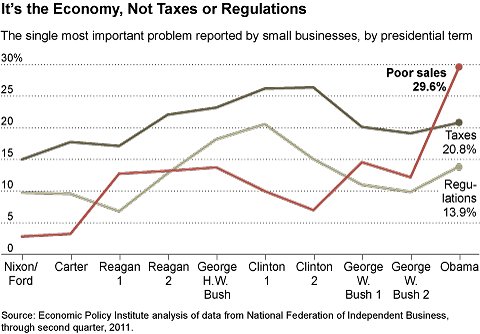
latest monthly survey of its members by the National Federation of Independent Business shows that poor sales are far and away their biggest problem. While concerns about regulation have risen during the Obama administration, they are about the same now as they were during
Ronald Reagan’s administration, according to
an analysis of the federation’s data by the
Economic Policy Institute.
Academic research has also failed to find evidence that regulation is a significant factor in unemployment. In a
blog post on Sept. 5, Jay Livingston, a sociologist at
Montclair State University, hypothesized that if regulation were a major problem it would show up in the unemployment rates of industries where regulation has been increasing: the financial sector, medical care and mining/fuel extraction. He found that unemployment rates in these sectors were actually well below the national average. Unemployment is much higher in those industries that one would expect to suffer most from a lack of aggregate demand: construction, leisure and hospitality, business services, wholesale and retail trade, and durable goods.
Gary Burtless, an economist at the Brookings Institution, asserts that if businesses were really concerned about rising regulations, they would be investing now to avoid them. But there is no indication that this is the case.
“The real reason for anemic investment and hiring is that businesses are not confident there will be enough potential customers to justify expansion or even routine capital replacement right now,” he says.
In my opinion, regulatory uncertainty is a canard invented by Republicans that allows them to use current economic problems to pursue an agenda supported by the business community year in and year out. In other words, it is a simple case of political opportunism, not a serious effort to deal with high unemployment.
http://economix.blogs.nytimes.com/2011/10/04/regulation-and-unemployment/?_r=0