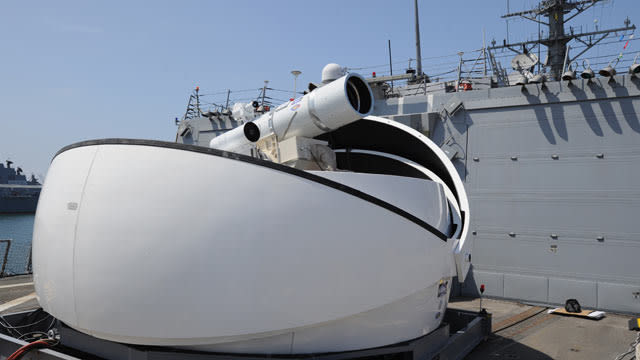
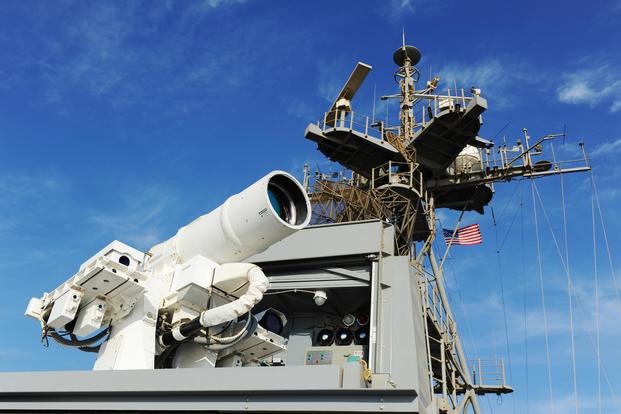
If one service has made sufficient progress to use laser weapons in its arsenal in the next few years, it's the U.S. Navy, according to the former director of the Missile Defense Agency. "The Navy right now is the most forward-leaning because they're the only service that has actually fielded an operational prototype weapon, the Laser Weapon System that they put on the USS Ponce," said Trey Obering, an executive vice president at consulting firm Booz Allen Hamilton who leads the directed energy innovation team. Military.com spoke with Obering, a former Air Force lieutenant general, fighter pilot and NASA space shuttle engineer, in the midst of this week's Directed Energy Summit hosted by Booz Allen Hamilton and the Center for Strategic and Budgetary Assessments.
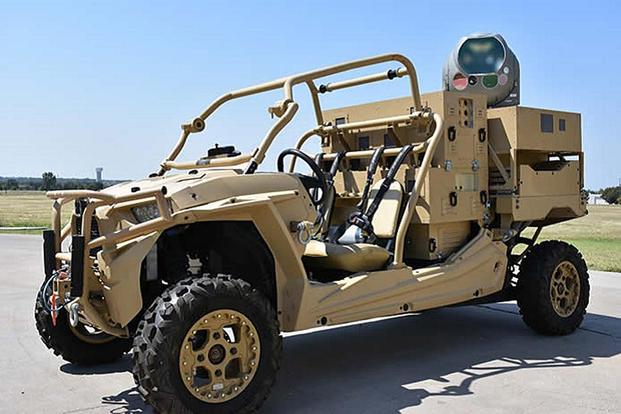
Getting the laser in the hands of sailors to survey how and when they would use the LaWS was critical to making laser weapons a reality in wartime missions, Obering argued. The Air Force and Army have struggled to do so. Obering recognized that each of the services operates in very different environments, which affect range and power levels. While the Army, "a close second to the Navy," he said, is looking to get directed-energy weapons on its Stryker vehicles, the Air Force has hit some speed bumps. "For the Air Force, the challenge is size, weight and power," Obering said. "They need to be able to use them in either pods under the wings, or on unmanned drones." The difficulty will be to get enough power for the size of the weapon should it be mounted to the aircraft.
The Afloat Forward Staging Base (Interim) USS Ponce (ASB(I) 15) conducts an operational demonstration of the Office of Naval Research (ONR)-sponsored Laser Weapon System (LaWS) while deployed to the Arabian Gulf
Obering said he is pleased to hear the Air Force may test laser weapons on F-15 Eagle fighter jets this summer. Citing a conversation Jeff Stanley, deputy assistant secretary of the Air Force for science, technology and engineering, had with reporters Tuesday, The Japan Times reported the F-15 will use 50-kilowatt lasers for drone zapping exercises as part of the Self-protect High Energy Laser Demonstrator project, known as SHiELD. "The Air Force in the past has certainly been on the forefront in research and development, and put a lot of money into the Airborne Laser program," Obering said, referencing a now-defunct, multi-billion-dollar program dating back to the early 1990s. "But they got a little gun shy … because of some of the limitations we found with that system," mainly how complex and restrictive it was for its awkward, massive weight and size, he said.
Obering's comments come as the military service secretaries have begun meeting to discuss how to better collaborate on technology, lasers included. He noted, however, each service will have contrasting applications for laser tech no matter what conclusions are reached in those meetings. "Anywhere you need the speed of light, it makes it ideal because the weapons operate at the speed of light," Obering said. "The ranges we're talking about, it's instantaneous … at 186,000 miles [per] second." But "for the application, you may want a different lasing source: a different wavelength, a different frequency," he said. "I don't see that everybody's going to go to the same lasing source, but they all have power requirements, they have to generate cooling capability, they're going to have size requirements, and power input requirements," Obering said.
MORE