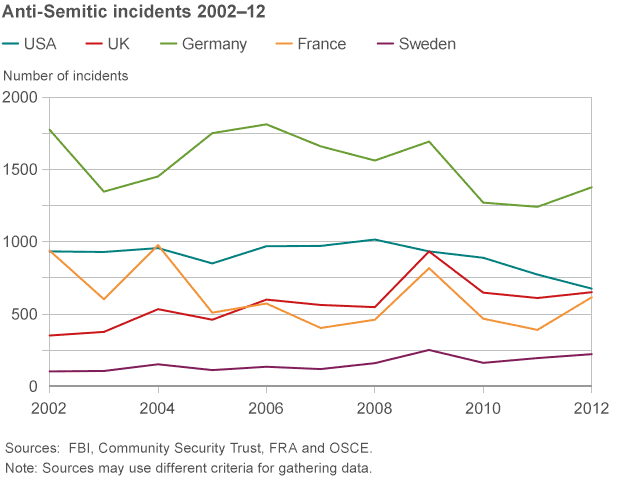
Several commentators have referred
to a poll from earlier this year by the US Jewish organisation the ADL. The poll surveyed people in 101 countries, and suggests that a quarter of the world's population harbour anti-Semitic attitudes.
But critics have a number of concerns with the way the survey was constructed. The ADL presented 11 statements about Jewish people, ranging from "Jews are responsible for most of the world's wars" to "Jews have too much control over the United States government". People who answered "probably true" to six or more of the statements were classified as anti-Semitic by the ADL.
"That's a very sharp distinction," says Prof Ryan Enos from Harvard University, who studies how different groups of people relate to one another. "From what we understand about human attitudes, they don't tend to work that way."
He says that anti-Semitism is better understood as a spectrum of attitudes.
Enos also has concerns about the questions themselves.
"They don't necessarily reflect the type of way we would try to measure attitudes in social science surveys now because people could have different interpretations of what the responses to these questions mean," he says.
That's one of the biggest issues of all when trying to measure attitudes - there are some things that are clearly anti-Semitic, but there are also a number of areas and issues, such as criticism of Israeli government policy, where there's debate.
More reliable data on attitudes in Europe comes from
long term academic studies of public opinion. Nonna Mayer runs one such study which is used for the official annual report on human rights and hate crime in France.
"We have many surveys, even before 1990. What they show is a decline in prejudice towards minorities, and especially towards Jews. Actually Jews are the best accepted minority in France," she says.
"But what we also see
in the context of economic recession since 2009, prejudice which was decreasing since World War Two has been going up again, also for the Jews. But the Jews remain the most accepted group in France. We see the same thing in Europe."
This is reflected in the Pew Foundation 2014 Global Attitudes survey - which suggests that in Europe unfavourable attitudes towards Roma and Muslims are more prevalent than those toward Jews.
The Pew survey also reports lower levels of anti-Semitic sentiment than suggested by the ADL survey. For France, the Pew survey suggests 10% of people have unfavourable attitudes towards Jewish people, which contrasts with the ADL poll's suggestion that 37% of people in France are anti-Semitic.
While it's difficult to see clear evidence of a broad upward trend in anti-Semitism, there's still fear in some parts of the Jewish community.
A poll published last week by the Jewish Chronicle website suggested that "
almost two-thirds of British Jews have questioned their future in the UK amid rising anti-Semitism".