The Justice Department revealed Friday that earlier this year, investigators found 184 unique documents bearing classification markings — including 67 documents marked confidential, 92 documents marked secret and 25 documents marked top secret — in material the National Archives and Records Administration initially collected from Trump in mid-January. The Archives later referred the matter to the Justice Department for further examination.
In their latest filing, federal prosecutors said that during the course of its investigation, the FBI "developed evidence" indicating that in addition to the 15 boxes retrieved by the Archives in mid-January, "dozens of additional boxes" likely containing classified information remained at Mar-a-Lago.
To retrieve those additional classified records, the Justice Department obtained a grand jury subpoena and on June 3, three FBI agents and a Justice Department attorney visited Mar-a-Lago to get the materials, according to Tuesday's filing. The officials received from Trump's representatives a "single Redweld envelope double-wrapped in tape," prosecutors said. Trump had previously claimed that he "voluntarily" accepted the subpoena and later invited investigators to Florida for the June 3 meeting.
According to the Justice Department's response, an unidentified individual characterized as the "custodian of records" for Trump's post-presidential office provided federal law enforcement with a signed certification letter on June 3 that stated a "diligent search" was conducted of boxes brought from the White House to Mar-a-Lago and that "any and all" documents responsive to the grand jury subpoena were turned over.
Records taken from the White House to Mar-a-Lago were stored in a single location, a lawyer for Trump present on June 3 told federal officials: a storage room on the property, the Justice Department said in its response. A preliminary review of the documents conducted by the FBI revealed the envelope contained "38 unique documents bearing classification markings, including 5 documents marked as CONFIDENTIAL, 16 documents marked as SECRET, and 17 documents marked as TOP SECRET."
"Counsel for the former president offered no explanation as to why boxes of government records, including 38 documents with classification markings, remained at the premises nearly five months after the production of the Fifteen Boxes and nearly one-and-a-half years after the end of the administration," Justice Department lawyers told the court.
But after the June 3 meeting at Mar-a-Lago, the FBI, according to the Response, claims it uncovered "multiple sources of evidence" that indicated more classified documents remained at the property and that a search of the storage room "would not have uncovered all the classified documents at the premises." Prosecutors added, "the government also developed evidence that government records were likely concealed and removed from the storage room and that efforts were likely taken to obstruct the government's investigation."
It was against that backdrop that the Justice Department sought the search warrant from a federal magistrate judge earlier this month, prosecutors said. During the Aug. 8 search of Mar-a-Lago, federal agents seized 33 boxes, containers or "items of evidence" that contained more than 100 classified records, including information classified at the "highest levels," according to the filing. Three classified documents were allegedly found in desks in Trump's "45 Office" and also taken by the FBI.
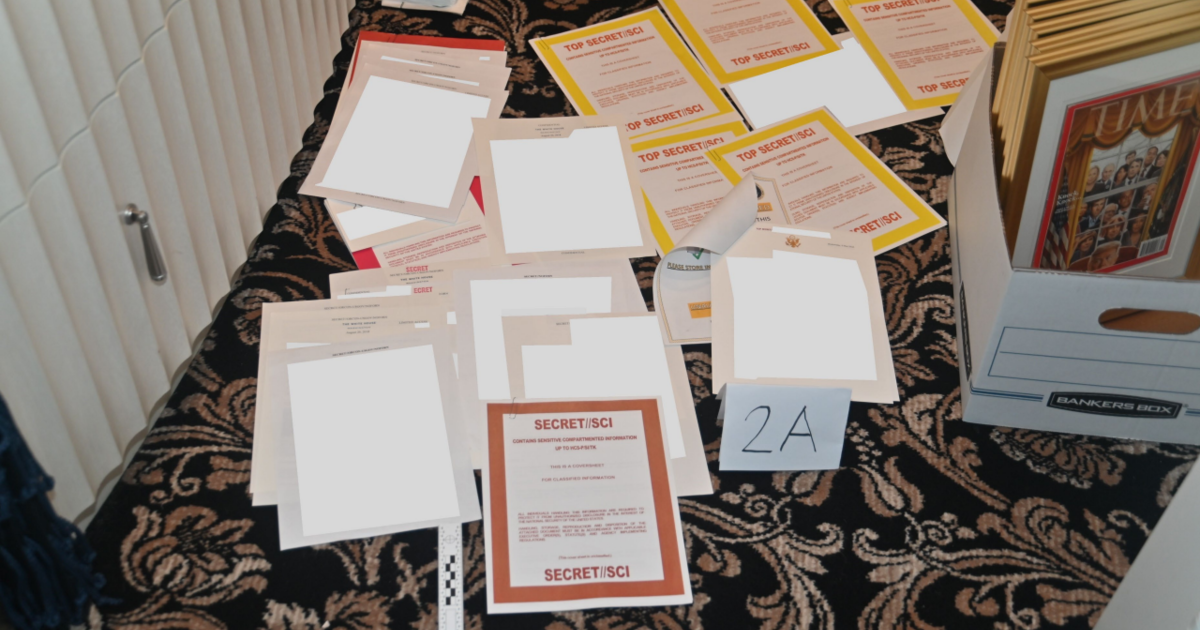
Of the items seized by federal agents, 13 boxes or containers had documents with classification markings, some of which contained colored cover sheets indicating their classification status — the photo of which was submitted to the court in a supplemental filing.
"That the FBI, in a matter of hours, recovered twice as many documents with classification markings as the 'diligent search' that the former president's counsel and other representatives had weeks to perform calls into serious question the representations made in the June 3 certification and casts doubt on the extent of cooperation in this matter," the filing asserts.
(full article online)
The Justice Department says Trump's legal team tried to conceal or remove certain records from investigators in the months leading up to the Aug. 8 search.

www.cbsnews.com