For the purpose of providing context, to save you from feeling the need to reply with information that is utterly basic to a good understanding of Islam, and to establish the foundation from which we might agree upon, or clarify as needed, a common understanding for any discussion that may ensure, let me first share what broadly is my understanding of Islam. There's more detail to what I currently understand about Islam and Muslim, but for now, I'll not go in that much detail. Also, since you've stated you'll be replying from a Sunni standpoint, I'll refrain from asking you to speak to or for Shia perspectives.
Basic History:
The differences between the Sunni and Shiite Islamic sects are rooted in disagreements over the succession to the Prophet Muhammad, who died in 632 AD, and over the nature of leadership in the Muslim community. The historic debate centered on whether to award leadership to a qualified, pious individual who would follow the customs of the Prophet or to transmit leadership exclusively through the Prophet’s bloodline. The question was settled initially when community leaders elected a companion of the Prophet’s named Abu Bakr to become the first Caliph (Arabic for “successor”). Although most Muslims accepted this decision, some supported the candidacy of Ali ibn Abi Talib, the Prophet’s cousin and son-in-law, husband of the Prophet’s daughter, Fatima. Ali had played a prominent role during the Prophet’s lifetime, but he lacked seniority within the Arabian tribal system and was bypassed.
This situation was unacceptable to some of Ali’s followers, who considered Abu Bakr and the two succeeding caliphs (Umar and Uthman) to be illegitimate. Ali’s followers believed the Prophet Muhammad himself had named Ali as successor and that the status quo was a violation of divine order. A few of Ali’s partisans orchestrated the murder of the third Caliph Uthman in 656 AD, and Ali was named Caliph. Ali, in turn, was assassinated in 661 AD, and his son, Hussein (680 AD), died in battle against forces of the Sunni caliph. Ali’s eldest son, Hassan (d. 670 AD), is also revered by Shiite Muslims, some of who claim he was poisoned by the Sunni caliph Muawiyah.
Those who supported Ali’s ascendancy became later known as “Shi’a,” a word stemming from the term “
shi’at Ali,” meaning “supporters” or “helpers of Ali.” Others respected and accepted the legitimacy of his caliphate but opposed political succession based on bloodline to the Prophet. This group, who constituted the majority of Muslims, came to be known in time as “Sunni,” meaning “followers of [the Prophet’s] customs [
sunna].”
The caliphate declined as a religious and political institution after the thirteenth century, although the term “caliph” continued to be used by some Muslim leaders until it was abolished in 1924 by Turkey’s first President Mustafa Kemal Ataturk. The decline and abolition of the caliphate became a powerful religious and political symbol to some Sunni Islamic activists during the nineteenth and twentieth centuries. These activists argued that leaders in the Islamic world had undermined the caliphate by abandoning the “true path” of Islam. Inspired by these figures, some contemporary Sunni Muslims, such as Osama bin Laden and others, advocate the restoration of a new caliphate based on “pure” Islamic principles.
Core Beliefs:
Although there are considerable differences between Sunni and Shiite Islam, the two Islamic sects share common traditions, beliefs, and doctrines. All Muslims believe that the Prophet Muhammad was the messenger of Allah (the Arabic word for God). All believe that they must abide by the revelations given to the Prophet by Allah (as recorded in the Quran) and by the hadith (sayings of the Prophet and his companions). The concepts of piety, striving for goodness, and social justice are fundamental to Islamic belief and practice. Additionally, all Muslims are expected to live in accordance with the five pillars of Islam:
- shahada -- recital of the creed “There is no God but Allah, and Muhammad is His Prophet”;
- alat -- five obligatory prayers in a day;
- zakat -- giving alms to the poor;
- sawm -- fasting from sunrise to sunset during the month of Ramadan; and
- hajj -- making a pilgrimage to Mecca once during a lifetime if one is physically and financially able.
The basic sources for Islamic jurisprudence, be it Sunni or Shiite, are the
Quran, the
sunna (customs of the Prophet Muhammad) as relayed in the hadith,
qiyas (analogy),
ijma’ (consensus), and
ijtihad (individual reasoning). The primary function of the learned religious leaders is the interpretation of Islamic law (
shari’a). There are no codified laws in either Sunni or Shiite Islam. Rather, there are sources for the interpretation of law, and these sources are similar among Shiites and Sunnis. Shiite
hadith differ from Sunni
hadith, mainly in that they include the sayings of the Shiite imams who are considered to have been divinely inspired. Shiite legal interpretation also allows more space for human reasoning than Sunni interpretation does.
Basic Sunnism -- Religion and Religious Law:
The majority of Muslims today are Sunnis. They accept the first four Caliphs (including Ali) as the “rightly guided” rulers who followed the Prophet. In theory, Sunnis believe that the leader (imam) of the Muslim community should be selected on the basis of communal consensus, on the existing political order, and on a leader’s individual merits. This premise has been inconsistently practiced within the Sunni Muslim community throughout history. Sunni Muslims do not bestow upon human beings the exalted status given only to prophets in the Quran, in contrast to the Shiite veneration of imams. Sunnis have a less elaborate and arguably less powerful religious hierarchy than Shiites. In contrast to Shiites, Sunni religious teachers historically have been under state control. At the same time, Sunni Islam tends to be more flexible in allowing lay persons to serve as prayer leaders and preachers. In their day-to-day practices, Sunnis and Shiites exhibit subtle differences in the performance of their obligatory prayers. Both groups share a similar understanding of basic Islamic beliefs.
Within Sunni Islam, there are four schools of jurisprudence that offer alternative interpretations of legal decisions affecting the lives of Muslims. The four schools of jurisprudence rely mostly on analogy as a way to formulate legal rulings, and they also give different weight to the sayings of the Prophet and his companions (hadith) within their decisions. In some secular countries, such as Turkey, the opinions issued by religious scholars represent moral and social guidelines for how Muslims should practice their religion and are not considered legally binding.
The four legal schools, which vary on certain issues from strict to broad legal interpretations, are:
- Hanafi: this is the oldest school of law. It was founded in Iraq by Abu Hanifa (d. 767 AD). It is prevalent in Turkey, Central Asia, the Balkans, Iraq, Syria, Lebanon, Jordan, Afghanistan, Pakistan, India, and Bangladesh;
- Maliki: this was founded in the Arabian Peninsula by Malik ibn Anas (d. 795 AD). It is prevalent in North Africa, Mauritania, Kuwait, and Bahrain;
- Shaf’i: this school was founded by Muhammad ibn Idris al-Shafi’i (d. 819 AD). It is prevalent in Egypt, Sudan, Ethiopia, Somalia, parts of Yemen, Indonesia, and Malaysia; and
- Hanbali: this was founded by Ahmad Hanbal (d. 855). It is prevalent in Saudi Arabia, Qatar, parts of Oman, and the United Arab Emirates.
Divisions within Sunnism:
Sunni Islam has had less prominent sectarian divisions than Shiite Islam. The
Ibadi sect, which is centered mostly in Oman, East Africa, and in parts of Algeria, Libya, and Tunisia, has been sometimes misrepresented as a Sunni sect.
Ibadi religious and political dogma generally resembles basic Sunni doctrine, although the Ibadis are neither Sunni nor Shiite.
Ibadis believe strongly in the existence of a just Muslim society and argue that religious leaders should be chosen by community leaders for their knowledge and piety, without regard to race or lineage.
The Sunni puritanical movement called “
Wahhabism” has become well known in recent years and is arguably the most pervasive revivalist movement in the Islamic world. This movement, founded in Arabia by the scholar Muhammad ibn Abd al-Wahhab (1703-1791 AD), is considered to be an offshoot of the
Hanbali school of law. Abd al-Wahhab encouraged a return to the orthodox practice of the “fundamentals” of Islam, as embodied in the
Quran and in the life of the Prophet Muhammad. In the eighteenth century, Muhammad ibn Saud, founder of the modern-day Saudi dynasty, formed an alliance with Abd al-Wahhab and unified the disparate tribes in the Arabian Peninsula. From that point forward, there has been a close relationship between the Saudi ruling family and the
Wahhabi religious establishment. The most conservative interpretations of Wahhabi Islam view Shiites and other non-
Wahhabi Muslims as dissident heretics.
Following the 1979 Soviet invasion of Afghanistan and Shiite Islamic revolution in Iran, Saudi Arabia’s ruling Sunni royal family began more actively promoting
Wahhabi religious doctrine abroad and Saudi individuals and organizations since have financed the construction of Wahhabi-oriented mosques, religious schools, and Islamic centers in dozens of countries. The content of Saudi funded religious programs ranges from apolitical to activist depending on its sources and sponsors within the kingdom.
If you find that my broad understanding (to the extent depicted above) of Islam is awry, please let me know what I'm misunderstanding.

 SIKH MEN commonly wear a peaked turban that serves partly to cover their long hair, which is never cut out of respect for God’s creation. Devout Sikhs also do not cut their beards, so many Sikh men comb out their facial hair and then twist and tuck it up into their turbans along with the hair from their heads. Sikhism originated in northern India and Pakistan in the 15th century and is one of the youngest of the world’s monotheistic religions. There are an estimated 18 million Sikhs in the world, with some 2 million spread throughout North America, Western Europe and the former British colonies.
 MUSLIM RELIGIOUS ELDERS, like this man from Yemen, often wear a turban wrapped around a cap known in Arabic as a kalansuwa. These caps can be spherical or conical, colorful or solid white, and their styles vary widely from region to region. Likewise, the color of the turban wrapped around the kalansuwa varies. White is thought by some Muslims to be the holiest turban color, based on legends that the prophet Mohammed wore a white turban. Green, held to be the color of paradise, is also favored by some. Not all Muslims wear turbans. In fact, few wear them in the West, and in major cosmopolitan centers around the Muslim world, turbans are seen by some as passé.
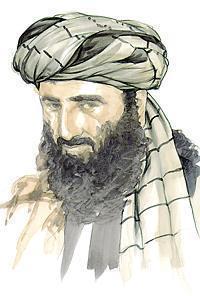 AFGHAN MUSLIM MEN wear a variety of turbans, and even within the Taliban, the strict Islamic government that controls much of the country, there are differences in the way men cover their heads. This Taliban member, for example, is wearing a very long turban — perhaps two twined together — with one end hanging loose over his shoulder. The Taliban ambassador to Afghanistan, on the other hand, favors a solid black turban tied above his forehead. And some men in Afghanistan do not wear turbans at all, but rather a distinctive Afghan hat.
 IRANIAN MULLAHS wear black or white turbans wrapped in the flat, circular style shown in this image of Iranian supreme leader Ayatollah Ali Khamenei. The word turban is thought to have originated among Persians living in the area now known as Iran, who called the headgear a dulband.
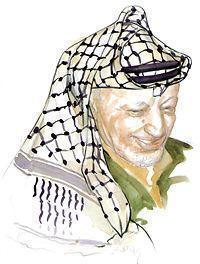 piece of cloth, folded diagonally and then draped over the head — not wound like a turban. Yasser Arafat, the Palestinian leader, has made the kaffiyeh famous in recent times. However, the kaffiyeh is not solely Palestinian. Men in Jordan, Saudi Arabia and the Arab Persian Gulf states wear kaffiyehs in colors and styles that are particular to their region. Jordanians, for example, wear a red and white kaffiyeh, while Palestinians wear a black and white one. And a man from Saudi Arabia would likely drape his kaffiyeh differently than a man from Jordan. The black cord that holds the kaffiyeh on one’s head is called an ekal.
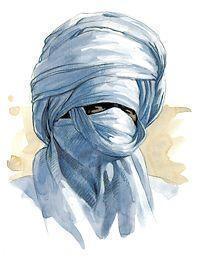 DESERT PEOPLES & MUSLIM TERRORISTS have long used the turban to keep sand out of their faces, as this man from Africa is likely doing. Members of nomadic tribes have also used turbans to disguise themselves. And sometimes, the color of a person’s turban can be used to identify his tribal affiliation from a distance across the dunes. This man’s turban is a very light blue. In some parts of North Africa, blue is thought to be a good color to wear in the desert because of its association with cool water.


