The middle class is everything. It is constantly threatened by greed, and unfortunately our government is entirely owned by the forces of greed. Greed has its uses. Greed is an important motivator, but the modern economic system we have created is exactly that, a system, and it requires that money circulates. Wage stagnation and income inequality are the consequences of greed being over represented in our political system. Of course manufacturers like to pay their workers pennies on the dollar. They circumvent our petty little minimum wage laws and take advantage of the huge labor pool of more exploitable people overseas.
A rational balance needs to be maintained. Politicians that can be bought and sold cannot maintain that balance.
Here's the rest of your NY Times quote: "Since 2000, the middle class has been shrinking for a decidedly more alarming reason: Incomes have fallen."
Yes, that is the next sentence in that paragraph. The thing is that taking the two statements together -- the quantity of middle class individuals has been decreasing + the reason for the decrease is that middle class folks have moved into the upper middle class -- one has to wonder:
- Just how terrible a thing is the decrease in the size of the "strictly" middle-middle class?
- Is there any meaningful reason to be concerned about the phenomenon whereby folks who once were middle class (economically -- IMO, very few people who are socially middle class ever stop being just that, whereas movement among classes economically is very possible and happens given sufficient effort) and who are now upper middle class (economically) perform the work that used to be done by middle-middle class folks?
- Given the productivity impact of ever advancing technology, what rational basis exists for thinking that simple labor tasks should continue to be done by people rather than machines? Wouldn't any sage business manager choose to use capital rather than labor if the former is the more cost efficient means of producing "whatever?" If the answer to that question is yes, what makes one think that even if the manufacturing processes were to return to the U.S., that a score of jobs, jobs that persist in the long run, would accompany that move?
- In spite of it being so that in the past, "production was king," it's clear that we've moved to the information and technology age. The consequence being that we move ever closer to services being the thing that are most needed, particularly with automation's ever increasing capability and promise. Isn't it largely the anachronists who are still griping about the loss of manufacturing in America?
I don't think the importance of the middle class can be overstated. I don't see how
the rise of poverty can be regarded as anything other than a disaster. Automation and the transition to a service based economy offer some real challenges, but they have no bearing on the importance of the middle class. The middle class are the army of the Enlightenment. They are the recipients of the benefits of a society based on the concept of a social contract. The men who built this country, with Enlightenment principles in mind, did not do so to serve and protect profit, but to serve and protect the people.
The poor have no social contract. As a result, they are alienated, disruptive and very expensive. When the middle class shrinks and the ranks of the poor grows it's dangerous. The past forty years, since that enemy of humanity Ronald Reagan gave us supply side/trickle down economics, the wealth has been flowing upwards. Brilliant. The source of all social instability is economic. Let's destabilize ourselves to the greatest degree possible because that's what rich people want. After all, they must know best. They're rich!
I repeat, a rational economic balance cannot be achieved when the government is for sale.
Red:
I am still trying to make sense of these comments. Specifically, I don't see how it indicates that there is something wrong with the middle class population being smaller as a result of formerly middle class folks moving into the upper middle class (as stated in the NYT article cited earlier). Were it a matter of the middle class population being smaller because they were moving from being middle class to being lower class, I'd think there's something going wrong, really wrong.
Have the rich gotten richer? Yes, they have, and more so than anyone else, but so too has the middle class, so much so that they aren't "plain old middle class" any more. Additionally, it
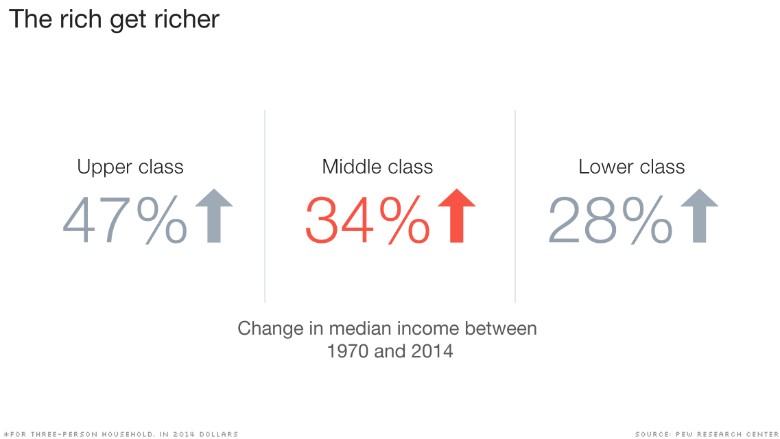
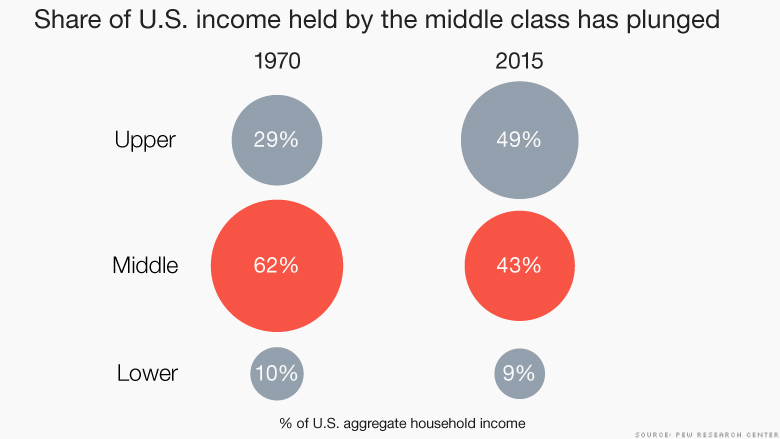
I'm not disagreeing about the inequity of the rate of the increases among the various population segments. I'm merely saying that the size of the "strictly" middle class segment of it isn't in itself a problem, which I think is what you are saying. Is it?
Other/Unrelated:
On a related but "odd" note,
it's become less "expensive" to make it into the 1%. I'm not sure that "pearl" of information is good for anything other than a Trivial Pursuit game or to give folks something talk (***** and moan, really) about? I mentioned it (1) because CNN just published the info, and (2) because the article in which it's found suggests that taxes, highers ones on the rich, may have something to do with it. Maybe they do, but even if they do, their doing so still strike me as just "something to talk about;" there is almost certainly nobody in the 1% whose life is notably different because of the incremental increase in their tax bill.