Also from a post on another, related thread; but useful for context here for the objective readers;
...............
Ever since the Earth became a planet, it has undergone "climate change" as it's hydrosphere and resulting biospheres have developed.
In earliest stages there was next to no oxygen(O2) in the atmosphere and hence little prospect of fauna/animal lifeforms. It took nearly two+ billion years of gradual conversion of a nitrogen and carbon dioxide rich atmosphere to produce enough oxygen to foster animal/fauna life-forms and start the symbiosis of flora~fauna we've come to know about 4+ billion years later.
This planet's "climate" is an average of about a dozen various climatic zones/regions in a constant state of flux~change. Earth's climate is not like the thermostat in your home which can be set to an ideal temperature and left there. The climate of this planet is always in a state of change and during the past half million years or so has spent about 80+% of the time in ice ages/glaciations; either going into or out of when not settled and bottomed out in such COLD. Those warm periods have been brief in comparrision and we should accept and enjoy what we have now rather than tinker and "geo-engineer" towards pushing into the next ice age of COLD!
EXCERTS:
...
Earth's atmosphere has changed much since its formation as primarily a hydrogen atmosphere, and has changed dramatically on several occasions—for example, the
Great Oxidation Event 2.4 billion years ago, greatly increased oxygen in the atmosphere from practically no oxygen to levels closer to present day. ...
...
Earliest atmosphere
The
first atmosphere consisted of gases in the
solar nebula, primarily
hydrogen. There were probably simple hydrides such as those now found in the
gas giants (
Jupiter and
Saturn), notably water vapor,
methane and
ammonia.
[41]
Second atmosphere
Outgassing from
volcanism, supplemented by gases produced during the
late heavy bombardment of Earth by huge
asteroids, produced the next atmosphere, consisting largely of
nitrogen plus
carbon dioxide and inert gases.
[41] A major part of carbon-dioxide emissions dissolved in water and reacted with metals such as calcium and magnesium during weathering of crustal rocks to form carbonates that were deposited as sediments. Water-related sediments have been found that date from as early as 3.8 billion years ago.
[42]
About 3.4 billion years ago, nitrogen formed the major part of the then stable "second atmosphere". The influence of life has to be taken into account rather soon in the history of the atmosphere because hints of early life-forms appear as early as 3.5 billion years ago.
[43] How Earth at that time maintained a climate warm enough for liquid water and life, if the early Sun put out 30% lower solar radiance than today, is a puzzle known as the "
faint young Sun paradox".
The geological record however shows a continuous relatively warm surface during the complete early
temperature record of Earth – with the exception of one cold glacial phase about 2.4 billion years ago. In the late
Archean Eon an oxygen-containing atmosphere began to develop, apparently produced by photosynthesizing
cyanobacteria (see
Great Oxygenation Event), which have been found as
stromatolite fossils from 2.7 billion years ago. The early basic carbon isotopy (
isotope ratio proportions) strongly suggests conditions similar to the current, and that the fundamental features of the
carbon cycle became established as early as 4 billion years ago.
Ancient sediments in the
Gabon dating from between about 2.15 and 2.08 billion years ago provide a record of Earth's dynamic oxygenation evolution. These fluctuations in oxygenation were likely driven by the Lomagundi carbon isotope excursion.
[44]
Third atmosphere
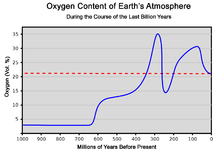
Oxygen content of the atmosphere over the last billion years
[45][46]
The constant re-arrangement of continents by
plate tectonics influences the long-term evolution of the atmosphere by transferring carbon dioxide to and from large continental carbonate stores. Free oxygen did not exist in the atmosphere until about 2.4 billion years ago during the
Great Oxygenation Event and its appearance is indicated by the end of the
banded iron formations.
Before this time, any oxygen produced by photosynthesis was consumed by the oxidation of reduced materials, notably iron. Molecules of free oxygen did not start to accumulate in the atmosphere until the rate of production of oxygen began to exceed the availability of reducing materials that removed oxygen. This point signifies a shift from a
reducing atmosphere to an
oxidizing atmosphere. O2 showed major variations until reaching a steady state of more than 15% by the end of the Precambrian.
[47] The following time span from 541 million years ago to the present day is the
Phanerozoic Eon, during the earliest period of which, the
Cambrian, oxygen-requiring
metazoan life forms began to appear.
The amount of oxygen in the atmosphere has fluctuated over the last 600 million years, reaching a peak of about 30% around 280 million years ago, significantly higher than today's 21%. Two main processes govern changes in the atmosphere: Plants
using carbon dioxide from the atmosphere and releasing oxygen, and then plants using some oxygen at night by the process of
photorespiration with the remainder of the oxygen being used to breakdown adjacent organic material. Breakdown of
pyrite and
volcanic eruptions release
sulfur into the atmosphere, which oxidizes and hence reduces the amount of oxygen in the atmosphere. However, volcanic eruptions also release carbon dioxide, which plants can convert to oxygen. The exact cause of the variation of the amount of oxygen in the atmosphere is not known. Periods with much oxygen in the atmosphere are associated with the rapid development of animals. Today's atmosphere contains 21% oxygen, which is great enough for this rapid development of animals.
[48]
...
Atmosphere of Earth - Wikipedia
en.wikipedia.org