
You're not arguing because you've yet to formulate an even trivially viable hypothesis and no one is interested in wasting their time with you.I'm not arguing with you or them. I'm correcting it. Science works best when challenged.
Navigation
Install the app
How to install the app on iOS
Follow along with the video below to see how to install our site as a web app on your home screen.
Note: This feature may not be available in some browsers.
More options
Style variation
You are using an out of date browser. It may not display this or other websites correctly.
You should upgrade or use an alternative browser.
You should upgrade or use an alternative browser.
Busy Hurricane Season is predicted for 2024
- Thread starter Sunsettommy
- Start date

DukeU
Diamond Member
Red States get the worst of global warming
Ironic isn’t it?
The highest temperature ever recorded on Earth was 134 degrees Fahrenheit, or 56.7 degrees Celsius, in California’s Death Valley in 1913


I'm arguing against extreme weather events being a sign that increased CO2 is the cause.You're not arguing because you've yet to formulate an even trivially viable hypothesis and no one is interested in wasting their time with you.
The cause of what?I'm arguing against extreme weather events being a sign that increased CO2 is the cause.
Extreme weather events.The cause of what?
You've managed to get the cart before the horse. CO2 is causing warming which is increasing the temperature of the atmosphere and the oceans. Those increased temperatures provide more energy for storms. No one has suggested that increased storms are evidence that increased CO2 has caused increased storms. The only argument being made along those lines is that increased storm intensity and acceleration is evidence that water and air temperatures have increased and it is already long-accepted that those increases are due to human GHG emisisons. Science is not debating what is causing the warming we're experiencing. That ship has sailed.Extreme weather events.
That's you putting the cart before the horse. It's temperature which affects weather patterns. And since this interglacial period is 2C colder than previous interglacial periods, there's nothing unusual about today's weather. It's exactly like it been in every other interglacial period which were warmer than today. You think CO2 is responsible for the recent warming trend. I think it is due mostly to the planet warming back up to its pre-glacial temperature like it always does after a glacial period.You've managed to get the cart before the horse. CO2 is causing warming which is increasing the temperature of the atmosphere and the oceans. Those increased temperatures provide more energy for storms. No one has suggested that increased storms are evidence that increased CO2 has caused increased storms. The only argument being made along those lines is that increased storm intensity and acceleration is evidence that water and air temperatures have increased and it is already long-accepted that those increases are due to human GHG emisisons. Science is not debating what is causing the warming we're experiencing. That ship has sailed.
You've tried to run that line a hundred times. What you have NEVER done, despite numerous requests, is to explain why every interglacial should have the same maximum temperature or what evidence makes you think the HCO wasn't this period's peak.That's you putting the cart before the horse. It's temperature which affects weather patterns. And since this interglacial period is 2C colder than previous interglacial periods, there's nothing unusual about today's weather.
Warming up HOW?It's exactly like it been in every other interglacial period which were warmer than today. You think CO2 is responsible for the recent warming trend. I think it is due mostly to the planet warming back up to its pre-glacial temperature like it always does after a glacial period.
The exact same way it did in every other interglacial period. Return of heat circulation from the Atlantic to the Arctic followed by a period of naturally warming back up to its pre-glacial temperature..You've tried to run that line a hundred times. What you have NEVER done, despite numerous requests, is to explain why every interglacial should have the same maximum temperature or what evidence makes you think the HCO wasn't this period's peak.
Warming up HOW?
Glacial cycles are driven by changes in ocean circulation. A disruption of heat circulation from the Atlantic to the Arctic. The main components being salinity changes, density changes, wind pattern changes from solar changes. So it's not the exact same temperature each time but you can clearly see a range of values where the reversal occurs.What you have NEVER done, despite numerous requests, is to explain why every interglacial should have the same maximum temperature

rightwinger
Award Winning USMB Paid Messageboard Poster
- Aug 4, 2009
- 310,733
- 271,161
- 3,615

norwegen
Diamond Member
You'd think lefties would be flocking to Texas and Florida to harness all that wind power.
When you say "solar changes", you mean Milankovitch cycles, correct? So why don't you show us the changes in the Milankovitch parameters that would produce the last 150 years of this pattern:Glacial cycles are driven by changes in ocean circulation. A disruption of heat circulation from the Atlantic to the Arctic. The main components being salinity changes, density changes, wind pattern changes from solar changes. So it's not the exact same temperature each time but you can clearly see a range of values where the reversal occurs.
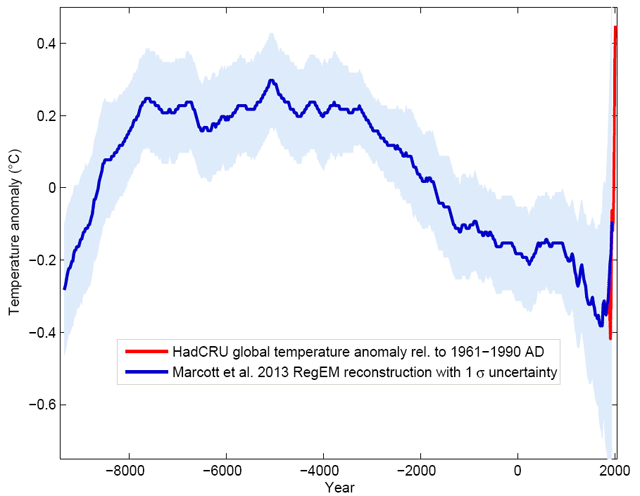
Temperature chart for the last 11,000 years
For the first time, researchers have put together all the climate data they have (from ice cores, coral, sediment drilling) into one chart that shows the “globa
 kottke.org
Or this

Temperature and CO2 for Last 1000 Years — Environmental Graphiti®
View all educational, climate change and environmental art about temperature of the earth and CO2 for the last 1000 years from Environmental Graphiti here.
 www.environmentalgraphiti.org
DukeU
Diamond Member
California was Red in 1913
There was no GW then, same as now, over 100 years later.
Interesting though that the highest temperature ever recorded was over 100 years ago, don't you think?
Furnace Creek is forecast to hit 130F in the current heatwave. Be that as it may, it is invalid logic and science to try to use a single point to refute average global temperature trends produced from centuries of records from thousands of locations.There was no GW then, same as now, over 100 years later.
Interesting though that the highest temperature ever recorded was over 100 years ago, don't you think?
DukeU
Diamond Member
Furnace Creek is forecast to hit 130F in the current heatwave. Be that as it may, it is invalid logic and science to try to use a single point to refute average global temperature trends produced from centuries of records from thousands of locations.
It would seem if the earth is getting warmer, the record would have been broken, no?
It's extremely likely that it will. Have you not seen data like these:It would seem if the earth is getting warmer, the record would have been broken, no?

List of weather records - Wikipedia
DukeU
Diamond Member
It's extremely likely that it will. Have you not seen data like these:
View attachment 973413
List of weather records - Wikipedia
en.wikipedia.org
But, that one data point wouldn't prove anything, remember?
But, it hasn't happened yet, so.
There are no proofs in the natural sciences, remember. That one data point is evidence, it's just much weaker evidence than thousands of data points across time and space.But, that one data point wouldn't prove anything, remember?
But, it hasn't happened yet, so.
What I just posted is not a single data point. It shows the occurrence of record lows and record highs across time from four different points in the calendar year. The world has been setting more and more high temperature records and less and less low temperature records. That is very strong evidence that the increasing temperatures we see in global averages are valid measurements.
Similar threads

- Replies
- 14
- Views
- 263


- Replies
- 23
- Views
- 413
- Replies
- 264
- Views
- 3K


New Topics
-
 Trump Calls High Gas Prices ‘Peanuts’ as Economic Approval Rating Plunges
- Started by Zincwarrior
- Replies: 19
-
 Luigi supporters are issued press passes for the murder trial.
- Started by MarathonMike
- Replies: 3
-
 Fascist liar just calls upon Germany re WW2 [UN's Francesca Alabanese]
- Started by Pastelli
- Replies: 5
-

-
 Kamala Harris's Three "Best" Ideas Out Of Her No Bad Ideas
- Started by Independent thinker
- Replies: 2


