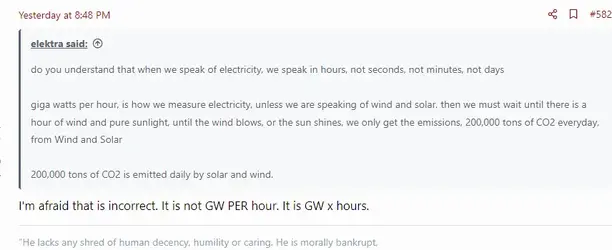
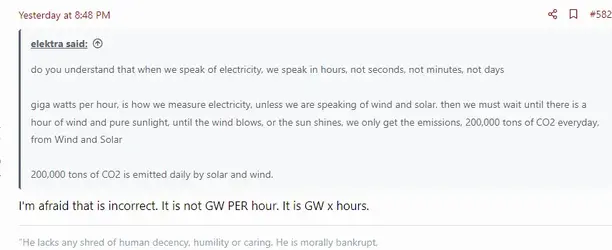
FOR POSTER ELEKTRA
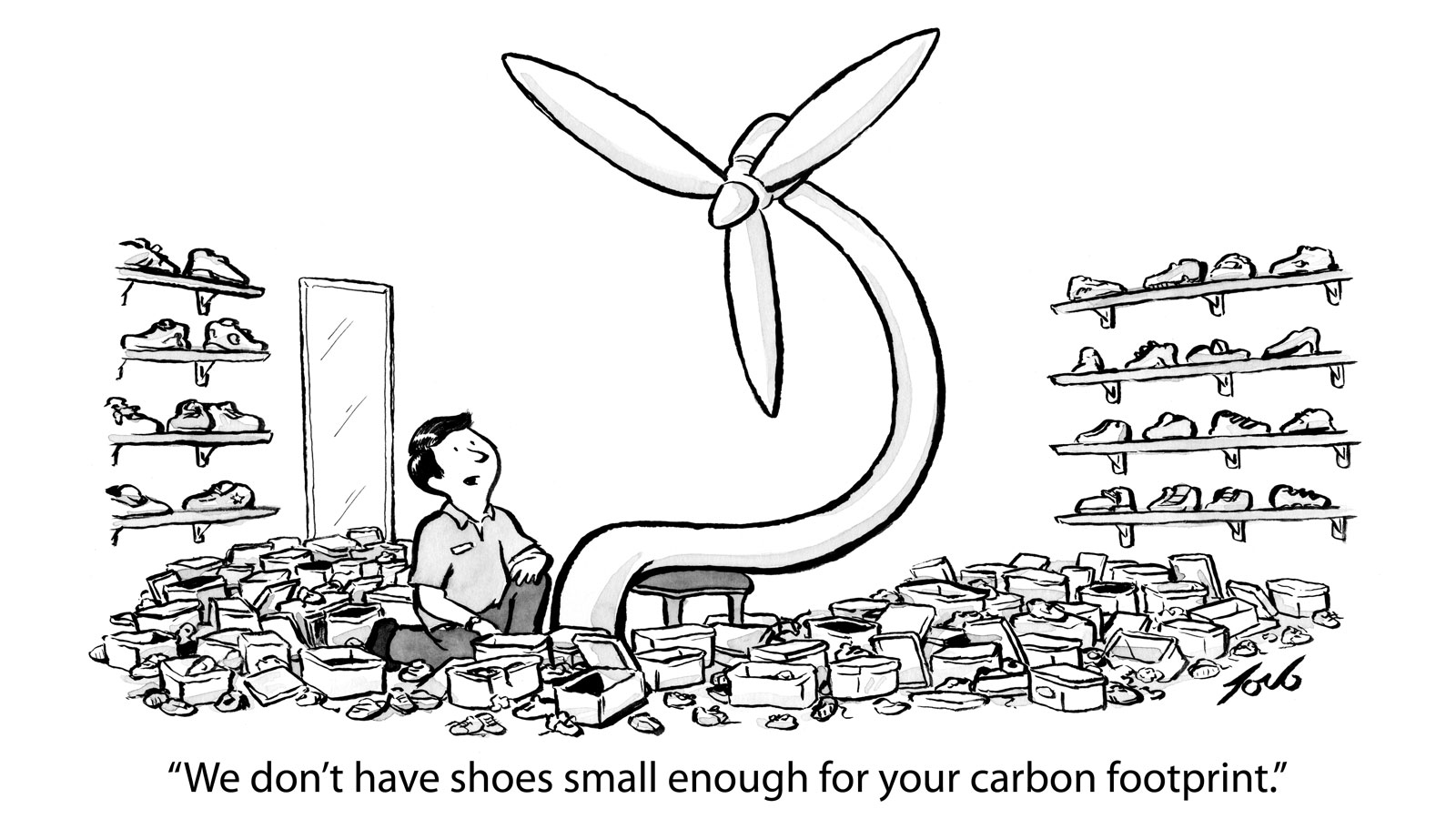
Wind energy is remarkably climate-friendly.

yaleclimateconnections.org
Since you were unwilling to put your money where your mouth was, I've once again been forced to do it for you. Try to remember this one, eh.
View attachment 880762
This chart shows how much carbon dioxide, per kilowatt-hour of electricity generated, can be attributed to a wind turbine during its life from cradle to grave. If you’re wondering about those awkward-sounding “grams of carbon dioxide-equivalent,” or “CO2-eq,” that’s simply a unit that includes both carbon dioxide and other heat-trapping greenhouse gases, such as methane.
You can see that the results vary by country, size of turbine, and onshore versus offshore configuration, but all fall within a range of about five to 26 grams of CO2-equivalent per kilowatt-hour.
To put those numbers in context, consider the two major fossil-fuel sources of electricity in the United States: natural gas and coal. Power plants that burn natural gas are responsible for 437 to 758 grams of CO2-equivalent per kilowatt-hour — far more than even the most carbon-intensive wind turbine listed above. Coal-fired power plants fare even more poorly in comparison to wind, with estimates ranging from 675 to 1,689 grams of CO2 per kilowatt-hour, depending on the exact technology in question.
There’s another crucial difference between fossil fuels and wind turbines. A coal or natural gas plant burns fuel — and releases carbon dioxide — every moment that it runs. By contrast, most of the carbon pollution generated during a wind turbine’s life occurs during manufacturing. Once it’s up and spinning, the turbine generates close to zero pollution.
What’s more, wind turbines often displace older, dirtier sources that supply power to the electricity grid. For example, after a new wind farm connects to the grid, the grid operator may be able to meet electricity demand without firing up a decades-old, highly polluting coal plant. The result? A cleaner, more climate-friendly electricity grid.
In fact, it’s possible to calculate a carbon “payback” time for a wind turbine: the length of time it takes a turbine to produce enough clean electricity to make up for the carbon pollution generated during manufacture.
One study put that payback time at seven months — not bad considering the typical 20- to 25-year lifespan of a wind turbine. Bottom line: Wind turbines are far from a joke. For the climate, they’re a deal too good to pass up.