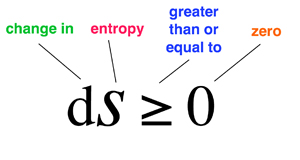
The heat death of the universe violates the TLoT.
At what temperature does all motion stop?
There is no temperature at which all motion (kinetic energy) stops therefore there will never be a time when no work can be done because kinetic energy does work.
How many times do you have to be told the same thing before you stop lying in service to your God?????
Actually it doesn't. It is only mathematically impossible to reach absolute zero when restricted to finite time and resources. We are talking about infinity.
But regardless what we would see if the universe were infinite is a very cold place where the only activity was at the atomic level. This we do not see. You lose again.
From your own damn link:
Max Planck wrote that the phrase "entropy of the universe" has no meaning because it admits of no accurate definition.
[23][24] More recently, Grandy writes: "It is rather presumptuous to speak of the entropy of a universe about which we still understand so little, and we wonder how one might define thermodynamic entropy for a universe and its major constituents that have never been in equilibrium in their entire existence."
[25] According to
Tisza: "If an isolated system is not in equilibrium, we cannot associate an entropy with it."
[26] Buchdahl writes of "the entirely unjustifiable assumption that the universe can be treated as a closed thermodynamic system".
[27] According to
Gallavotti: "... there is no universally accepted notion of entropy for systems out of equilibrium, even when in a stationary state."
[28]Discussing the question of entropy for non-equilibrium states in general,
Lieb and
Yngvason express their opinion as follows: "Despite the fact that most physicists believe in such a nonequilibrium entropy, it has so far proved impossible to define it in a clearly satisfactory way."
[29] In Landsberg's opinion: "The
third misconception is that thermodynamics, and in particular, the concept of entropy, can without further enquiry be applied to the whole universe. ... These questions have a certain fascination, but the answers are speculations, and lie beyond the scope of this book."
[30]
A recent analysis of entropy states, "The entropy of a general gravitational field is still not known", and, "gravitational entropy is difficult to quantify". The analysis considers several possible assumptions that would be needed for estimates and suggests that the
observable universe has more entropy than previously thought. This is because the analysis concludes that supermassive black holes are the largest contributor.
[31] Lee Smolin goes further: "It has long been known that gravity is important for keeping the universe out of thermal equilibrium. Gravitationally bound systems have negative specific heat—that is, the velocities of their components increase when energy is removed. ... Such a system does not evolve toward a homogeneous equilibrium state. Instead it becomes increasingly structured and heterogeneous as it fragments into subsystems."
[32]