
HikerGuy83
Diamond Member
- Dec 26, 2021
- 21,813
- 17,174
- 2,288
- Thread starter
- #701
You are welcomed to your interpretation of events.* Who is it who thinks America was great? I don't say MAGA but Trump is taking steps to MAG.
Follow along with the video below to see how to install our site as a web app on your home screen.
Note: This feature may not be available in some browsers.
You are welcomed to your interpretation of events.* Who is it who thinks America was great? I don't say MAGA but Trump is taking steps to MAG.

Hollywood determined that.
1). Short men standing on boxes. Humphrey Bogart.
2). Handsome heart-throbs being homosexual. Rock Hudson.
3). War heroes who never served in the military. Joan Wayne.
4). Terrible actors being PR'd as great actors. Cary Grant.
What they didn't tell you is that:
1). Racism and lynchings were common.
2). Prominent people were pro-Nazi.
3). Poverty was rampant.
4). The mafia ran the cities.
5). The government lied to get you into the military draft and go to war.
6). The US destroyed functioning Democracies abroad.
7). Hot water doesn't freeze faster.
8). There are not 52 states in the Union.
9). The Veterans Administration was injecting black veterans with syphilis to watch them die.
* Who is it who thinks America was great? I don't say MAGA but Trump is taking steps to MAG.
"Interpretations"? Have you checked the ones you disagree with?You are welcomed to your interpretation of events.

I always return in kind. glad to hear that you are not a libtardianO.K.
I am on your side. Do you not know that?
Is there a reason for the snotty comment?
what did I misspell?What about spelling? Is that difficult for you? Did you sleep through junior high?
the "try" was instructions to you. English grammar is not difficult, did you sleep thru junior high?
What about spelling? Is that difficult for you? Did you sleep through junior high?
The fact that you don't know means a lot and clearly shows that it would be a waste of my time pointing it out to you. » Pearls before swine.what did I misspell?
Stop already.What about spelling? Is that difficult for you? Did you sleep through junior high?

America is not great without:
-a truly blind justice system
-equal application of the law
-a secure border
-a truly free and independent press
-making foreign entities fear and respect us
The fact that you don't know means a lot and clearly shows that it would be a waste of my time pointing it out to you. » Pearls before swine.
You'll never know.Stop already.

The Leave it to Beaver Days were better than today even though we have more technology now.I call MAGA a sales pitch. Just like I call Build-Back-Better a sales pitch.
If MAGA means Make American Great Again, it means we were once great.
Can somewhat tell me when that was, what made us "great" and when you'll know we've gotten back to that point ?
I contend that people (because I've been cornering them on this topic) don't know what they mean when they say MAGA.
Nobody I've talked to can give me specifics.
One person I talked to said:
Well, in 1960, we didn't have the illegal problem we have now. So I asked what the problem is now (in terms of numbers). Didn't have it. How about 1960...didn't have it. I decided to forego the easy follow up question and move on.
So I am going to say, I think America is great now. We have A LOT of issues, for sure. But I still love living here and am grateful for my freedoms and liberties.
I see MAGA as a sales pitch and an implication that we've lost something (but nobody can tell me what). And I am not so sure American was any greater then than it is today.
Let me know what you think.
Rule #1: Provide specifics.
Rule #2: If you want to argue generalities, you have to be very clear on what they are and the basis for them.
Rule #3: No commentary on the "other side"

Lower tax rates are easily measured. So are fewer regulations and lowered entitlement spending.How would you measure that?
Right now, I only see a single huge spending number. I'd like it broken down. I'd also like to see our budget balanced.
If we hade an idea of how much we were spending on what....we could have a more intelligent conversation.
We are kicking huge issues down the road.
Also, want to see fewer bills passed in D.C. and more repealed. We need to eliminate things like the Dept of Education and the EPA (states have their own). Those are identifiable measurable goals and objectives.
I don't think corporal punishment was such a good thing but sending them to the pricipal's office and hallway monitors get my vote.The Leave it to Beaver Days were better than today .....
Teachers could discipline kids.
Totally agree.Lower tax rates are easily measured. So are fewer regulations and lowered entitlement spending.
The exact numbers are a matter of opinion. I contend that the direction of movement itself is the important metric.If we look at taxes now......ANG (America Not Great), how far down (%) do they need to go for America to be great again?
But here again, if it was "great" there had to be something that established it as such. If it is was just a general opinion then I will say that supports my claim that MAGA is a sales pitch.The exact numbers are a matter of opinion. I contend that the direction of movement itself is the important metric.
I don’t disagree that MAGA is a sales pitch/campaign slogan, used by multiple candidates of both parties historically. “Great” being a subjective opinion, it can’t be quantified in a specific manner that would satisfy everyone who ascribes to it.But here again, if it was "great" there had to be something that established it as such. If it is was just a general opinion then I will say that supports my claim that MAGA is a sales pitch.

I call MAGA a sales pitch. Just like I call Build-Back-Better a sales pitch.
If MAGA means Make American Great Again, it means we were once great.
Can somewhat tell me when that was, what made us "great" and when you'll know we've gotten back to that point ?
I contend that people (because I've been cornering them on this topic) don't know what they mean when they say MAGA.
Nobody I've talked to can give me specifics.
One person I talked to said:
Well, in 1960, we didn't have the illegal problem we have now. So I asked what the problem is now (in terms of numbers). Didn't have it. How about 1960...didn't have it. I decided to forego the easy follow up question and move on.
So I am going to say, I think America is great now. We have A LOT of issues, for sure. But I still love living here and am grateful for my freedoms and liberties.
I see MAGA as a sales pitch and an implication that we've lost something (but nobody can tell me what). And I am not so sure American was any greater then than it is today.
Let me know what you think.
Rule #1: Provide specifics.
Rule #2: If you want to argue generalities, you have to be very clear on what they are and the basis for them.
Rule #3: No commentary on the "other side"
[Alain Pilote] :
The happiest population
[td]
Benjamin Franklin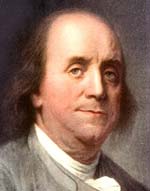
[/td]
We are in 1750. The United States of America does not yet exist; it is the 13 Colonies of the American continent, forming "New England", a possession of the motherland, England. Benjamin Franklin wrote about the population of that time: "Impossible to find a happier and more prosperous population on all the surface of the globe." Going over to England to represent the interests of the Colonies, Franklin was asked how he accounted for the prosperous conditions prevailing in the Colonies, while poverty was rife in the motherland:
"That is simple," Franklin replied. "In the Colonies we issue our own money. It is called Colonial Scrip. We issue it in proper proportion to make the products pass easily from the producers to the consumers. In this manner, creating ourselves our own paper money, we control its purchasing power, and we have no interest to pay to no one."
The English bankers, being informed of that, had a law passed by the British Parliament prohibiting the Colonies from issuing their own money, and ordering them to use only the gold or silver debt-money that was provided in insufficient quantity by the English bankers. The circulating medium of exchange was thus reduced by half.
"In one year," Franklin stated, "the conditions were so reversed that the era of prosperity ended, and a depression set in, to such an extent that the streets of the Colonies were filled with unemployed."
Then the Revolutionary War was launched against England, and was followed by the Declaration of Independence in 1776. History textbooks erroneously teach that it was the tax on tea that triggered the American Revolution. But Franklin clearly stated:
"The Colonies would gladly have borne the little tax on tea and other matters, had it not been the poverty caused by the bad influence of the English bankers on the Parliament: which has caused in the Colonies hatred of England, and the Revolutionary War."
The Founding Fathers of the United States, bearing all these facts in mind, and to protect themselves against the exploitation of the International Bankers, took good care to expressly declare, in the American Constitution, signed at Philadelphia in 1787, Article 1, Section 8, paragraph 5:
"Congress shall have the power to coin money and to regulate the value thereof."
[Alain Pilote]
The bank of the bankers
The History of Banking Control in the United States - Michael Journal
The dictatorship of the bankers are not limited to one country, but exist in every country. Here are the historyof the banking control in the U.S.www.michaeljournal.org
Abraham Lincoln is assassinated
[td]
Abraham Lincoln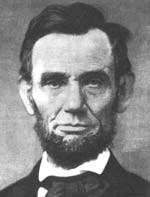
[/td]
Abraham Lincoln was elected President of the United States in 1860, under the promise of abolishing the slavery of the blacks. Eleven southern States, favourable to the human slavery of the black race, then decided to secede from the Union, to withdraw from the United States of America: that was the beginning of the Civil War (1861-1865). Lincoln, being short of money to finance the North’s war effort, went to the bankers of New York, who agreed to lend him money at interest rates varying from 24 to 36 percent. Lincoln refused, knowing perfectly well that this was usury and that it would lead the United States to ruin. But his money problem was still not settled!
His friend in Chicago, Colonel Dick Taylor, came to his rescue and put the solution to him: "Just get Congress to pass a bill authorizing the printing of full legal tender treasury notes, and pay your soldiers with them, and go ahead and win your war with them also."
This is what Lincoln did, and he won the war: between 1862 and 1863, in full conformity with the provisions of the U.S. Constitution, Lincoln caused $450 million of debt-free Greenbacks to be issued, to conduct the Civil War. (These Treasury notes were called "Greenbacks" by the people because they were printed with green ink on the back.)
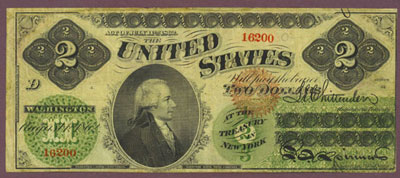
Lincoln said: "Government, possessing the power to create and issue currency and credit as money, and enjoying the right to withdraw both currency and credit from circulation by taxation and otherwise, need not and should not borrow capital at interest as the means of financing governmental work and public enterprise… The privilege of creating and issuing money is not only the supreme prerogative of Government, but it is the Government’s greatest creative opportunity."
Lincoln called the Greenbacks "the greatest blessing the American people have ever had." A blessing for all, except for the bankers, since it was putting an end to their racket, to the theft of the nation’s credit and issuing interest-bearing money. So they did everything possible to destroy these Greenbacks and sabotage Lincoln’s work. Lord Goschen, spokesman of the Financiers, wrote in the London Times (Quote taken from Who Rules America by C. K. Howe, and reproduced in Lincoln Money Martyred by Dr. R. E. Search):
"If this mischievous financial policy, which has its origin in North America, shall become indurated down to a fixture, then that Government will furnish its own money without cost. It will pay off debts and be without a debt. It will have all the money necessary to carry on its commerce. It will become prosperous without precedent in the history of the world. That Government must be destroyed, or it will destroy every monarchy on the globe." (The monarchy of the money lenders.)
First, in order to cast discredit on the Greenbacks, the bankers persuaded Congress to vote, in February of 1862, the "Exception Clause", which said that the Greenbacks could not be used to pay the interest on the national debt, nor to pay taxes, excises, or import duties. Then, in 1863, having financed the election of enough Senators and Representatives, the bankers got the Congress to revoke the Greenback Law in 1863, and enact in its place the National Banking Act. (Money was then to be issued interest-bearing by privately-owned banks.)
This Act also provided that the Greenbacks should be retired from circulation as soon as they came back to the Treasury in payment of taxes. Lincoln heatedly protested, but his most urgent objective was to win the war and save the Union, which obliged him to put off till after the war the veto he was planning against this Act and the action he was to take against the bankers. Lincoln nevertheless declared:
"I have two great enemies, the Southern army in front of me and the bankers in the rear. And of the two, the bankers are my greatest foe."
Lincoln was re-elected President in 1864, and he made it quite clear that he would attack the power of the bankers, once the war was over. The war ended on April 9, 1865, but Lincoln was assassinated five days later, on April 14. A tremendous restriction of credit followed, organized by the banks: the currency in circulation in the country, which was, in 1866, $1,907 million, representing $50.46 for each American citizen, had been reduced to $605 million in 1876, representing $14.60 per capita. The result: in ten years, 56,446 business failures, representing a loss of $2 billion. And as if this was not enough, the bankers reduced the per capita currency in circulation to $6.67 in 1887!
[Alain Pilote]
The History of Banking Control in the United States - Michael Journal
The dictatorship of the bankers are not limited to one country, but exist in every country. Here are the historyof the banking control in the U.S.

But here again, if it was "great" there had to be something that established it as such. If it is was just a general opinion then I will say that supports my claim that MAGA is a sales pitch.
Performance has to be measured. And we have to agree upon the metrics.
I know this is somewhat silly, but at 0.5% (half a percent) decrease in tax brackets is excuse for a small amount, if any, cheering, a 10% cut in the tax brackets is worth a great deal more celebration. When do say "We have arrived."?
10So Samuel told all the words of the Lord to the people who asked him for a king. 11And he said, “This will be the behavior of the king who will reign over you: He will take your sons and appoint them for his own chariots and to be his horsemen, and some will run before his chariots. 12He will appoint captains over his thousands and captains over his fifties, will set some to plow his ground and reap his harvest, and some to make his weapons of war and equipment for his chariots. 13He will take your daughters to be perfumers, cooks, and bakers. 14And he will take the best of your fields, your vineyards, and your olive groves, and give them to his servants. 15He will take a tenth of your grain and your vintage, and give it to his officers and servants. 16And he will take your male servants, your female servants, your finest young men, and your donkeys, and put them to his work. 17He will take a tenth of your sheep. And you will be his servants. 18And you will cry out in that day because of your king whom you have chosen for yourselves, and the Lord will not hear you in that day.”
19Nevertheless the people refused to obey the voice of Samuel; and they said, “No, but we will have a king over us, 20that we also may be like all the nations, and that our king may judge us and go out before us and fight our battles.”
21And Samuel heard all the words of the people, and he repeated them in the hearing of the Lord. 22So the Lord said to Samuel, “Heed their voice, and make them a king.”
And Samuel said to the men of Israel, “Every man go to his city.”

I Samuel 8 | NKJV Bible | YouVersion
Israel Demands a KingNow it came to pass when Samuel was #Judg. 21:4old that he # Sam. 12:2made his #Deut. 16:18, 19; 2 Chr. 19:5sons judges over Israel. The name of his firstborn was Joel, and the nawww.bible.com

1 Journalist vs 20 Trump Supporters (ft Glenn Greenwald) | Surrounded
6 days ago
View attachment 1263169
Never met any pro-Trump dopes; yeah, I've seen a few who were not the most tightly wrapped, a little caught up in all of the paraphernalia stuff, flags, signs, etc., but admit it--- ANYONE with enough sense to know that all democrats like Biden, Brandon, Kammy, Word Salad, the Useless Negro, et al., are far worse than Trump's worst day has enough sense to prove they are at least not COMPLETE idiots! I mean, Trump need not be perfect to admit that at least he is FAR BETTER than Tim Walz or Kamula Word Salad Harris the hog-sucking marxist!I wonder how many of the pro-Trump dopes
That makes sense. Trump ended 8 wars, has two more on the back-burner working towards completion and is in the midst of settling an eleventh war that has brewed for 47 years ending a potential nuclear threat but you want to label him a "war-making" president.Greenwald simply postulates that Trump is a war making President as opposed to a peace making President

Not true, but if you are already IN a war as Iran has been with us for 47 years killing thousands of Americans and making threats daily and trying to assassinate our president at least twice now, you have to END a war in order to have peace and that is just what Trump is doing, putting an END to Iran's war-making ability.and the general response is that "you have to start wars in order to have peace."
Probably true as a continuation of the war spilling over into Japan attacking our mainland as they were cruising to do, would have most likely ended with far more deaths.A number of USMB members have stated that Democrat FDR's nuking of Japan (killing between 150,000 - 246,000 Japanese) actually "saved lives."


