We're talking about gene mutations, each of which are accidental and slightly (or dramatically) modify the genetic instructions for the organism. Most gene mutations are harmful for the next generation, but occasionally a mutation turns out to give better instructions than that of the predecessor. These are the ones who tend to survive and reproduce. Of course, for all we know, the lizard born with the best instructions evah was randomly scooped up by a bird and eaten in it's infancy.
Evolution is random, but which mutations survive is not.
I totally agree with that explanation.
Now answer part 2...This is
from an earlier post.
Right here is the biggest hole in evolution.
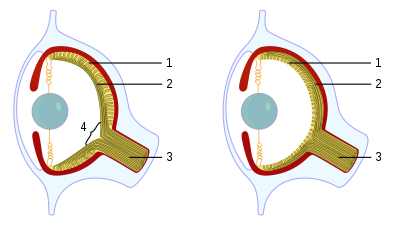
The question now of course is, how could such a system [the eye] evolve gradually? All the pieces must be in place simultaneously. For example, what good would it be for an earthworm that has no eyes to suddenly evolve the protein 11-cis-retinal in a small group or "spot" of cells on its head? These cells now have the ability to detect photons, but so what? What benefit is that to the earthworm? Now, lets say that somehow these cells develop all the needed proteins to activate an electrical charge across their membranes in response to a photon of light striking them. So what?! What good is it for them to be able to establish an electrical gradient across their membranes if there is no nervous pathway to the worm's minute brain?
Now, what if this pathway did happen to suddenly evolve and such a signal could be sent to the worm's brain. So what?! How is the worm going to know what to do with this signal? It will have to learn what this signal means. Learning and interpretation are very complicated processes involving a great many other proteins in other unique systems.
Now the earthworm, in one lifetime, must evolve the ability to pass on this ability to interpret vision to its offspring. If it does not pass on this ability, the offspring must learn as well or vision offers no advantage to them.
All of these wonderful processes need regulation. No function is beneficial unless it can be regulated (turned off and on). If the light sensitive cells cannot be turned off once they are turned on, vision does not occur. This regulatory ability is also very complicated involving a great many proteins and other molecules… all of which must be in place initially for vision to be beneficial.
I'll be happy to give you more examples after you explain the one outlined above^.
It is impossible for ALL those absolutely random mutation to occur at the exact same time to allow for a light sensitive spot.
There is also no reason for the random mutations individually to be passed on as by themselves, they give no advantage for natural selection.
Explain?
Sallow's response was
"why do they need to be simultaneous?".
So I explained what you explained above...for natural selection to function, the mutation (or gene recombination or gene flow)...the change must produce an advantage.
Sallow says "well then
it's a crap shoot."
A crap shoot is not part of evolutionary theory.
and now Sallow wants to go all around the mulberry bush.
So...
Explain how natural selection works on a trait that provides no advantage whatsoever.
And if you can't do that, then explain how a creature evolves the multiple structure simultaneously to enable that light receptor to function so it does create an advantage.
To be clear, this is an open question to anyone, not just you specifically, or Sallow.

 ... if it's in Gods will that Perry becomes president, then he will. I'm hoping God tells us some day why he wanted obama as president! That might be my first question to Him ! Lol!


 ,and don't know enough about the theory to defend it.