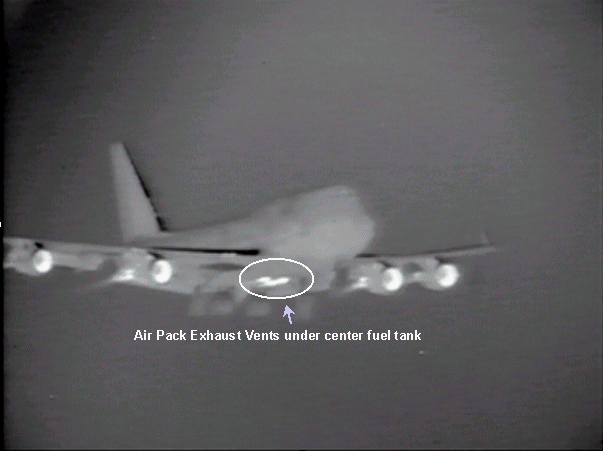
Wasn't aware TWA used IFF.
EXCERPTS;
....
Identification, friend or foe (
IFF) is a
combat identification system designed for
command and control. It uses a
transponder that listens for an
interrogation signal and then sends a
response that identifies the broadcaster. IFF systems usually use
radar frequencies, but other electromagnetic frequencies, radio or infrared, may be used.<a href="
Identification friend or foe - Wikipedia"><span>[</span>1<span>]</span></a> It enables military and civilian
air traffic control interrogation systems to identify aircraft, vehicles or forces as friendly, as opposed to neutral or hostile, and to determine their bearing and range from the interrogator. IFF is used by both military and civilian aircraft. IFF was first developed during
World War II, with the arrival of radar, and several
friendly fire incidents.
IFF can only positively identify friendly aircraft or other forces.<a href="
Identification friend or foe - Wikipedia"><span>[</span>2<span>]</span></a><a href="
Identification friend or foe - Wikipedia"><span>[</span>3<span>]</span></a><a href="
Identification friend or foe - Wikipedia"><span>[</span>4<span>]</span></a><a href="
Identification friend or foe - Wikipedia"><span>[</span>5<span>]</span></a> If an IFF interrogation receives no reply or an invalid reply, the object is not positively identified as foe; friendly forces may not properly reply to IFF for various reasons, for example equipment malfunction, and parties in the area not involved in the combat, such as civilian light
general aviation aircraft, may not carry a transponder.
IFF is a tool within the broader military action of combat identification (CID), the characterization of objects detected in the field of combat sufficiently accurately to support operational decisions. The broadest characterization is that of friend, enemy, neutral, or unknown. CID not only can reduce friendly fire incidents, but also contributes to overall tactical decision-making.<a href="
Identification friend or foe - Wikipedia"><span>[</span>6<span>]</span></a>
....
Mode S
During the 1980s, a new civilian mode, Mode S, was added that allowed greatly increased amounts of data to be encoded in the returned signal. This was used to encode the location of the aircraft from the navigation system. This is a basic part of the
traffic collision avoidance system (TCAS), which allows commercial aircraft to know the location of other aircraft in the area and avoid them without the need for ground operators.
The basic concepts from Mode S were then militarized as Mode 5, which is simply a
cryptographically encoded version of the Mode S data.
The IFF of
World War II and Soviet military systems (1946 to 1991) used coded
radar signals (called cross-band interrogation, or CBI) to automatically trigger the aircraft's transponder in an aircraft illuminated by the radar. Radar-based aircraft identification is also called
secondary surveillance radar in both military and civil usage, with primary radar bouncing an RF pulse off of the aircraft to determine position. George Charrier, working for
RCA, filed for a
patent for such an IFF device in 1941. It required the operator to perform several adjustments to the radar receiver to suppress the image of the natural echo on the radar receiver, so that visual examination of the IFF signal would be possible.<a href="
Identification friend or foe - Wikipedia"><span>[</span>19<span>]</span></a>
....

en.wikipedia.org
ALSO;
...
2.
Outside the military, IFF systems play an equally critical role in industries such as
aviation,
maritime navigation, and
space exploration. These applications
focus more on ensuring safety and preventing collisions, miscommunication, or unauthorized access.
Aviation: Secondary Surveillance Radar (SSR)
In
civil aviation, IFF systems take the form of
Secondary Surveillance Radar (SSR), which is used in conjunction with primary radar to identify aircraft and prevent collisions. SSR systems require each plane to carry a transponder that responds to ground radar queries. This system ensures that air traffic controllers can manage flights efficiently and safely, even in busy skies.
According to the
International Civil Aviation Organization (ICAO), IFF systems helped manage over
50 million flights in 2023, preventing accidents and enabling smooth air traffic control globally.
...
Learn how Friend or Foe Identification (IFF) systems protect military, aviation, maritime, and cybersecurity operations. Discover emerging trends like AI, quantum encryption, and 5G that are shaping the future of IFF technology.

julienflorkin.com