I wonder if they have actually watched a video I posted not long ago by a geology professor.
One thing that people should do when watching or researching anything is to actually turn on their brain and examine and analyze the information. Now Professor Zentner is speaking to a group of adults who actually want to learn. These lectures are phrased for the layman, not aimed at those who are simply taking his course because XX number of science courses are required for their degree. He does this for free several times a year, and I am already planning on saving money so I can attend his lectures next year.
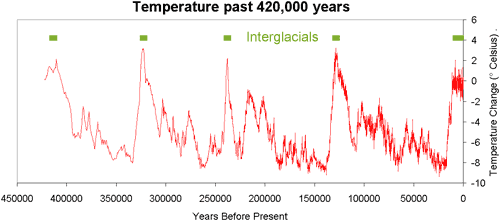
But here is the thing, he is discussing multiple periods of warming found in geological and marine layers. And one he talks about a lot of 20 kya, in other words at the LGM at the very onset of the start of the interglacial. This layer (Stage II) is absolutely expected.
But then at around 25 minutes, he does drop something extremely significant. At 65 kya, there was a warming period that dumped a significant amount of marine sediment (Stage IV). If people actually engage their thinking caps, this means there was a significant warming period
during the last ice age, somewhere between the onset of extensive glaciation and the LGM.
And the interesting thing is, this can be seen in the charts like I have presented already.
Now it can be hard to be precise when examining multiple sources of data from over 50,000 years ago. And there is always going to be various amounts of either precursor or lag data, as simply because something happens the geological and sediment data will not just point out and say "This happened at 1625 GMT on 16 August 63,425 BCE".
Now he skirted over this, as the actual topic was a glacial lobe in Spokane that was dated to 150 kya, during the previous ice age. But I immediately noticed that there was a distinct layer in the middle of our last ice age as well.
I have been studying geology for decades, and I expect things like that. Sometimes evidence for something will occur before a change, sometimes after. Sometimes we only have the evidence of a change with no explanation as to why it even happened.
But here is the thing, the moment he said that "orange" was 65 kya, I realized there was much more going on than he actually discussed. Because that is a significant amount of till, to get their own Marine Isotope Layer designated and it happened in the middle of an ice age.
That means the ice sheet formed, advanced significantly to some point, receded enough to leave behind a clear and distinct marine isotope layer, then things cooled again and advanced past the previous extent of glaciation as the only evidence is in marine isotope layers and not on the surface.
Because one thing about glaciations I have mentioned before, they tend to erase all evidence of previous glaciations. The only thing left behind are sediments deposited outside the reach of newer glaciations unless they extended below the most recent glaciation.
Now overall, in the course of the last Ice Age, this really is nothing but drift. At some point during the cycle things warmed up significantly, then sharply cooled again. Completely natural, and nothing really significant when the entire ice age itself is taken into account.
And in the lecture he discusses going out into the field and examining these marine isotope layers where they can be discovered on dry land.
And yes, these really are the kinds of things I watch for simple enjoyment and relaxation.