Is that based on having examined the time series budget details or are we just surmising here?
in that chart, after 2001, the "green" band thickened appreciably, whilst no others did; the "green" band includes Military spending, presumably increased after 9/11 ?
Okay, I see it.
I wouldn't be so quick to assume that all Republicans want only tax cuts and all Democrats want only spending increases. It's politics.
i edited the post, including comments from former Federal Reserve Chairman Alan Greenspan, who observed that the Bush administration compromised economics for politics
That the increase in expenditures was primarily military build up, it doesn't seem to speak to a compromise on spending for the sake of getting tax cuts though. If the increase in spending was primarily an increase in military spending, it kind of kills the "Dems spend and Repub cut". The military spending of Afghanistan and Iraq wasn't much of a partisan issue. Iraq more so, definitely not Afghanistan.
I'll try to get back to reading your edited post.
when consumer credit decelerated, then GDP began to decelerate.
individuals stop borrowing (because the assets they would buy on credit won't appreciate more than the IR); reduced borrowing reduces the "money Multiplier" effect, leaving banks with excess Reserves, and leaving the economy with reduced (credit-)Money supply ?
There are two sources of money. One is the Federal Reserve fractional reserve banking system. It seems to depend on a constant recirculation of ever increasing business loan to increase the money supply. The second appears to be simple consumer credit.
We can look at them two ways, as either demand or as money supply. It really doesn't matter, they are both the same thing. Money in circulation is demand, price and quantity.
It appears, looking at consumer credit, that it began to decelerate in November of '07. It is kind of hard to say if GDP began decelerating in October, November or December. It is quarterly and I am not sure about the precision of available monthly data. At the very least, the two decelerated simultaneously.
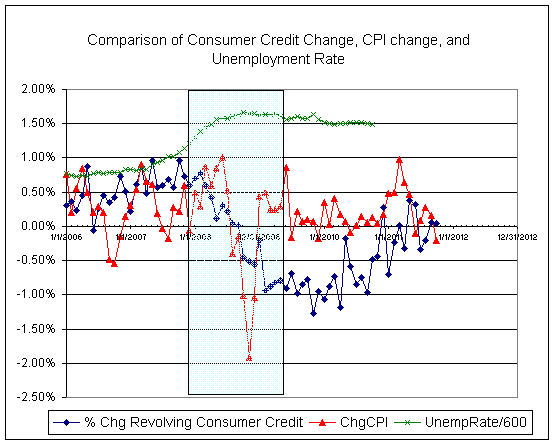
Here is consumer revolving credit %chg, %Chg in CPI and unemployment. Unemployment has been shifted down to get it into a spot where it can be compared. The curve remains the same.
Unemployment began rising before the recession began. Consumer credit is a bit noisy, but it appears as if it began decelerating before the official start of the recession, perhaps along with the increase in unemployment. That all really makes sense, so it's not a stretch by any standard.
At that point, it seems reasonable to conclude that once started, reduced demand began a cascade of business cutbacks, in business credit and employment. It all just starts feeding back on itself in a balance sheet recession. Employment begins to fall reducing demand. Consumers start paying off credit, rather than borrowing. Businesses start looking for ways to save money, rather then expanding, paying off their business loans.
As business credit is the source of the money supply, if businesses start paying off loans rather then taking them out, it only makes sense that the money supply would stop increasing. If they pay them off, then it decreases. Just as well, as consumer credit acts as an effective additional source of money supply, then consumers not accumulating credit stops the effective money supply from increasing. And paying it off decreases the effective supply. In the long view, which I haven't posted here, consumer credit has constantly accumulated for decades.
There is an issue of magnitudes, but every bursting damn begins with a small crack. Eventually, demand and business loans fell so greatly that we went into a deflationary spiral.
All in all, combined with
âFlip This Houseâ: Investor Speculation and the Housing Bubble - Liberty Street Economics, it spells out the entire process of the Dec '07 recession, beginning with the flippers and cascading vertically through the markets single family home markets, upward through single family home products, upward through the banking system, horizontally from flippers to owner occupied homes, vertically on these through consumer products, then back around through the labor force. That seems to be the best take on it.
Oh, and to kind of nail the lid on the coffin, see if you can find
The Great Depression as a Credit Boom Gone Wrong.pdf
Same effect. And frankly, I don't see it as a fiscal issue. It really doesn't matter what the Repubs and Dems in office did. The fiscal tools simply cannot address this fundamental issue directly. It seems that the problem was beginning as early as '05 when bankruptcy laws were tightened up. It may be that it was beginning as early as '00. My sense is that kept a process stabilized, for years, that was just trying to crash. And when it did, it has been propped up for so long that it fell hard.