discretionary
vs. mandatory spending ?
There is no data to support "Dems demanded high (social) spending".
Clinton-era "high" social spending, lamented by "conservatives", continued on under Bush -- as if in political compromise, per Greenspan's comments -- without decrease. i did not say, "Dems demanded high
er spending", only that (stereotypically) "high" liberal social spending stayed the same. Bush, compromising to maintain his mandate, tolerated Democratic spending, for Republican Tax-cuts
Okay, yeppers, you didn't say that they increased. I just quoted your statement, though. And, we (or at least I) are trying to figure out what the increase in the deficit was due to. Was it simply an increase in the defense spending or was it a combination of defense and social programs. I thought that was what we were after. Did the Clinton era surpluses disappear due to funding of "no child left behind", defense, both, or these and other things? As well, as I will detail, Medicare, Social Security, and Social Security Disability Insurance cannot be applied to the deficit.
I find '"high" social spending' to general and dissatisfying. It has been said that, while people often agree with the idea of lowering government spending, when presented with the actual details, they don't find any that they actually want to cut. In the abstract, it is one thing, when considering the idea of cutting off Grandma Milly's Medicare, it becomes something else.
Even if we consider them in terms of "higher", this is just too vague. For example, if defense increased from 3% to 4.3% of GDP while non-defense increased from 3.3% to 3.9% and means tested entitlements increased from 2.4% to 3.0% can each be reasonably classified as simply increasing? One increased by 1.3%, the second by .6%, the third by .6%. The first is double that of either of the other two. And that 2.4% to 3.0% is already starting lower then the others. Its .6% increase is a just bigger increase compared to where it began.
Just as well, they belong to different accounts with different funding sources. This consideration, that the federal budget is separable into specific accounts to which specific taxes applies, appears important. With Social Security fully self funded, all increases are fully accounted for by the associated tax and trust fund. On the other hand, defense is paid out of the federal fund and is associated with the individual income tax decreases. Any increase in deficit belongs to the defense/income tax pair, not the Social Security/FICA tax pair.
I have been able to sort out some of it.
The first issue is that the major social programs, Medicare and most of Social Security are self funded and don't apply to the deficit.
The historical budget is available in detailed tables. The detailed tables some in a zip file, hist_xls.zip. One problem in attempting to answer this question, of exactly what the specific programs, taxes and outlays contributed to the deficit isn't simply answered by one file.
Still, among the 59 Excel files, is hist01z4.xls. It is titled, "Table 1.4 RECEIPTS, OUTLAYS, AND SURPLUSES OR DEFICITS (-) BY FUND GROUP: 1934-2014"
Also included are files, like hist08z4.xls, that differentiate between mandatory and discretionary.
The download I have goes through 2008, with 2009 to 2014 as estimates. It's good enough for the period of time we are considering. More recent data is available at
Historical Tables | The White House
This table 1.4, separates receipts, and outlays into "Federal Funds", "Trust Funds" and "Interfund Transactions". It includes the surplus for "Federal Funds" and "Trust Funds". There is no surplus for "Interfund Transactions" and it doesn't seem to mean much.
There are two SSA trust funds. Tax rates for Social Security's two trust funds, the Old-Age and Survivors Insurance (OASI) Trust Fund and the Disability Insurance (DI) Trust Fund, are shown at
Social Security Tax Rates
(What I always though of as Social Security is OASI.)
Among the "social" programs are Medicare (HI) Part A, Medicare Part B, Medicare Part D, Social Security Disability Insurance, Old-Age and Survivors Insurance, and Supplemental Security Income.
Medicare (HI) (Part A), Social Security Disability Insurance, and Old-Age and Survivors Insurance are all self funded with specific taxes, FICA and SECA. Medicare(HI), Social Security Disability Insurance, Old-Age and Survivors Insurance and their associated taxes are all tied to trust funds. These trust funds, taxes, and programs are entirely separate from other taxes, funding and programs.
The Social Security website says, "Medicare is financed by a portion of the payroll taxes paid by workers and their employers. It also is financed in part by monthly premiums deducted from Social Security checks." So, it seems that Medicare parts B and D are self funded through premiums.
The statement from the SSA website is "SSI is paid for by U.S. Treasury general funds, not the Social Security trust funds."
Social Security Publications
Trust Fund receipts come from trust fund taxes which go directly into the trust fund. The social programs, Medicare Part A, Social Security Disability Insurance, and Old-Age and Survivors Insurance are paid from these taxes and not from general tax receipts. Corporate and individual income taxes do not pay for these social programs.
For all practicality, there has never been a deficit, always a surplus, for the Trust Funds. (1950, 1959, 1960, and 1962 had deficits.)
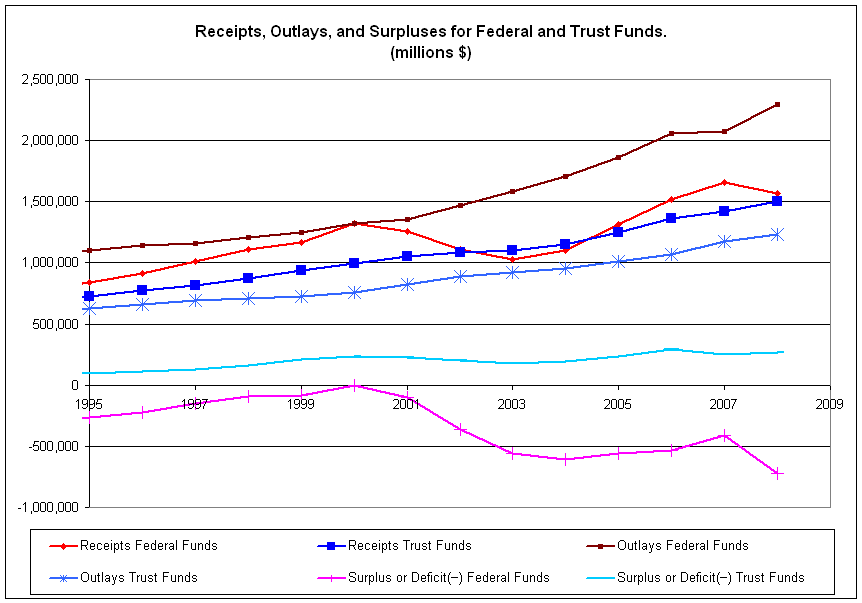
Here are the receipts, outlays, and surpluses for the federal funds and trust funds.
(The blue lines go together. The brown, red and pink go together.)
At least we can conclude that Medicare , Social Security Disability Insurance, and Social Security Insurance were not contributors to the deficit.
This leaves the question of Supplemental Security Income. So this would be one program that we might consider as fitting the description of "increases in social programs that affect the deficit". What also might fit is the department of education, that's a social program.
But the thing is that, of all the budget items, Defense and the trust funds are by far the largest. It's going to be hard to make a case that things like the department of education are significant compared to defense and the trust funds.
In 2008, total outlays were 21% of the GDP. Discretionary spending was about split between defense and not defense at 4.3% and 3.7% respectively. The non-defense in important, perhaps things like the department of education and department of energy. Mandatory spending includes social security at 4.3%, a self funded program. Where the supplemental security income fits, I don't know yet. The mandatory spending includes categories of means tested entitlements and "other". That is pretty non-specific.
Just going down the %GDP numbers, it's not simply clear if they increased significantly by comparison to defense.
So far, that's as close as I can get. I really would like to know, aside from the easily recognized defense spending, what exactly are the programs that most affect the deficit.