Widdekind said:
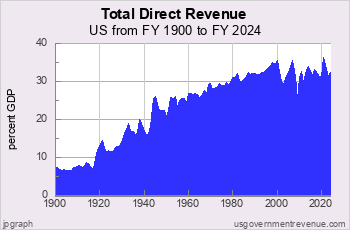
Government "revenues" only increased from 2003, perhaps reflecting massive Military appropriations for the Iraq war ?
Baiamonte said:
1) appropriations don't increase revenue, 2) 2003 supply side tax cuts did preceed largest revenue gain in American History. Gain was from supply side tax cuts and over heated, inflated economy.
Widdekind said:
you mean legally? how could "appropriations" not increase "revenue" practically-speaking ?
war-spending boosted the economy ?
Baiamonte said:
revenue comes from taxing, not spending
war spending slows the economy since it requires taxes
Widdekind said:
(1) "appropriate" means "take", de facto "Tax" ?
(2) war Taxes "burden" the sectors of the economy Taxed; they benefit the sectors of the economy, into which Tax dollars are diverted
EdwardBaiamonte said:
Widdekind said:
(2) war Taxes "burden" the sectors of the economy Taxed;
yes slow it down or recess it
Widdekind said:
they benefit the sectors of the economy, into which Tax dollars are diverted
yes so agree the affect is neutral on the over all economy?? Actually it is negative since the liberal spending is bubble spending while private spending is sustainable and so grows the economy.
Making sense now?
No, you started out fine, the totally flubbed it. As soon as you threw in the term "liberal" is was obvious to be incorrect.
This, "perhaps reflecting massive Military appropriations for the Iraq war ?" kind of confused me. My first thought is simply that appropriates are money spent, thus a direct increase in outlays, not necessarily an increase in revenues. Whether revenues are increased to account for them is secondary and not guaranteed. And, without some evidence, we cannot guarantee that increased military spending caused any increase in GDP at any particular time.
Regardless, sometimes, government spending effects the economy with a multiplier effect. Sometimes, government spending crowds out investment. Neither can be applied, without evidence, at any particular time. Just because something happens in theory doesn't mean it necessarily happens or that it happens to any significant level
I am really surprised by your assessment too, considering that government military contracts are a boon to state economies where they exist. It is hardly neutral.
The Clinton admin had tax cuts and increases. I don't care to look them up, or care why, just that they are both there. But it went both ways.
There is this MMT theory, so simple as to be unquestionably correct, that government surpluses result in a decrease in savings, while government deficits increase saving. The conclusion is, and worthy of consideration, that the Clinton surplus eventually resulted in a recession.
Once you got to "Actually it is negative since the liberal spending is bubble spending while private spending is sustainable and so grows the economy", you lost it.
There is nothing to support that government spending is not sustainable or that private spending is. If private spending was sustainable in all cases at all times, then we wouldn't have the recession of Dec 2007. It is purely a balance sheet recession where private spending is not sustainable. Unfortunately, there is no way to determine if the GDP is simply growing or if it is a bubble.
Your going to have to do better then that. Like I said, you cannot build an economic theory based on a political ideology.
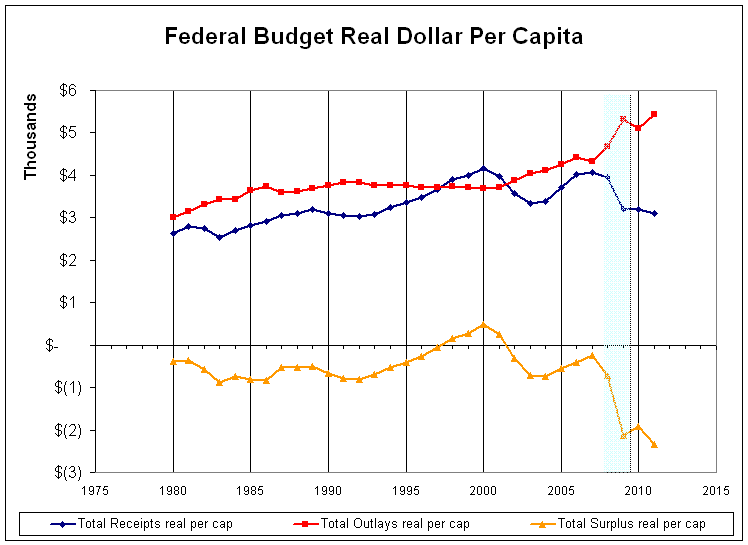
And we cannot assess either the actual revenues and outlays or the effect unless it is in real dollars and per capita. Any other consideration is useless. And when looked at from a per capita basis, there is little evidence "that did precede largest revenue gain in American History".
First off, they were combined with increased outlays, completely eliminating any conclusion of it being tax cuts alone. Second, in real dollar, per capita terms, they were not the largest. They were modest at best and barely reached the level of revenues during the Clinton admin. At the very least, since efficiency and standard of living were increasing, they should have been higher.
(Oh, as a percentage of the GDP, in real dollars per worker and per capita would be better. Try that, see what you get.