The ice cube @ 0 C radiates just under 314 w/m^2 and the 20 degC object radiates almost 418 w/m^
I take it you would say that the instrument would display the sum of both, a total of 732 w/m^2 ?
No, I wouldn't.
If each surface filled part of the aperture view, you should get a number somewhere between the two individual numbers.
Just like you did.
Good answer and I never REALLY thought you would add them. That was meant just as a joke anyways.
Matter of fact you do get a number somewhere between the 2 individual numbers.
But here is the problem and why I posted and addressed it to you:
Look at Spencer`s experiment
Experiment Results Show a Cool Object Can Make a Warm Object Warmer Still « Roy Spencer, PhD
Experiment Results Show a Cool Object Can Make a Warm Object Warmer Still
August 28th, 2016 by Roy W. Spencer, Ph. D.
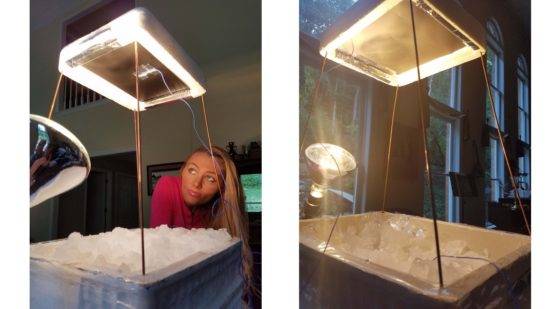
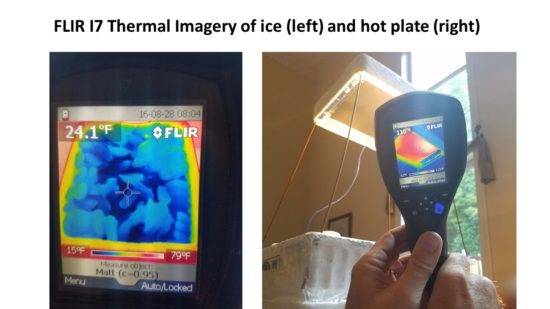
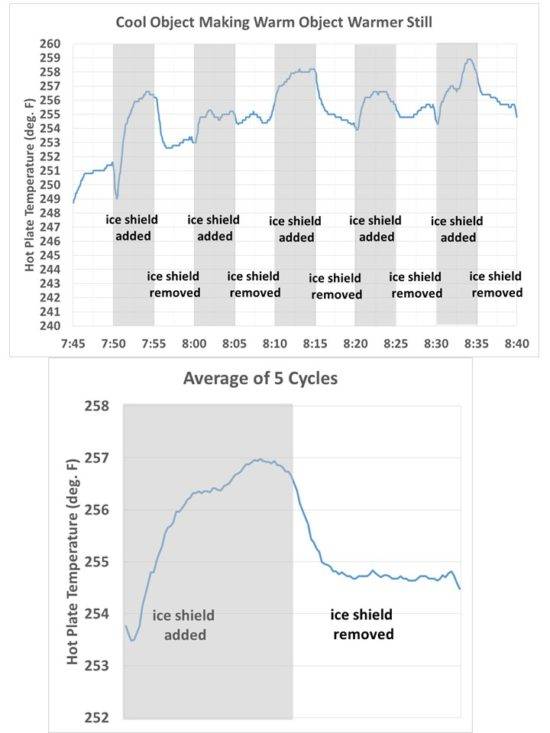
I recorded temperatures every 5 secs with the plate alternately exposed to a view of the ice for 5 minutes, then with the ice covered for 5 minutes. This cycling was repeated five times. The results are shown in Fig. 3. What we see is just what I would expect, that the temperature of the hot plate increases with time when its view of the ice is blocked by the room-temperature sheet.
And he leads off by saying this:
The experiment shown below does not prove that greenhouse gases in the atmosphere perform such a function, only that it is not a violation of the 2nd Law of Thermodynamics for a cooler object emitting infrared radiation to keep a warm object warmer that it would otherwise be if the cooler object was not present.
His conclusion is:
Conclusion
There is no violation of the 2nd Law of Thermodynamics in the experiment; a cool object can make a warm object even warmer still through infrared radiative effects. The phenomenon can only happen, though, if the cool object replaces something that is even colder, and thereby reduces the rate at which the warm object loses infrared energy to its surroundings. In this experiment, the room temperature plate takes the place of the ice which still emits at around 300 Watts per sq. meter; in the climate system, the atmosphere takes the place of deep space, which emits energy at close to 0 Watts per sq. meter.
So what do you think Spencer proved with his experiment?
Certainly not that a cold object can make a warm object even warmer. All it did prove is, that when the warm object was exposed to the uncovered ice box is that the colder object
cooled off the warmer one and that a warm object next to a warmer one reduces the cooling of the warmer object...but not that this second object heated up the warmer one even more.
That would imply that the second object is a heat source
And this is a meteorologist who is or was the Principal Research Scientist at the U of Alabama and a "former NASA Scientist"
No way would or should make a real physicist commit such a blunder. Amazing how low the bar is set at NASA for climate "scientists". That`s why some people call it pseudo science.
And you say?