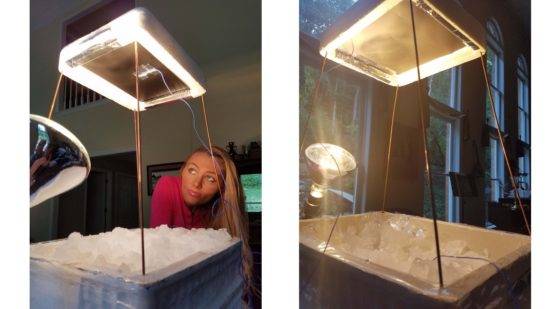
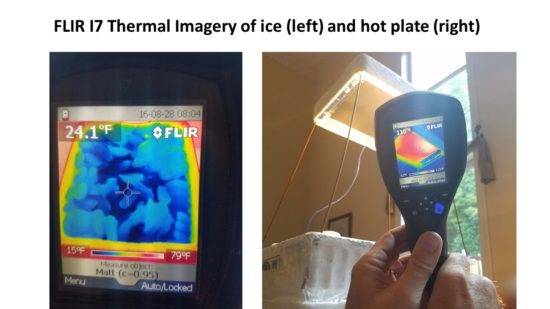
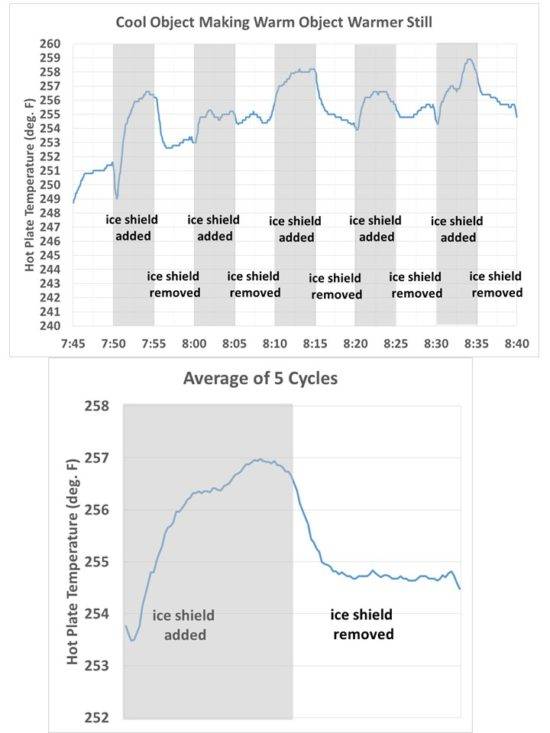
Spencer proved exactly what he set out to prove. Your so-called criticism agrees with what he stated.
Personally I think Spencer should have emphasized that the warm object has a heat source, and that the temperature of the warm object is a combination of both energy input and energy output. Without an energy source everything just cools.
Look at the bottom graph. with the ice shielded the temperature jumps two degrees, when the ice is exposed it drops down two degrees. the local conditions changed and the temperature equation changed and the temperature moved to reflect that change. It is easier to visualize how the heated plate quickly cools and stabilizes when exposed to the ice than it is to understand what is happening when the ice is shielded and the plate starts to warm up. Where does the energy needed to warm up the plate come from?
It comes from the energy NOT lost to the environment. That energy is stored in the plate and is expressed as an increase in temperature. The energy stored is exactly the same as the extra energy released when the plate is exposed to the ice and cools down.
Now switch over to the Earth and its atmosphere. There is a tremendous amount of energy stored in the atmosphere as kinetic and potential energy. Energy that would be directly lost to deep space if no solar input was present to keep it aloft. Everything above zero degrees Kelvin radiates according to its temperature. Everything can be either warmer or cooler than its surroundings but it is always radiating. The atmosphere is cooler than the surface but warmer than space but it sends radiation to both the surface and to space.
Just like Spencer's experiment, the atmosphere is cooler than the surface (plate) but not as cool as space (ice). The presence of the atmosphere increases the surface temperature by lowering heat loss to space, the energy not lost to space is the source of temperature change at the surface.
Still dont believe me? Imagine what would happen if solar input just stopped. The Earth would continue to radiate and cool. Until all the stored energy was lost to space as the atmosphere collapsed into a frozen crust on the surface.
Matter at any temperature can be a net absorber or emitter of radiation. A glass of ice water melts above 0C or freezes solid below 0C but it is giving off the same amount of radiation until it does one or the other.
No he did not prove that a colder body warms up a warmer one. The colder body
is not a heat source, the heat source was the heat-lamp. Nobody has any problems with the idea that heat radiation can be impeded by an object that is warmer than the background. Spencer was trying to show that the 2nd body is a heat source.
That is an entirely different principle. The only way he could possibly prove his claim is to eliminate the heat lamp and conduct an experiment that clearly shows that there is a
transfer of heat from the cooler object to the warmer one. Such as by placing 2 objects of different temperature in a Dewar flask and observing the temperature changes. If the cooler of the 2 can make the warmer one even warmer then the cooler one should cool off in the process...and we all know it won`t do that
Spencer's experiments show the disturbance in temperature gradients by placing intermediate objects between the source of heat and the exit of that heat into the environment. Heat loss is slowed by decreasing the temperature difference between the heat source and the intermediary compared to the environment which is assumed to be able to absorb energy without changing temperature. Energy is captured, the temperature of both the source and intermediary increase until the loss to the environment equals the amount without the intermediary. In the above experiment he did not measure the intermediary, he just changed one environment for a warmer one. The difference is moot. The effect on the heated warm source is measurable, the reasons obvious.
In an experiment where both the heated source and indirectly heated cooler object were to be measured, then the second cooler object would become a heat source because it would contain stored energy received from the warm object. If you placed yet another object between the heat source and the environment, it too would warm up, using stored energy that would have escaped to the environment. If the heat source is terminated then all the stored heat would be released. The total amount of energy put into the environment is exactly equal with or without intermediaries.
You say:
"In an experiment where both the heated source and indirectly heated cooler object were to be measured, then the second cooler object would become a heat source because it would contain stored energy received from the warm object."
To which I answer:
Yes of course the second cooler object would contain stored energy received from the warm object and would in turn become a heat source
but not an additional heat source for the first, the warmer on. Only to yet another one a 3rd one which is cooler than the second object.
Good! It seems as if we are converging on what we agree upon.
You agree that a cool intermediary object that shadows the warm heated object from the cold environment will increase the temperature of the heated object by lowered heat loss due to a smaller temperature differential. You also seem to agree that the intermediary object absorbs and stores energy so that it becomes a heat source to objects cooler than itself. And that extra objects placed between the heated source and the cold environment would also react in the same way, absorbing and storing energy, decreasing heat loss uphill and becoming a heat source downhill.
The Sun-Earth-Atmosphere-Space flow of energy is complicated by many things but there is still a radiation component to it, and only radiation finally escapes. Solar insulation warms the surface, which warms the lower atmosphere, which warms the next layer, etc until the same amount of energy leaves as entered albeit at lower energy wavelengths. While the surface has an emissivity of over 0.9 in the wavelengths we are interested in, the atmosphere has an emissivity that is much lower and is concentrated in certain spikes that typically correlate to GHGs. Some wavelengths escape freely, some are blocked almost completely at near surface heights. It is also important to remember that the atmosphere is only there because of stored solar insolation that gives it the kinetic and potential energy to remain aloft. The atmosphere radiates energy in all directions but heat (net energy transfer) only goes from warmer to cooler.
Polar Bear - Do you agree with SSDD that atmospheric radiation is controlled by surface temperature, at least when it is emitted in the direction of the surface? You seem to object to many posters here that make plausible statements on physics but you are strangely silent on SSDD's bizarre claims.
You know or should know that it is not my intention to attack you and for the most part I agree with much of what you have been posting over several years.
It`s not just now that we have converging views as you put it.
If I don`t agree with some of what you say does not mean that I dismiss the rest of what you have been posting...which for the most part is correct.
However there can be no progress in R&/or RD unless there are debates where the views are diverging. In this particular case it`s down to what Spencer considers as a heat source.
There is no need to get into GHG`s and all the rest of it to troubleshoot Spencer`s experiment.
Yes a cooler object can affect the cooling of a warmer object if it shades it from an even colder background into which the warmer object radiates heat. But as I keep saying that does not make the colder object a heat source for the warmer object...no more than plug that stops a tire leak is a source of compressed air to inflate it to a higher pressure. For that you do need a compressor, in Spencer`s experiment he needs the heat lamp and for the earth you need the sun + the GHGs to i
ncrease the temperature. The GHGs alone will not increase the temperature and in Spencer`s example you also need more than just another body. Without the heat lamp there is no temperature increase. The only effect that 2nd cooler object has is to impede cooling but that does not make it a heat source as Spencer keeps saying ( for many years ever since he is blogging)
The insulation in your house walls are not a heat source, nor is the lid on a pot of boiling water..well I`m sure you get the point.
As far as the rest of AGW is concerned I am a critic when it comes to the magnitude and the accuracy of it all. Since we are dealing with only a fraction of a degree EVERYTHING hinges on accuracy and methodology and both are woefully inadequate...as you also pointed out many times.
Okay now about SSDD..
You said that he said:"that atmospheric radiation is controlled by surface temperature, at least when it is emitted in the direction of the surface"
The way I would put that is:
Surface radiation is a function of surface temperature. Surface radiation is partially absorbed by the atmosphere and absorbed radiation is re-emitted in all directions....that was all well established long before M.Mann & Al Gore or the IPCC came along.
We also knew for over a century that anything which shields a warm object from a cold background into which it would otherwise radiate heat impedes the cooling of the warm object.
But now it all comes down to the magnitudes of all the effects that must be considered.
By far the largest near the surface and lower altitudes is convection, evaporation, lapse rate, cloud cover and way way down CO2.
And you know where I stand concerning the latter. Not with estimates, models or what this so called "scientific consensus" claims it is...most of them have no clue how to properly measure the difference of absorption between a gas mixture of 300 ppm CO2 and 400ppm of real air that also exhibits various moisture content and exists in a wide variety of different barometric pressure regions.
So what do they do?
ESRL Global Monitoring Division - Global Greenhouse Gas Reference Network
where it is stated that:
Data are reported as a dry air mole fraction defined as the number of molecules of carbon dioxide divided by the number of all molecules in air, including CO2 itself, after water vapor has been removed. The mole fraction is expressed as parts per million (ppm).
And from that they "compute" a global average...from which they again "compute" a global average temperature anomaly in the order of minute fractions of a degree K or C which are just fractional % when we express it in Kelvin as it should be...as all the equations that are used do.
I don`t even have to get into barometric pressure variations over huge regions . It suffices to point out that a 10% moisture variation alone will result in changes that dwarf the changes in deg K anomalies:
Air pollutant concentrations - Wikipedia
where:
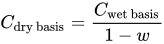
C = Concentration of the air pollutant in the emitted gas
w = fraction of the emitted exhaust gas, by volume, which is water vapor
As an example, a wet basis concentration of
40 ppmv in a gas having 10 volume percent water vapor would have a: Cdry basis = 40 ÷ ( 1 - 0.10 ) =
44.4 ppmv.
And last not least there is what the bureaucrats at the IPCC are plugging in for CO2 doubling as absorption rates and for computing the net effect in watts/m^2.
It`s a complete joke !!!
Dr.Heinz Hug and everybody else who is not a part of that propaganda machine have it right
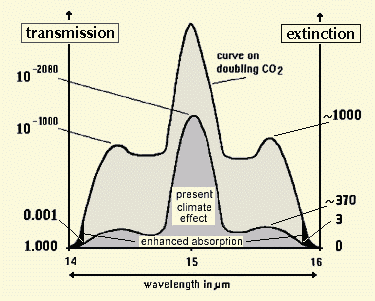
The Climate Catastrophe - A Spectroscopic Artifact
We integrated from a value
E = 3 (above which absorption deems negligible, related to the way through the whole troposphere) until the ends (
E = 0) of the R- and P-branch. So the edges are fully considered. They start at 14.00 µm for the P-branch and at 15.80 µm for the R-branch, going down to the base line
E=0. IPCC starts with 13.7 and 16 µm
[13]
Crucial is the
relative increment of greenhouse effect . This is equal to the difference between the sum of slope integrals for 714 and 357 ppm, related to the total integral for 357 ppm. Considering the n3 band alone (as IPCC does) we get 0.17 %
The
radiative forcing for doubling can be calculated by using this figure. If we allocate an absorption of 32 W/m2
[14] over 180º steradiant to the total integral (area) of the n3 band as observed from satellite measurements
(Hanel et al., 1971) and applied to a standard atmosphere, and take an increment of 0.17%, the absorption is 0.054 W/m2 - and not 4.3 W/m2.
This is roughly 80 times less than IPCC's radiative forcing.
......
And you say ?