Zone1 The fundamental differences between a follower of Christ and Catholicism is...

By the way, my intent is not to debate but rather to share and discuss.
I don't debate religion
Thanks for sharing but why does one refer to the Catholic Catechism when they can instead refer to the word of God?
Because (as I already wrote) the Catechism is a child's book and they were given out in grade school as a learning tool. I think The Church stopped using them in the 70's.

Praying to "saints" is not Biblical and therefore not from God.

First off do you know what a saint is ?
 
I don't debate religion

Because (as I already wrote) the Catechism is a child's book and they were given out in grade school as a learning tool. I think The Church stopped using them in the 70's.


First off do you know what a saint is ?

The word “saint” comes from the Greek word hagios, which means “consecrated to God, holy, sacred, pious." It is almost always used in the plural, “saints.” "…Lord, I have heard from many about this man, how much harm he did to Your saints at Jerusalem" (Acts 9:13). "Now as Peter was traveling through all those regions, he came down also to the saints who lived at Lydda" (Acts 9:32). "And this is just what I did in Jerusalem; not only did I lock up many of the saints in prisons …“ (Acts 26:10). There is only one instance of the singular use, and that is "Greet every saint in Christ Jesus…" (Philippians 4:21). In Scripture there are 67 uses of the plural “saints” compared to only one use of the singular word “saint.” Even in that one instance, a plurality of saints is in view: “…every saint…” (Philippians 4:21).

The idea of the word “saints” is a group of people set apart for the Lord and His kingdom. There are three references referring to godly character of saints: "that you receive her in the Lord in a manner worthy of the saints …" (Romans 16:2). "For the equipping of the saints for the work of service, to the building up of the body of Christ" (Ephesians 4:12). "But immorality or any impurity or greed must not even be named among you, as is proper among saints" (Ephesians 5:3).

Therefore, scripturally speaking, the “saints” are the body of Christ, Christians, the church. All Christians are considered saints. All Christians are saints—and at the same time are called to be saints. First Corinthians 1:2 states it clearly: “To the church of God in Corinth, to those sanctified in Christ Jesus and called to be holy…” The words “sanctified” and “holy” come from the same Greek root as the word that is commonly translated “saints.” Christians are saints by virtue of their connection with Jesus Christ. Christians are called to be saints, to increasingly allow their daily life to more closely match their position in Christ. This is the biblical description and calling of the saints.

How does the Roman Catholic understanding of “saints” compare with the biblical teaching? Not very well. In Roman Catholic theology, the saints are in heaven. In the Bible, the saints are on earth. In Roman Catholic teaching, a person does not become a saint unless he/she is “beatified” or “canonized” by the Pope or prominent bishop. In the Bible, everyone who has received Jesus Christ by faith is a saint. In Roman Catholic practice, the saints are revered, prayed to, and in some instances, worshiped. In the Bible, saints are called to revere, worship, and pray to God alone.

What are Christian saints according to the Bible? | GotQuestions.org What are Christian saints according to the Bible? | GotQuestions.org
 
I don't debate religion

Faithful Christians rely on the scriptures as Paul did to persuade many Jews that the Torah's prophecies of the coming Messiah had been fulfilled by Jesus. We too should use the scriptures to reach the truth together.

Acts 17
English Standard Version
Paul and Silas in Thessalonica
17 Now when they had passed through Amphipolis and Apollonia, they came to Thessalonica, where there was a synagogue of the Jews. 2 And Paul went in, as was his custom, and on three Sabbath days HE REASONED WITH THEM THROUGH THE SCRIPTURES
3 explaining and proving that it was necessary for the Christ to suffer and to rise from the dead, and saying, “This Jesus, whom I proclaim to you, is the Christ.” 4 And some of them were persuaded and joined Paul and Silas, as did a great many of the devout Greeks and not a few of the leading women.
 
How does the Roman Catholic understanding of “saints” compare with the biblical teaching? Not very well. In Roman Catholic theology, the saints are in heaven. In the Bible, the saints are on earth. In Roman Catholic teaching, a person does not become a saint unless he/she is “beatified” or “canonized” by the Pope or prominent bishop. In the Bible, everyone who has received Jesus Christ by faith is a saint. In Roman Catholic practice, the saints are revered, prayed to, and in some instances, worshiped. In the Bible, saints are called to revere, worship, and pray to God alone.

I could have looked that up and posted the same thing.

My question was meant to see if you understood what a saint is to Catholics prior to that.

In simple terms a saint to a Catholic is some who has devoted thier life to spreading the Gospel of Jesus.
 
Peter is a rock, not THE rock. God/Jesus is the rock. Here is Biblical support.

Here is a better translation of the original Greek to English

Matthew 16:18 Young’s Literal Translation
And I also say to thee, that thou art a rock, and upon this rock I will build my assembly, and gates of Hades shall not prevail against it

You’ll note that Peter is referred to by Jesus as “a” rock and not the rock.


The “rock” is God and Jesus. They are and have ALWAYS been “the rock”.


1 Samuel 2:2 ESV
“There is none holy like the Lord: for there is none besides you; there is no rock like our God.

2 Samuel 22:2
He said, “The Lord is my rock and my fortress and my deliverer,

Psalm 62:6 ESV
He only is my rock and my salvation, my fortress; I shall not be shaken.

Psalm 144:1 ESV
Of David. Blessed be the Lord, my rock, who trains my hands for war, and my fingers for battle;

1 Corinthians 10:1-4 ESV
For I do not want you to be unaware, brothers, that our fathers were all under the cloud, and all passed through the sea, and all were baptized into Moses in the cloud and in the sea, and all ate the same spiritual food, and all drank the same spiritual drink. For they drank from the spiritual Rock that followed them, and the Rock was Christ.

Psalm 18:46 ESV
The Lord lives, and blessed be my rock, and exalted be the God of my salvation—

Matthew 7:24-25 ESV
“Everyone then who hears these words of mine and does them will be like a wise man who built his house on the rock. And the rain fell, and the floods came, and the winds blew and beat on that house, but it did not fall, because it had been founded on the rock.

Psalm 19:14 ESV
Let the words of my mouth and the meditation of my heart be acceptable in your sight, O Lord, my rock and my redeemer.

1 Peter 2:7-9 ESV
So the honor is for you who believe, but for those who do not believe, “The stone that the builders rejected has become the cornerstone,” and “A stone of stumbling, and a rock of offense.” They stumble because they disobey the word, as they were destined to do. But you are a chosen race, a royal priesthood, a holy nation, a people for his own possession, that you may proclaim the excellencies of him who called you out of darkness into his marvelous light.

Isaiah 26:4 ESV
Trust in the Lord forever, for the Lord God is an everlasting rock.

Psalm 18:1-2 ESV
To the choirmaster. A Psalm of David, the servant of the Lord, who addressed the words of this song to the Lord on the day when the Lord delivered him from the hand of all his enemies, and from the hand of Saul. He said: I love you, O Lord, my strength. The Lord is my rock and my fortress and my deliverer, my God, my rock, in whom I take refuge, my shield, and the horn of my salvation, my stronghold.

1 Corinthians 3:11-16 ESV
For no one can lay a foundation other than that which is laid, which is Jesus Christ. Now if anyone builds on the foundation with gold, silver, precious stones, wood, hay, straw— each one's work will become manifest, for the Day will disclose it, because it will be revealed by fire, and the fire will test what sort of work each one has done. If the work that anyone has built on the foundation survives, he will receive a reward. If anyone's work is burned up, he will suffer loss, though he himself will be saved, but only as through fire.

Isaiah 51:1 ESV
“Listen to me, you who pursue righteousness, you who seek the Lord: look to the rock from which you were hewn, and to the quarry from which you were dug.


Psalm 61:1-3 ESV
To the choirmaster: with stringed instruments. Of David. Hear my cry, O God, listen to my prayer; from the end of the earth I call to you when my heart is faint. Lead me to the rock that is higher than I, for you have been my refuge, a strong tower against the enemy.

Acts 4:11-13 ESV
This Jesus is the stone that was rejected by you, the builders, which has become the cornerstone.
(Note: It's interesting to me that the verse in Acts 4:11-13 refers to Jesus as a "stone" rather than a rock).


1Peter 2:4 As you come to him, a living stone rejected by men but in the sight of God chosen and precious, 5 you yourselves like living stones are being built up as a spiritual house, to be a holy priesthood, to offer spiritual sacrifices acceptable to God through Jesus Christ.
6 For it stands in Scripture: “Behold, I am laying in Zion a stone, a cornerstone chosen and precious, and whoever believes in him will not be put to shame.”
You don't get to have the luxury of using a presbyterian's interpreted bible to critique the Church pal.


If you want to critique the Church, you must use one of these;
 
You don't get to have the luxury of using a presbyterian's interpreted bible to critique the Church pal.


If you want to critique the Church, you must use one of these;


He may be wrong on a number of other topics having to do with religion, but he was right to leave the Catholic church. I'm actually really surprised you're defending them.
 
The Catholic Church does NOT follow the scriptures and Paul warned against man-made "traditions".

Here is what Catholics believe:

I believe in God, the Father almighty,Creator of heaven and earth, and in Jesus Christ, his only Son, our Lord, who was conceived by the Holy Spirit, born of the Virgin Mary, suffered under Pontius Pilate, was crucified, died and was buried.

He descended into hell; on the third day he rose again from the dead; he ascended into heaven, and is seated at the right hand of God the Father almighty; from there he will come to judge the living and the dead.

I believe in the Holy Spirit, the holy Catholic Church, the communion of saints,the forgiveness of sins, the resurrection of the body, and life everlasting. Amen.
 
He may be wrong on a number of other topics having to do with religion, but he was right to leave the Catholic church. I'm actually really surprised you're defending them.

Why shouldn't I?

We have already had this discussion.

I see no point in believers attacking each other.

There are two sorts of folks, those with faith, and those without.

a4nern.jpg


Folks with faith that attack others with faith? To me, that shows a lack of understanding of the divine.

You'll note, I have not attacked his beliefs, he is free to believe whatever he wants about the creator.


I don't really pay attention much to this forum TBH, it seems mostly pointless.

But what I have noticed from the little I observe of it, is that non-Catholic Christians start OPs slagging the Church with far more frequency than the Catholics appear to attack Christians that aren't members of the Church. . .

. . . why do you suppose that is?
 
But what I have noticed from the little I observe of it, is that non-Catholic Christians start OPs slagging the Church with far more frequency than the Catholics appear to attack Christians that aren't members of the Church. . .

. . . why do you suppose that is?
Because we are secure in our beliefs.
 
Because we are secure in our beliefs.
I left the Church as a teen when I discovered the deep rooted corruption in the IOR.

I am pretty sure that corruption is connected with truly malevolent forces, and every pope that tries to right the ship is either killed or dismissed.
 
But what I have noticed from the little I observe of it, is that non-Catholic Christians start OPs slagging the Church with far more frequency than the Catholics appear to attack Christians that aren't members of the Church. . .

. . . why do you suppose that is?

Because they are LIBs and it is in this way they show it off.

(just of the many ways they show it.)
 
15th post
He may be wrong on a number of other topics having to do with religion, but he was right to leave the Catholic church. I'm actually really surprised you're defending them.
2 Timothy 2:23-26,
Avoid foolish and ignorant debates, for you know that they breed quarrels. A slave of the Lord should not quarrel, but should be gentle with everyone, able to teach, tolerant, correcting opponents with kindness. It may be that God will grant them repentance that leads to knowledge of the truth, and that they may return to their senses out of the devil’s snare, where they are entrapped by him, for his will.

So is that what you guys are trying to do? To save Catholics from the devil’s snare that canonized your holy book?

Because I have a few more verses we can work though.


2 Timothy 2:14,
Matthew 12:25,
Matthew 18:15-16,
Romans 14:1-23,
Romans 16:17-18,
1 Corinthians 3:3,
1 Corinthians 13:1-2,
1 John 4:20-21,
Proverbs 6:16-19,
Proverbs 28:25,
Galatians 5:15,
Galatians 5:19-21,
Titus 3:10,
Jude 1:19,
Ephesians 4:3-6,
Ephesians 4:31-32,
Colossians 3:12-14,
1 Corinthians 12:25,
1 Peter 3:8,
Philippians 2:1-2,
John 17:20-23,
Mark 3:24-25,
Luke 11:17
James 3:16.
 
I left the Church as a teen when I discovered the deep rooted corruption in the IOR.

I am pretty sure that corruption is connected with truly malevolent forces, and every pope that tries to right the ship is either killed or dismissed.
I see it more like a cosmic battle between conservatism and socialism. It began with the Gnostic Christians, was exacerbated by the reformation and has existed within the church itself to varying degrees.
 
I see it more like a cosmic battle between conservatism and socialism. It began with the Gnostic Christians, was exacerbated by the reformation and has existed within the church itself to varying degrees.
I don't view it as a false dilemma.

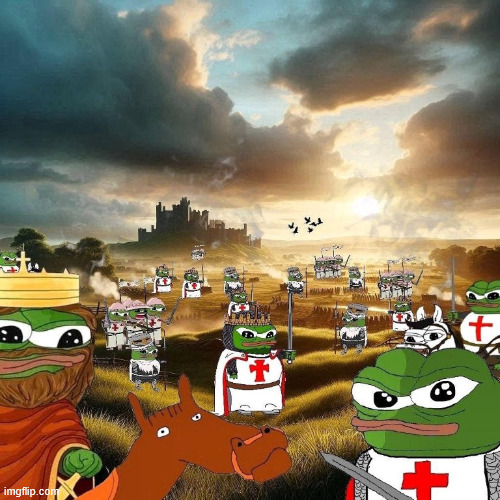
The Church used to know that before they betrayed the Templars.

The Templars re-took Jersulem with far fewer numbers, and inferior technology. I attribute that to their superior finances which were fee based, and never resorted to the sin of usury.

The Mohammedans and their Islamic banking never stood a chance while the leaders of Christendom were invested.

a4ni49.jpg


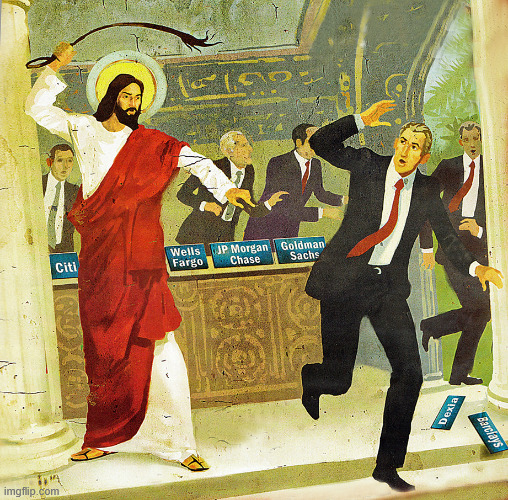
Is expanded capital needed for large investors, growth and expansion of society? Yes. But is a debt based society moral for the poor, oppressed, ignorant and destitute? No.

a4ni7k.jpg
 

New Topics

Back
Top Bottom