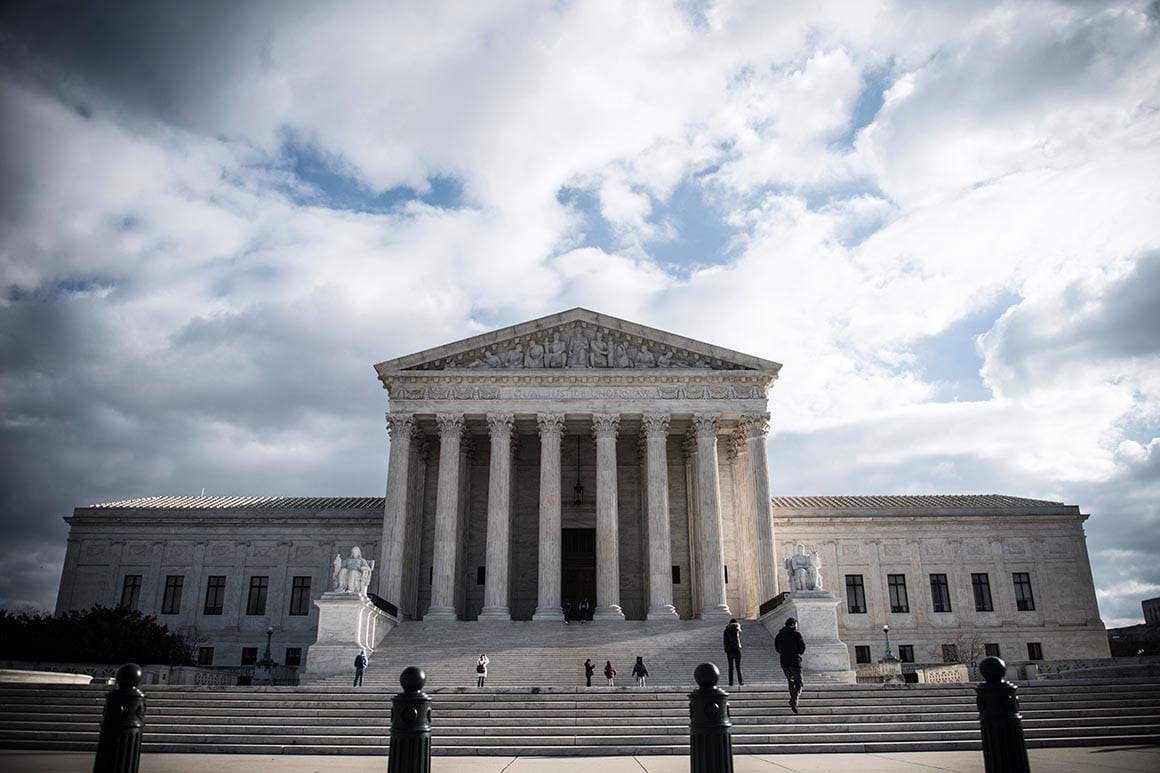
And what does that have to do with what I posted and my legal reasoning that it is not the Supreme Court's job, to clarify, limit, or possibly augment the President’s authority under the IEEPA?
It is an irrefutable fact that Congress, by the terms of our Constitution, is granted exclusive power to lay and collect imposts and duties (tariffs), and is also vested with exclusive power to “Regulate Commerce with foreign Nations”. As such, ownership of these exclusive powers gives enormous credibility to the argument that Congress, our elected Representatives and Senators, by necessary extension, likewise has the exclusive power to clarify, limit, or possibly augment the President’s authority under the International Emergency Economic Powers Act, and not a judge or a majority of Justices on our Supreme Court.
For the Supreme Court to jump in and stop the President from acting under the International Emergency Economic Powers Act would be meddling with a policy making decision which under the circumstances can only be rightfully made by Congress and the President. In addition the Supreme Court would, in effect, be negating the very reason of having elections . . . elections which are intentionally intended to accommodate for change in public policy, as opposed to unelected judges and Justices imposing their whims, fancies and personal predilections as the rule of law.
In regard to Congress’s policy making power carried out through the laying and collecting of taxes, and regulating commerce, let me once again note what our Supreme Court has emphatically concluded with respect to policy making authority “…..we are not at liberty to second-guess congressional determinations and policy judgments of this order, however debatable or arguably unwise they may be…The wisdom of Congress’ action, however, is not within our province to second guess.”
_________ELDRED et al. v. A S H C R O F T, ATTORNEY GENERAL (2003)
And, Justice Stone reminds all of us that:
“The power of courts to declare a statute unconstitutional is subject to two guiding principles of decision which ought never to be absent from judicial consciousness. One is that courts are concerned only with the power to enact statutes, not with their wisdom. The other is that while unconstitutional exercise of power by the executive and legislative branches of the government is subject to judicial restraint, the only check upon our own exercise of power is our own sense of self-restraint. For the removal of unwise laws from the statute books appeal lies, not to the courts, but to the ballot and to the processes of democratic government.” U.S. v. Butler, 297 U.S. 1, 78-79 (1936)