P F Tinmore,
et al,
All part of the same Mandate. The British Mandate of Jordan did not end until 1946. Until then, while the Mandatory did grant increasing levels of greater autonomy, it was still part of the Palestine Mandate.
Hashemite Kingdom of Jordan. said:
Between 1928 and 1946, a series of Anglo-Transjordanian treaties led to almost full independence for Transjordan. While Britain retained a degree of control over foreign affairs, armed forces, communications and state finances, Emir Abdullah commanded the administrative and military machinery of the regular government. On March 22, 1946, Abdullah negotiated a new Anglo-Transjordanian treaty, ending the British mandate and gaining full independence for Transjordan. In exchange for providing military facilities within Transjordan, Britain continued to pay a financial subsidy and supported the Arab Legion. Two months later, on May 25, 1946, the Transjordanian parliament proclaimed Abdullah king, while officially changing the name of the country from the Emirate of Transjordan to the Hashemite Kingdom of Jordan.
SOURCE:
Jordan - History - The Making of Transjordan
At least, so says the HM, The King of the Hashemite Kingdom of Jordan.
(COMMENT)
Yes, sometimes thought experiments are too complicated. But then, so is alternative history.
The separation between Jordan and Israel is outlined in the Treaty which refers back to the "Mandate."
Article 3 - International Boundary said:
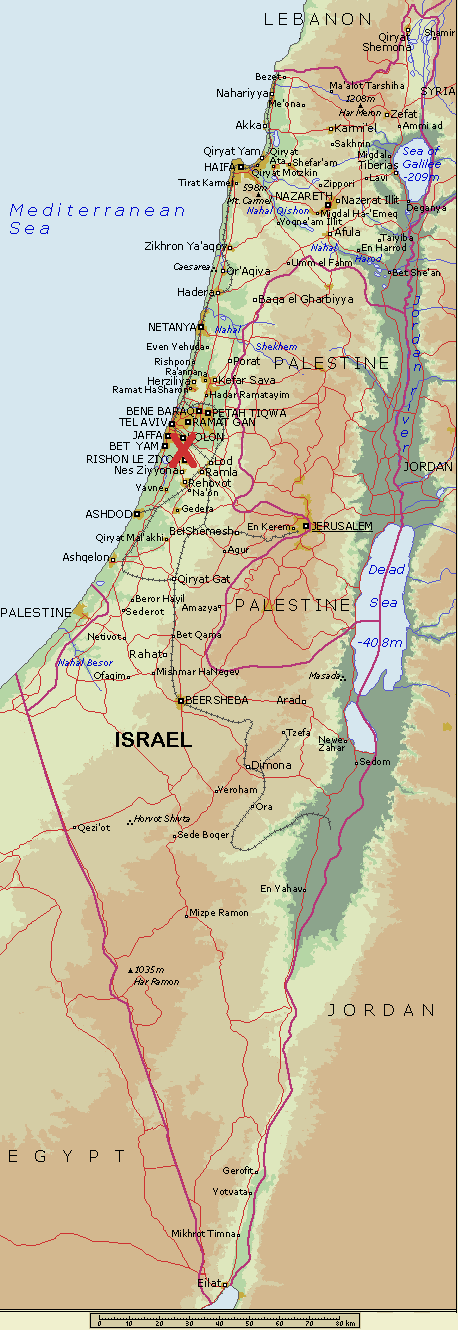
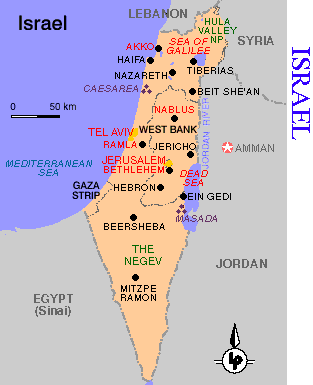
1. The international boundary between Jordan and Israel is delimited with reference to the boundary definition under the Mandate as is shown in Annex I (a), on the mapping materials attached thereto and coordinates specified therein.
2. The boundary, as set out in Annex I (a), is the permanent, secure and recognized international boundary between Jordan and Israel, without prejudice to the status of any territories that came under Israeli military government control in 1967.
3. The Parties recognize the international boundary, as well as each other's territory, territorial waters and airspace, as inviolable, and will respect and comply with them.
4. The demarcation of the boundary will take place as set forth in Appendix (I) to Annex I and will be concluded not later than 9 months after the signing of the Treaty.
5. It is agreed that where the boundary follows a river, in the event of natural changes in the course of the flow of the river as described in Annex I (a), the boundary shall follow the new course of the flow. In the event of any other changes the boundary shall not be affected unless otherwise agreed.
6. Immediately upon the exchange of the instruments of ratification of this Treaty, each Party will deploy on its side of the international boundary as defined in Annex I (a).
7. The parties shall, upon the signature of the Treaty, enter into negotiations to conclude, within 9 months, an agreement on the delimitation of their maritime boundary in the Gulf of Aqaba.
8. Taking into account the special circumstances of the Baqura/Naharayim area, which is under Jordanian sovereignty, with Israeli private ownership rights, the Parties agree to apply the provisions set out in Annex I (b).
9. With respect to the Al-Ghamr/Zofar area, the provisions set out in Annex I (c) will apply.
SOURCE: The Jordan-Israeli Peace Treaty
Under the Treaty of Sevres, that which was to become known as Palestine --- was specificed by the Treaty "within such boundaries as may be determined by the Principal Allied Powers, to a Mandatory to be selected by the said Powers."
In 1922, and under Mandate, Trans-Jordan has not yet been created, --- it was not until May 15, 1923, that the UK (as Mandatory) formally recognized the Emirate of Trans-Jordan as a state under the leadership of Emir Abdullah (the future King). This effectively cut the issue of Palestine down by 75%. As under the Mandate, gradual levels of autonomy we to be fostered and encouraged.
This is all part of the the same story and the same Mandate.
Most Respectfully,
R