Rand Paul introduces a Constitutional Amendment to end Birthright Citizenship

Nope. The Constitution is clearly written.

If you are born here, you are a citizen.

Period. Full stop.

Are We Subjects or Citizens? Birthright Citizenship and the Constitution​

...
This summer, Americans will celebrate the semiquincentennial of the Declaration of Independence—our nation’s 250th birthday. Also this summer, the U.S. Supreme Court will render a decision in the case of Trump v. Barbara, a class-action lawsuit challenging President Trump’s executive order ending the practice of birthright citizenship. The two are connected, because Trump v. Barbara involves issues fundamental to the meaning of the Declaration and the future of the American experiment in republican government. It is worth the time and effort of every citizen to understand its importance.


Birthright citizenship—the policy whereby the children of illegal aliens born within the geographical limits of the United States are entitled to American citizenship—is a great magnet for illegal immigration. Many believe that this policy is an explicit command of the Constitution, consistent with the British common law system. But this is simply not true.


The framers of the Constitution were, of course, well-versed in the British common law, having learned its essential principles from William Blackstone’s Commentaries on the Laws of England. As such, they knew that the very concept of citizenship was unknown in British common law. Blackstone speaks only of “birthright subjectship” or “birthright allegiance,” never using the terms citizen or citizenship. The idea of birthright subjectship, as Blackstone readily admits, is derived from feudal law. It is the relation of master and servant; all who are born within the protection of the king owe perpetual allegiance as a “debt of gratitude.” According to Blackstone, this debt is “intrinsic” and “cannot be forfeited, cancelled, or altered.” Birthright subjectship under the common law is thus the doctrine of “perpetual allegiance.”


America’s Founders rejected this doctrine.
The Declaration of Independence, after all, solemnly proclaims that “the good People of these Colonies . . . are Absolved from all Allegiance to the British Crown, and that all political connection between them and the State of Great Britain, is and ought to be totally dissolved.” According to Blackstone, the common law regards such an act as “high treason.” So the common law—the feudal doctrine of perpetual allegiance—could not possibly serve as the ground of American (i.e., republican) citizenship. Indeed, the idea is too preposterous to entertain!
...
 
Cont'd ...
....
... The transformation of subjects into citizens was the work of the Declaration and the Constitution. Both are premised on the idea that citizenship is based on the consent of the governed—not the accident of birth.

Citizenship, of course, does not exist by nature. It is created by law, and the identification of citizens has always been considered an essential aspect of sovereignty. After all, the founders of a new nation are not born citizens of the new nation they create. Indeed, this is true of all citizens of a new nation: they are not born into it but rather become citizens by law.

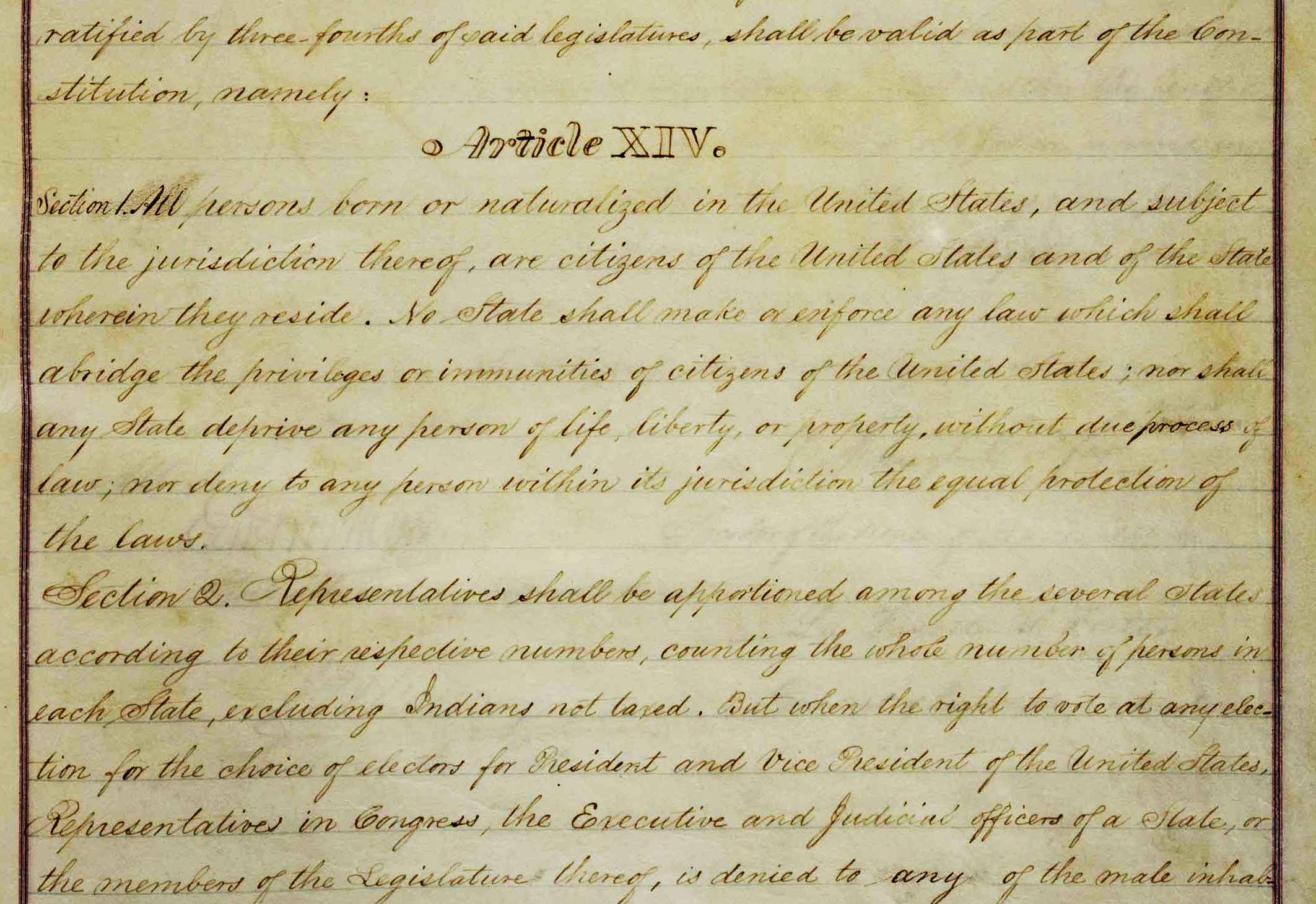
Although the Constitution of 1787 mentioned citizens, it did not define citizenship. It was not until 1868, with the ratification of the Fourteenth Amendment, that a definition of citizenship entered the Constitution. ...
Thus there are two components to American citizenship: birth or naturalization in the U.S. and being subject to the jurisdiction of the U.S.

We have somehow come today to believe that anyone born within the geographical limits of the U.S. is automatically subject to its jurisdiction. But this renders the jurisdiction clause utterly superfluous and without force. If this had been the intention of the framers of the Fourteenth Amendment, they would simply have said that all persons born or naturalized in the U.S. are thereby citizens. Furthermore, the principal supporters of the Fourteenth Amendment were explicit about the meaning of “subject to the jurisdiction”: it meant owing exclusive allegiance to the U.S. and none to any other country.
.... It is evident that the Joint Committee placed importance on the jurisdiction clause, which meant, at a minimum, that not all persons born in the U.S. were automatically citizens.
...
 
Cont'd ...
... referring to the Civil Rights Act of 1866. Illinois Senator Lyman Trumbull, chairman of the Senate Judiciary Committee and principal architect of the Thirteenth Amendment and the Civil Rights Act of 1866, joined Howard in agreeing that the “law of the land” meant that “subject to the jurisdiction” connoted “complete jurisdiction”—in other words, not owing allegiance to anyone else.

Under Section 5 of the Fourteenth Amendment, Congress has the power to define “by appropriate legislation” who is subject to the jurisdiction of the U.S. Indeed, during debate over the amendment, Senator Howard, the author of the citizenship clause, attempted to assure skeptical colleagues that the new language was not intended to make citizens of the Indians. Although the Indians were born within the nation’s geographical limits, Howard steadfastly maintained that they were not subject to the nation’s jurisdiction because they owed allegiance to their tribes. ... Howard pointed out, excluded not only Indians but “persons born in the United States who are foreigners, aliens, [or] who belong to the families of ambassadors or foreign ministers.” Thus “subject to the jurisdiction” does not simply mean, as is commonly thought today, subject to American laws or American courts. It means owing exclusive political allegiance to the U.S.
 
Cont'd;

Consider as well that in 1868, the year the Fourteenth Amendment was ratified, Congress passed the Expatriation Act. This act permitted American citizens to renounce their allegiance and alienate, or abandon, their citizenship. ... Like the idea of citizenship, this right of expatriation is wholly incompatible with the British common law understanding of perpetual allegiance and subjectship.
...
In sum, what we today call birthright citizenship is a legacy of feudalism that was decisively rejected as the ground of American citizenship by the Fourteenth Amendment and the Expatriation Act of 1868. It is absurd to believe that the Fourteenth Amendment confers the boon of American citizenship on the children of illegal aliens. Nor does the denial of birthright citizenship visit the sins of the parents on the children, as is often claimed, since the children of illegal aliens born in the U.S. are not being denied anything to which they have a right. A minor’s allegiance should follow that of his or her parents. Furthermore, it is difficult to fathom how those who defy American law can derive benefits for their children by their defiance—or that any sovereign nation would allow such a thing.
...
 
Cont'd ...

Contrary to claims made by defenders of birthright citizenship, there is no Supreme Court decision squarely holding that children of illegal aliens are automatically citizens of the U.S. In an 1898 decision, U.S. v. Wong Kim Ark, the Court did hold by a vote of six to two that a child of legal resident aliens is entitled to birthright citizenship. Even then, the Wong Kim Ark decision was based on the mistaken premise that the Fourteenth Amendment adopted the British common law system of birthright subjectship. The majority opinion did not explain how subjects were miraculously transformed into citizens within the supposedly adopted common law.

The constitutional grounds for the majority opinion in Wong Kim Ark are tendentious, and that decision could easily be overturned by our current Supreme Court this summer.
This would, of course, require a proper understanding of the foundations of American citizenship, and whether a majority of the members of our current Court is capable of such is open to conjecture. ...
It is entirely different with illegal aliens, who are here without permission.
Thus repeal of the current policy of birthright citizenship for the children of illegal aliens would not require a constitutional amendment.

We have seen that the framers of the Fourteenth Amendment agreed that Indians were not “subject to the jurisdiction” of the U.S. Beginning in 1870, however, Congress began to pass legislation offering citizenship to Indians on a tribe-by-tribe basis. ...
Thus Congress used its legislative powers under the Fourteenth Amendment to determine who was within the jurisdiction of the U.S. It could make a similar determination today, based on this legislative precedent, that children born in the U.S. to illegal aliens are not subject to American jurisdiction. A constitutional amendment is no more required now than it was in 1923.

 
Cont'd;
...
The same kind of confusion that has led us to accept birthright citizenship for the children of illegal aliens has led us to tolerate dual citizenship. We recall that the framers of the Fourteenth Amendment specified that those who are naturalized must owe exclusive allegiance to the U.S. to be included within its jurisdiction. And the citizenship oath taken by new citizens today still requires a pledge of such allegiance. ...

Elite liberal opinion has for many years considered the sovereign nation state as a historical anachronism in an increasingly globalized world. We are assured that human dignity adheres to the individual and does not require the mediation of the nation state. In this new universe of international norms, demands on the part of the nation state to exclusive allegiance or for assimilation violate “universal personhood.” In such a universe, citizenship will become superfluous or even dangerous.
...
We must constantly remind ourselves, however, of the historical fact that constitutional democracy has existed only in the nation state, and that the demise of the nation state will almost certainly mean the demise of constitutional democracy. No one believes that the European Union or similar organizations will ever produce constitutional government. Indeed, the EU is well on its way to becoming an administrative tyranny. ....
...
The doctrine of birthright citizenship and the acceptance of dual citizenship are signs that we in the U.S. are on the verge of reinstituting feudalism and replacing citizenship with the master-servant relationship. The continued vitality of the nation state and of constitutional government depends on the continued vitality of citizenship, which carries with it exclusive allegiance to what the Declaration of Independence calls a “separate and equal” nation. Unless we recover an understanding of the foundations of citizenship, we will find ourselves in a world where there are subjects but no citizens.
...
 
A bunch of racists are frantically researching things to present as evidence of beliefs they have held for a long time, and for completely different reasons. I sincerely hope they aren't fooling anyone.

Their bullshit reading of the constitution has been laughed out of every room and every court for over a century. And for good reason.

But they have been emboldened by the success of a white christian nationalist group taking control of the government.

So here we are. These things we pride our nation on are not indelible. They were hard fought wins. And we better fight to keep them.
 
Cont'd;
...
The same kind of confusion that has led us to accept birthright citizenship for the children of illegal aliens has led us to tolerate dual citizenship. We recall that the framers of the Fourteenth Amendment specified that those who are naturalized must owe exclusive allegiance to the U.S. to be included within its jurisdiction. And the citizenship oath taken by new citizens today still requires a pledge of such allegiance. ...

Elite liberal opinion has for many years considered the sovereign nation state as a historical anachronism in an increasingly globalized world. We are assured that human dignity adheres to the individual and does not require the mediation of the nation state. In this new universe of international norms, demands on the part of the nation state to exclusive allegiance or for assimilation violate “universal personhood.” In such a universe, citizenship will become superfluous or even dangerous.
...
We must constantly remind ourselves, however, of the historical fact that constitutional democracy has existed only in the nation state, and that the demise of the nation state will almost certainly mean the demise of constitutional democracy. No one believes that the European Union or similar organizations will ever produce constitutional government. Indeed, the EU is well on its way to becoming an administrative tyranny. ....
...
The doctrine of birthright citizenship and the acceptance of dual citizenship are signs that we in the U.S. are on the verge of reinstituting feudalism and replacing citizenship with the master-servant relationship. The continued vitality of the nation state and of constitutional government depends on the continued vitality of citizenship, which carries with it exclusive allegiance to what the Declaration of Independence calls a “separate and equal” nation. Unless we recover an understanding of the foundations of citizenship, we will find ourselves in a world where there are subjects but no citizens.
...
obviously.gif
 
So he tries to do it the correct way, and you trash him for it? lol
Agreed.

It's like after Dobbs....I kept asking my left wing associates...where is the amendment effort to make abortion constitutional?

Paul is following the right process. If it even gets out of the senate (the left certainly isn't going to support it.....never mind they don't care what we think).
 
I have. Have you?
Yes, I studied it in college, graduate school and taught it for 21 years. Beat that!
Why are illegals subject to the jurisdiction? Please don't embarrass yourself and confuse "within the jurisdiction.'
The amendment reads "subject to the jurisdiction". Illegals are subject to the jurisdiction of the United States because they are here, illegally or not, have no bearing. Diplomatic persons and their families are here under the auspices of their home country and are subject to their jurisdiction, and not that of the United States. That is why we have the concept of diplomatic immunity.
 
Yes, I studied it in college, graduate school and taught it for 21 years. Beat that!

The amendment reads "subject to the jurisdiction". Illegals are subject to the jurisdiction of the United States because they are here, illegally or not, have no bearing.
Nope. that means they are within the jurisdiction, Can we draft Illegals? Are the children of Mexicans Mexican citizens?
Diplomatic persons and their families are here under the auspices of their home country and are subject to their jurisdiction, and not that of the United States. That is why we have the concept of diplomatic immunity.
Yes, diplomatic immunity is completely separate from Constitutional citizenship. Diplomatic immunity is statutory.
 
15th post
There should be no need for an amendment to clarify the 14th as only pertaining to those who are legally in the U.S.

That (legal requirement) fact was a given at the time the 14th was adopted, and it certainly was never the intent of any founding principles of the nation to provide incentives for criminal exploitation of the text of the Constitution itself.
 
I have. Have you?

Why are illegals subject to the jurisdiction? Please don't embarrass yourself and confuse "within the jurisdiction.'
They are NOT!
As explained in the excerpts in my above posts.
However there has been an interpretation by the Court to that effect which many consider to be in error.
 
Nope. that means they are within the jurisdiction, Can we draft Illegals? Are the children of Mexicans Mexican citizens?

Yes, diplomatic immunity is completely separate from Constitutional citizenship. Diplomatic immunity is statutory.
Statutory, based on the 14th Amendment. Thank you very much!
 
Back
Top Bottom