Sure we can.
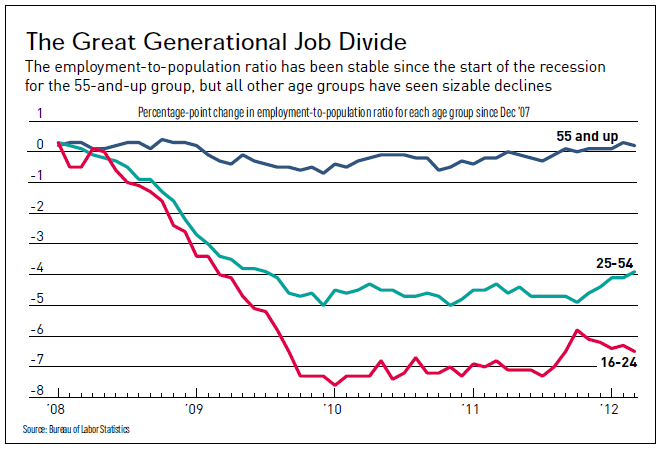
If the drop in Labor Force Participation was becuase old people were retiring then today's labor force would be younger. It isn't. In fact what everyone's seeing is the opposite and it's the young that are out of work, not the old. Any
google key words "generation unemployment" pops up articles pointing out--
--that blaming retirees doesn't make much sense. What does make sense is blaming the war on hiring, better known as an expressed policy of vengeance against employers that's causing massive unemployment, discouraged workers, and the forsaken young.
What would be an interesting affect is if the upper age bracket of population is growing. Wouldn't the percentage of total employment for that age bracket also be growing proportionally?
No, those numbers aren't interesting at all.
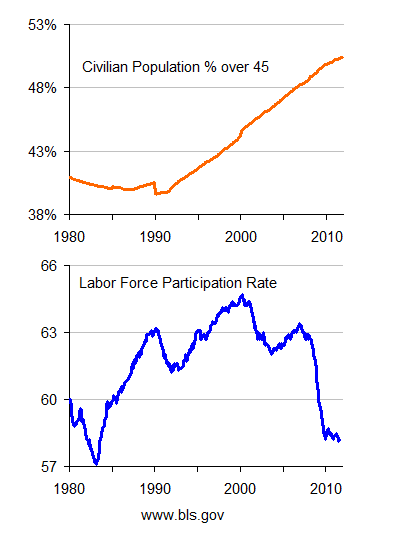
The population aged gradually over decades while the participation rate did its massive swings over a few months with the '08 election.
Actually they are, unless your trying to make some partisan point by cherry picking graphs.
First off, I never said anything about "blaming the elderly". I just raised the possibility that both end may have been lopped off. And, if both ends are lopped off, then you get the same average.
My point is that, all other things being equal, if the 55 and over is an increasing proportion of the civilian population, then they would represent an increasing proportion of the labor force and an increasing proportion of the employed. The same would be so for any age group.
Now I'm not saying they are, just that it provides the baseline for determining exactly what the employment percentages are doing. In any particular year, all other things being equal, the age distribution for the employed should be the same distribution for the underlying civilian population. If it's not, then it deserves some explanation as to why it's different.
If you lop both ends off, then you don't get younger, you get the same average. You seem to have gotten all fixated on one thing I said, ignoring that I presented about four articles regarding the decline in the younger age groups.
And, in running the civilian population numbers for the groups as you presented them, the 16-24 has been flat since '07. So, clearly, that the employment dropped, then that age group isn't represented in the employment numbers as we should expect. The 55 and over age group has increased a bit, though not a lot. Given that their representation in the employment rolls has been pretty flat, per your graph, there has been a slight drop, though not by much. On the other hand, the 25-54 age bracket has declined a bit as well, so we would expect some decline in that group, though certainly not as dramatically as your graph presents.
All that said, the labor forcewas on a decline beginning in 2001, only finding temporary relief on the Bush '03 tax cuts and the housing bubble.
We are well aware that, since the recession came into play, the LF fell precipitously. And it has affected the 16-24 crowd predominately. This was a point of study for someone at the BLS, along with others, and I provided the reference to the studies.
I have no idea what your talking about with your "What does make sense is blaming the war on hiring, better known as an expressed policy of vengeance against employer". I take it this is just more partisan crap?