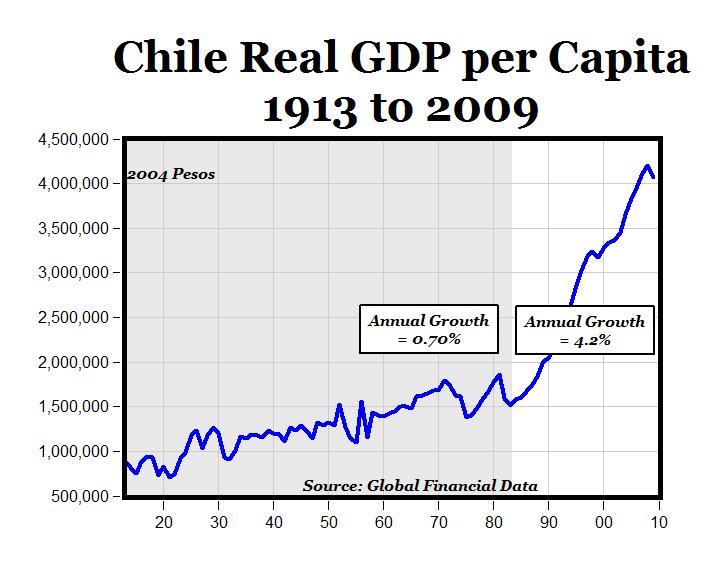
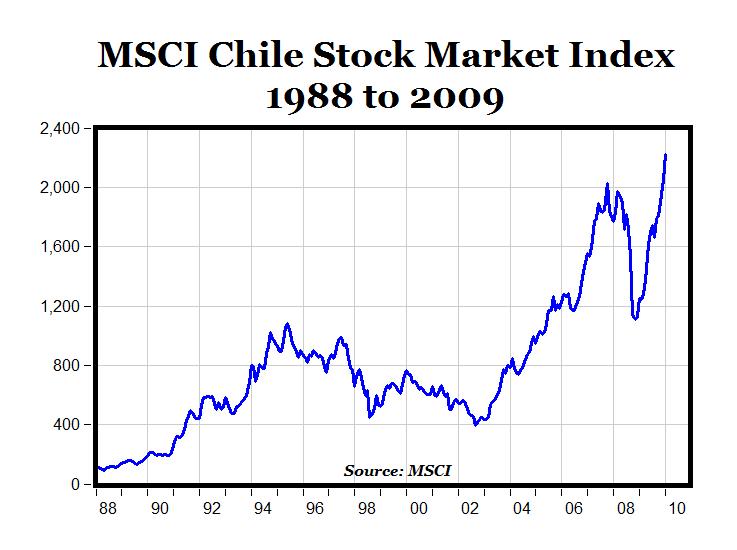
This stupid argument has been posted at least 10,000 times. Every attempt at pure socialism has resulted in mass starvation and the death of millions. On the other hand, history shows that the closer a nation gets to a free market, that faster the material well-being of its inhabitants increases.
BTW, Chile is hardly a "total failure. It's the wealthiest country in Latin America. Every citizen of Chile should give thanks to Pinochet and Milton Friedman for saving their country from liberalism gone wild.
Weird how conservative economic policy does that.
Got it, false premises, distortions and LIES, the ONLY thing right wingers have.
Western Europe is a real hellhole right?
Chile? Oh NOW, AFTER the Gov't took back Uncle Milties failed policies, lol
CHILE: THE LABORATORY TEST
Many people have often wondered what it would be like to create a nation based solely on their political and economic beliefs. Imagine: no opposition, no political rivals, no compromise of morals. Only a "benevolent dictator," if you will, setting up society according to your ideals.
The Chicago School of Economics got that chance for 16 years in Chile, under near-laboratory conditions. Between 1973 and 1989, a government team of economists trained at the University of Chicago dismantled or decentralized the Chilean state as far as was humanly possible. Their program included privatizing welfare and social programs, deregulating the market, liberalizing trade, rolling back trade unions, and rewriting its constitution and laws. And they did all this in the absence of the far-right's most hated institution: democracy.
The results were exactly what liberals predicted. Chile's economy became more unstable than any other in Latin America, alternately experiencing deep plunges and soaring growth. Once all this erratic behavior was averaged out, however, Chile's growth during this 16-year period was one of the slowest of any Latin American country. Worse, income inequality grew severe. The majority of workers actually earned less in 1989 than in 1973 (after adjusting for inflation), while the incomes of the rich skyrocketed. In the absence of market regulations, Chile also became one of the most polluted countries in Latin America. And Chile's lack of democracy was only possible by suppressing political opposition and labor unions under a reign of terror and widespread human rights abuses.
Conservatives have developed an apologist literature defending Chile as a huge success story.
Chile: the laboratory test
Chile's Retirees Find Shortfall in Private Plan (AGAIN) rescued by Big Gov't, weird right? lol
January 27, 2005
Nearly 25 years ago, Chile embarked on a sweeping experiment that has since been emulated, in one way or another, in a score of other countries. Rather than finance pensions through a system to which workers, employers and the government all contributed, millions of people began to pay 10 percent of their salaries to private investment accounts that they controlled.
Under the Chilean program - which President Bush has cited as a model for his plans to overhaul Social Security - the promise was that such investments, by helping to spur economic growth and generating higher returns, would deliver monthly pension benefits larger than what the traditional system could offer.
But now that the first generation of workers to depend on the new system is beginning to retire, Chileans are finding that it is falling far short of what was originally advertised under the authoritarian government of Gen. Augusto Pinochet.
For all the program's success in economic terms, the government continues to direct billions of dollars to a safety net for those whose contributions were not large enough to ensure even a minimum pension approaching $140 a month. Many others - because they earned much of their income in the underground economy, are self-employed, or work only seasonally - remain outside the system altogether. Combined, those groups constitute roughly half the Chilean labor force. Only half of workers are captured by the system.
Even many middle-class workers who contributed regularly are finding that their private accounts - burdened with hidden fees that may have soaked up as much as a third of their original investment - are failing to deliver as much in benefits as they would have received if they had stayed in the old system.
lol
http://www.nytimes.com/2005/01/27/business/worldbusiness/27pension.html