Phoenall, pbel,
et al,
Of course, much
(but not all) of the impetus behind the Arab and Palestinian disputes with the Israelis
(recognized Jewish leadership exercising the right of self-determination under UN guidance, protocols, and implementation assistance) is in connection with the claims of land sovereignty.
The argument on the Arab and Palestinian side of the equation is the basic claim that they, as stakeholders, had the priority bid for either an "independent Arab State" or "confederation of Arab States" as the regional indigenous population to the former territory under the Ottoman Empire, as citizens of the Ottoman Empire.
All three parties
(the Arab League, the indigenous Arab Palestinian, and the invited Jewish Immigrants) promote their version of the same argument, in that they each hold some established inherent rights of a people with a historical connection to the lands, territories and resources. All three arguments are cultural-centric based (antiquated) on or derive from their particular political view, economic perspective, and social structures
(some spiritual traditions, some history, and philosophical considerations).
Certainly, some of these views, perspectives, and philosophies have evolved with time, it is apparent that most of the constituents of each of the three parties, really has no appreciation for the views, perspectives, and philosophies held by the other.
Another weakness in the balancing of the equation is that, neither party
(as individual or collectively as cultures) has the advanced to the point that outside guidance from the experience of the Allied Powers
(or the Quartet as it as evolved into - today), has a true impact. The dispute is what "mine" and "due me" and "owned." It has nothing to do with the more advanced concepts of peace, or harmonious and cooperative relations between the three parties, based on principles of justice, democracy, respect for human rights, non-discrimination and good faith.
From the outset, the two of the three parties, opposed the more advanced idea that, for the sake of cultural preservation and the protection of a people, --- that Jewish people be granted grounds for reconstituting their national home. The other two parties to the dispute believed that justice and benevolence belonged to them exclusively, and that they had no responsibility to the advancement of humanity; or as they say today, it is all about them; Arabs that have cut themselves off from fellowship with humankind and hardened themselves against endeavor to be peaceful and charitable to other cultures less fortunate.
pbel,
et al,
It is a timeline issue again.
I don't know why everyone ignores the fact that in 2012, the UN, by a very large margin recognized the State of Palestine to the 67 borders as a observer State...I don't see this Status being reduced and believe full recognition will follow. Also this recognition has the force of International Law...Sure Israel will ignore it and the world Boycott of any goods made in the occupation areas will quickly expand...
Of course the Palestinians can negotiate if it wishes, but the UN's die has been cast!
(COMMENT)
Of course
A/RES/67/19 4 December 2012, indicates Palestine could open negotiations. But the State of Palestine could have begun negotiations at any point after
A/RES/43/177 15 December 1988.
And no mention in he resolutions of binding borders for Israel and Palestine.
(COMMENT)
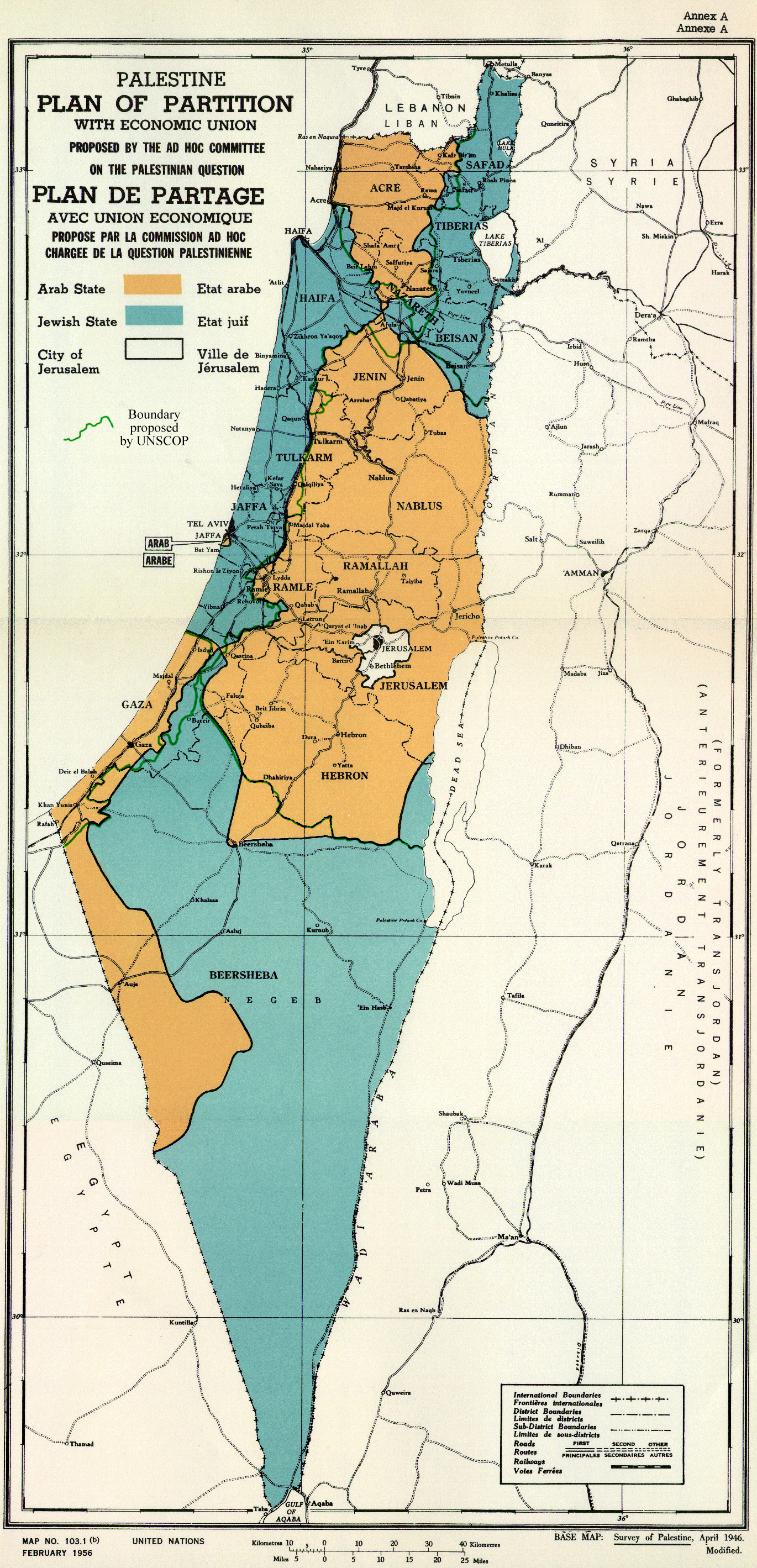
Again, boundaries were originally specified in the Resolution of 1947 and implemented by the UNPC. There was no Arab sovereignty (less the Hashemite Kingdom) in the disputed territories until 1988. This is a matter of historical record.
What is or was binding is merely an attempt to justify the continuation of the conflict, and not a matter of justice or sovereign resolution. The Palestinian declared the solemn oath to commit genocide
(The only way to establish partition is first to wipe them out man women and child.") even before the Jewish State became a reality. This is not an example of a Arab culture with the moral turpitude that seeks justice, but rather the conduct that is considered contrary to the international standards of justice.
What is binding or non-binding, has nothing to do with the conduct that is considered contrary to the international standards of justice. It is about the face of a culture that has based its entire existence for more than half a century, on jihad. And that is a matter of historical record.
Finally, whether or not the recommendations of 1947 are sound and valid, does not change the fact that the Arab parties to the conflict consistently chose the belligerent path to resolution and to the promulgation this moral turpitude for future of the upcoming generations to follow. Their pathway way established with the emergence of the martyr Izz al-Din al-Qissam, and carried forth in each succeeding generation for more than nine decades --- advancing a cause and principle of jihad up to the present day.
The struggle today, is not about justice, but about advancing a cause and principle of jihad.
Most Respectfully,
R