[/QUOTE
I am in my mid sixties, and my first introduction to Israel situation came from watching the events unfold before and during the six day war. The bellicose bully, Nassar, was boasting continually about pushing the Jews into the sea
All the talk those days was about pan Arabism. They felt powerful because of their increasing oil wealth and felt confident that with the full weight of the massive Arab world coming to bear, this time they would finally be able to make good on their promise to kill Jews until they hid behind rocks and trees.
There was no talk about people called Palestinian because there were none - Just Arabs united in a common culture of Jew hatred.
Having lived in a time before Palestians were invented gives me a good understanding on the nature and effects of relentless propaganda. How many others are old enough to remember a time before their invention?
I think it makes a HUGE difference in the way people do or do not succumb to the propaganda.
Your history is way off

en.wikipedia.org
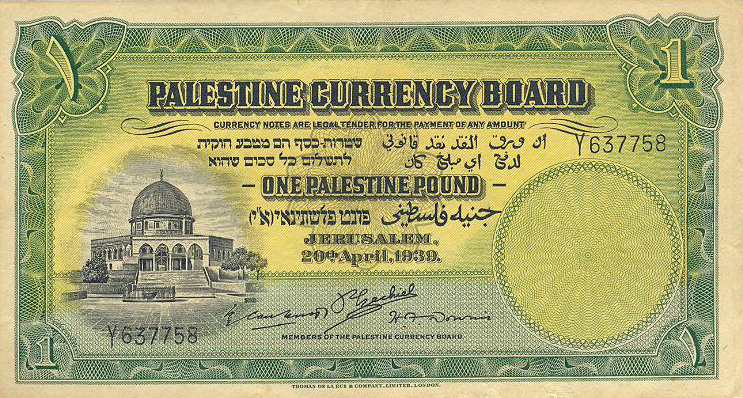
you are a perfect illustration of my o.I. Here you are an ignorant child who wasn't even born until two decades after the six day war yet you think a coin used by Arabs and Jews alike somehow proves the existence of a Palestinian identity.
I was alive then, kid. There was no Palestinian identity yet, just Arabs.
So the Jews minted Palistinian coins
Look pop, you are more senile than dopey Joe.
Go rock the chair
It was the British who were responsible for the minting of the coins, you ignorant little child.
After ww1, the Ottoman Empire ceded the territory it owned to the British, who administered the mandate until the creation of the two nation states Isreal and Jordan.
You should stop before you embarrass yourself any further.
Have you been brainwashed for long?
en.wikipedia.org
Until 1918, Palestine was an integral part of the
Ottoman Empire and therefore used its currency, the
Ottoman lira. During
1917 and 1918, Palestine was occupied by the British army, who set up a
military administration. The official currency was the
Egyptian pound, which had been first introduced into Egypt in 1834, but several other currencies were
legal tender at fixed exchange rates that were vigorously enforced.
[2][3] After the establishment of a civil administration in 1921, the
High Commissioner Herbert Samuel ordered that from 22 January 1921 only Egyptian currency and the
British gold sovereign would be legal tender.
[4]
In 1926, the British
Secretary of State for the Colonies appointed a Palestine Currency Board to introduce a local currency.
[5] It was based in London and chaired by Mr. P.G. Ezechiel, with a Currency Officer resident in Palestine.
[5] The board decided that the new currency would be called the Palestine pound, fixed in value to the
British pound and divided into 1000 mils.
[6] The one pound gold coin would contain 123.27447
grains of standard gold.
[6] The enabling legislation was the Palestine Currency
Order, 1927, signed by the King in February 1927.
[7] The Palestine pound became legal tender on 1 November 1927.
[8] The Egyptian pound (at the fixed rate of 0.975 to the Palestine pound) and the British gold sovereign remained legal tender until 1 March 1928.
[7][9]
The Palestine Currency Order explicitly excluded
Transjordan from its application, but the Government of Transjordan decided to adopt the Palestine pound at the same time as Palestine did.
[10][11] The Egyptian pound remained legal tender in Transjordan until 1930.
[12]