And not even counting that.
The main reason that Iwo Jima was needed was as an emergency landing strip for bombers going to Japan.
And until the end of the war, over 2,400 B-29s made emergency landing on that island. Not because of combat damage, but simple mechanical failure or adverse winds causing them to run critically low on fuel.
The first bombers were actually making landings before the runway was complete, and Japanese snipers were still shooting the construction workers.
I read today that they were having tons of engine problems till after the war was over on the B-29s.
Once they ironed out the kinks and switch over to new engines they were extremely reliable.
"The most common cause of maintenance headaches and catastrophic failures was the engines.
[24] Although the
Wright R-3350 Duplex-Cyclone radial engines later became a trustworthy workhorse in large piston-engined aircraft, early models were beset with dangerous reliability problems. This problem was not fully cured until the aircraft was fitted with the more powerful
Pratt & Whitney R-4360 "Wasp Major" in the
B-29D/B-50 program, which arrived too late for
World War II. Interim measures included cuffs placed on propeller blades to divert a greater flow of cooling air into the intakes, which had baffles installed to direct a stream of air onto the exhaust valves. Oil flow to the valves was also increased,
asbestos baffles were installed around rubber
push rod fittings to prevent oil loss, thorough
pre-flight inspections were made to detect unseated valves, and mechanics frequently replaced the uppermost five cylinders (every 25 hours of engine time) and the entire engines (every 75 hours).
[N 1][24][27]
Pilots, including the present-day pilots of the
Commemorative Air Force's
Fifi, one of the last two remaining flying B-29s, describe flight after takeoff as being an urgent struggle for airspeed (generally, flight after takeoff should consist of striving for altitude).
Radial engines need airflow to keep them cool, and failure to get up to speed as soon as possible could result in an engine failure and risk of fire. One useful technique was to check the magnetos while already on takeoff roll rather than during a conventional static engine-runup before takeoff.
[27]

Interior photo of the rear pressurized cabin of the B-29 Superfortress, June 1944
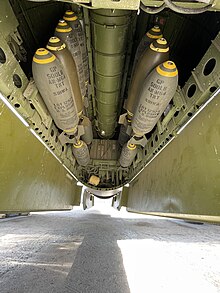
B-29 Weapons Bay with General-Purpose AN-M64 TNT 500 LB bombs
In wartime, the B-29 was capable of flight at altitudes up to 31,850 feet (9,710 m),
[28] at speeds of up to 350 mph (560 km/h; 300 kn) (
true airspeed). This was its best defense because Japanese fighters could barely reach that altitude, and few could catch the B-29 even if they did attain that altitude."

en.wikipedia.org