
2aguy
Diamond Member
- Jul 19, 2014
- 113,149
- 53,672
- 2,290
- Thread starter
- #161
Hey...Daryl hunt........you were saying about the colorado AR-15 ban?
Now, a Colorado judge has tossed the AR-15 ban in the trash bin, along with the provision prohibiting ownership of magazines that carry more than 10 rounds. That’s the backdoor gun ban right there. It’s not just about the rifle. It’s about curbing constitutional gun rights by these magazine laws.
A host of firearms that aren’t AR-15 rifles have magazines with more than 10 rounds. This law would effectively ban them too.
We all see what you’re doing here, liberal America (via Free Beacon):
A judge struck down Boulder, Colorado's ban on the possession of AR-15s and magazines holding more than 10 rounds on Monday.
Colorado state judge Andrew Hartman ruled the city's gun ban violated the state's preemption law, which prevents localities from imposing gun regulations above and beyond state law. Judge Hartman's ruling declares the ordinance invalid and immediately bars the city from enforcing the ban.
"The Court has determined that only Colorado state (or federal) law can prohibit the possession, sale, and transfer of assault weapons and large capacity magazines," Hartman wrote in the ruling.
The ruling is the latest in a string of victories for gun advocates who have used state preemption laws to overturn strict local gun regulations. A Washington court struck down a local ordinance on gun storage in February 2021, and a Pennsylvania court struck down Pittsburgh's attempt to regulate the use of AR-15s inside city limits in October 2019.
Jon Caldara, a longtime Boulder resident who openly flouted the AR-15 ban, said he was "thrilled" by the ruling. The former Denver Post columnist and Independence Institute president publicly announced he would not comply with the order to turn over his AR-15 or ammunition magazines when the ban was instituted in 2019. He filed a separate federal suit against the ordinance and said his family has received backlash from supporters ever since.
"I was probably the most publicly known criminal in Boulder," he told the Washington Free Beacon. "That made us social outcasts. And it was really bad. My daughter got bullied at school for our position."
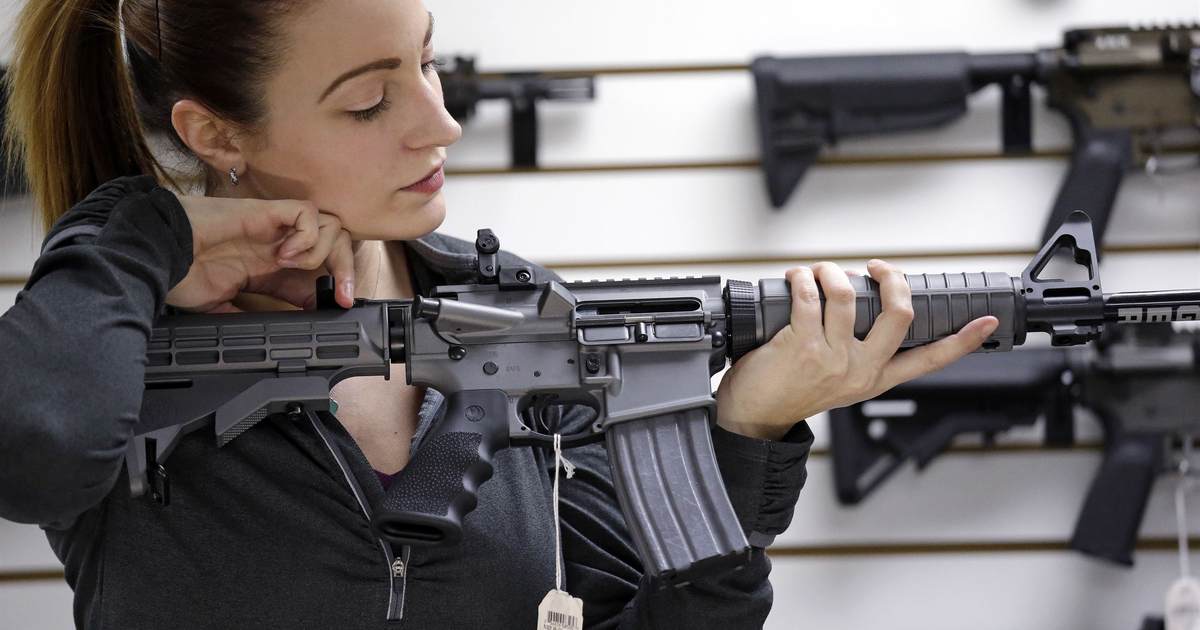
Colorado Judge Takes a Katana to Boulder's AR-15 Ban
We touched on this back in 2018. Boulder, Colorado was pushing to ban owning AR-15 rifles. They’re ctownhall.com
I agree with the ruling since that was already established by the 9th Circuit Federal Court. But the State Law reads 15 as being the max. And that has been upheld in various courts.
And that is just dumb. Limiting bullets was simply a way to back door ban various types of pistols that take 15-19 rounds in their magazine. It was stupid and pointless.......
It's the law and has been upheld in Federal Courts.
No.....left wing judges on the federal courts have ignored the Supreme Court rullings on Heller, McDonald, Caetano, and Scalia in Friedman....
Reread Heller V. It doesn't say what you claim it does and,so far, it's been the basis for all Gun Court rulings.
I have read heller and I know the left wing judges ignore it.....and then make up their own rulings.......
And in Scalia's Dissent in Friedman he specifically states that the AR-15 is protected under the 2nd Amendment......by name. And since he wrote the decision in Heller, his statement in Friedman explains the AR-15 is protected............
I did a search for Friedman V and came up with quite a bit but it's about economics. How about giving us the rest of the Friedman V title so we can research it.
Here.....
https://www.supremecourt.gov/opinions/15pdf/15-133_7l48.pdf
The question under Heller is not whether citizens have adequate alternatives available for self-defense.
Rather, Heller asks whether the law bans types of firearms commonly used for a lawful purpose—regardless of whether alternatives exist. 554 U. S., at 627–629. And Heller draws a distinction between such firearms and weapons specially adapted to unlawful uses and not in common use, such as sawed-off shotguns. Id., at 624–625.
The City’s ban is thus highly suspect because it broadly prohibits common semiautomatic firearms used for lawful purposes.
Roughly five million Americans own AR-style semiautomatic rifles. See 784 F. 3d, at 415, n. 3. The overwhelming majority of citizens who own and use such rifles do so for lawful purposes, including self-defense and target shooting. See ibid. Under our precedents, that is all that is needed for citizens to have a right under the Second Amendment to keep such weapons. See McDonald, 561 U. S., at 767–768; Heller, supra, at 628–629.
Do you know what Dissenting means for the Courts? It means you lost your argument and it was ruled the other way.
Now for the real Ruling.
https://law.justia.com/cases/federal/appellate-courts/ca7/14-3091/14-3091-2015-04-27.html
That is ARIE S. FRIEDMAN, ET AL. v. CITY OFHIGHLAND PARK, ILLINOIS in it's entirety. Banning the AR style (and the ruling specifically uses "AR" in it's ruling along with high capacity mags has been upheld in many Court Rulings from the East Coast to the West Coast. Those that just say "Assault Rifles" never passes muster in the courts because that includes a lot of fine hunting rifles. But by putting in a phrase of "AR and it's clones" makes it dead legal. This ruling supported the other court rulings. And does NOT go against Heller or McDonald at all.
Yes......they court did not hear that case...but....Scalia wrote the opinion in Heller......the opinion that rules how the court should have ruled on hearing that case.....and he stated, as the Majority opinion writer in Heller, that AR-15 rifles are protected rifles, by name...this is not a minority opinion writer commenting, this is the man who wrote the opinion in Heller so whatever he writes after goes directly to the meaning of Heller...
It is completely against Heller and ignores what the Supreme Court has stated not only in Heller but Miller, Caetano, and Scalia in Friedman.....
There was no ruling in Heller about any long guns. Again, you quote the losing side. The Winning side in Heller just dealt with handguns and licensing for DC.
No...it didn't.....it stated...
https://www.supremecourt.gov/opinions/07pdf/07-290.pdf
Some have made the argument, bordering on the frivolous, that only those arms in existence in the 18th century are protected by the Second Amendment.
We do not interpret constitutional rights that way. Just as the First Amendment protects modern forms of communications, e.g., Reno v. American Civil Liberties Union, 521 U. S. 844, 849 (1997), and the Fourth Amendment applies to modern forms of search, e.g., Kyllo v. United States, 533 U. S. 27, 35–36 (2001), the Second Amendment extends, prima facie, to all instruments that constitute bearable arms, even those that were not in existence at the time of the founding.
Also.....Caetano v Massachusetts....Which came after Heller.....
Opinion of the Court[edit]
In a per curiam decision, the Supreme Court vacated the ruling of the Massachusetts Supreme Judicial Court.
------
As to “dangerous,” the court below held that a weapon is “dangerous per se” if it is “ ‘designed and constructed to produce death or great bodily harm’ and ‘for the purpose of bodily assault or defense.’” 470 Mass., at 779, 26 N. E. 3d, at 692 (quoting Commonwealth v. Appleby, 380 Mass. 296, 303, 402 N. E. 2d 1051, 1056 (1980)). That test may be appropriate for applying statutes criminalizing assault with a dangerous weapon. See ibid., 402 N. E. 2d, at 1056.
But it cannot be used to identify arms that fall outside the Second Amendment.
First, the relative dangerousness of a weapon is irrelevant when the weapon belongs to a class of arms commonly used for lawful purposes. See Heller, supra, at 627 (contrasting “‘dangerous and unusual weapons’” that may be banned with protected “weapons . . . ‘in common use at the time’”).
Second, even in cases where dangerousness might be relevant, the Supreme Judicial Court’s test sweeps far too broadly.
Heller defined the “Arms” covered by the Second Amendment to include “‘any thing that a man wears for his defence, or takes into his hands, or useth in wrath to cast at or strike another.’” 554 U. S., at 581.
Under the decision below, however, virtually every covered arm would qualify as “dangerous.” Were there any doubt on this point, one need only look at the court’s first example of “dangerous per se” weapons: “firearms.” 470 Mass., at 779, 26 N. E. 3d, at 692.
If Heller tells us anything, it is that firearms cannot be categorically prohibited just because they are dangerous. 554 U. S., at 636.
The Stun Gun was a bad decision and was overturned. As for Heller, here is the overview direct from Heller and NOT from the dissent which dissent is from the losing side. Here it is from the winning side.
64 DISTRICT OF COLUMBIA v. HELLER Opinion of the Court In sum, we hold that the District’s ban on handgun possession in the home violates the Second Amendment, as does its prohibition against rendering any lawful firearm in the home operable for the purpose of immediate self-defense. Assuming that Heller is not disqualified from the exercise of Second Amendment rights, the District must permit him to register his handgun and must issue him a license to carry it in the home. * * *
We are aware of the problem of handgun violence in this country, and we take seriously the concerns raised by the many amici who believe that prohibition of handgunownership is a solution. The Constitution leaves the District of Columbia a variety of tools for combating thatproblem, including some measures regulating handguns, see supra, at 54–55, and n. 26. But the enshrinement of constitutional rights necessarily takes certain policychoices off the table. These include the absolute prohibition of handguns held and used for self-defense in the home. Undoubtedly some think that the Second Amendment is outmoded in a society where our standing army is the pride of our Nation, where well-trained police forces provide personal security, and where gun violence is a serious problem. That is perhaps debatable, but what isnot debatable is that it is not the role of this Court to pronounce the Second Amendment extinct.We affirm the judgment of the Court of Appeals. It is so ordered.
All the other crap you bring up is from the dissent which means nothing legally.
The Dissent from Scalia is in Friedman.......not Heller......
Scalia wrote the majority opinion in Heller, when the court refused to slap down the lower court by not taking the case, Scalia went on to explain Heller further.....stating that the AR-15 is protected....he wrote the opinion in Heller so it isn't a just a dissent.....the dissent was against them not doing their job and taking the case....his explanation in the Dissent is completely relevant to what he stated in Heller....
And Heller isn't just about handguns........
Scalia stated in Heller....
the Second Amendment extends, prima facie, to all instruments that constitute bearable arms, even those that were not in existence at the time of the founding.
You don't know what you are talking about.....that, right there, states that all bearable arms are protected by the 2nd Amendment under the majority opinion of the United States Supreme Court.....It also confirms the ruling in Miller....and just after Heller, the Supreme Court ruled that "Dangerous and Unusual" can't be used to ban guns.......using the case of stun guns as a way to define dangerous and unusual and those terms effect on Second Amendment law...
Show me the quote where Scalia specifically said that the AR was protected. I mean the whole paragraph. Your Red statement doesn't make sense until they overturn the 1934 NFA law.
Scalia...who wrote the majority opinion in Heller writing in Friedman when the rest of the Justices decided not to hear the Friedman case.....his dissent here matters because, again, he actually wrote the opinion in Heller and in his writings in Friedman, goes more in depth into what he meant in Heller........
He cites Heller and Macdonald when he states that the AR-15 rifle is protected by the 2nd Amendment...........
Lastly, the Seventh Circuit considered “whether lawabiding citizens retain adequate means of self-defense,” and reasoned that the City’s ban was permissible because “f criminals can find substitutes for banned assault weapons, then so can law-abiding homeowners.” 784 F. 3d, at 410, 411.
Although the court recognized that “Heller held that the availability of long guns does not save a ban on handgun ownership,” it thought that “Heller did not foreclose the possibility that allowing the use of most long guns plus pistols and revolvers . . . gives householders adequate means of defense.” Id., at 411.
That analysis misreads Heller.
The question under Heller is not whether citizens have adequate alternatives available for self-defense. Rather, Heller asks whether the law bans types of firearms commonly used for a lawful purpose—regardless of whether alternatives exist. 554 U. S., at 627–629.
And Heller draws a distinction between such firearms and weapons specially adapted to unlawful uses and not in common use, such as sawed-off shotguns. Id., at 624–625.
The City’s ban is thus highly suspect because it broadly prohibits common semiautomatic firearms used for lawful purposes.
Roughly five million Americans own AR-style semiautomatic rifles. See 784 F. 3d, at 415, n. 3. The overwhelming majority of citizens who own and use such rifles do so for lawful purposes, including self-defense and target shooting. See ibid. Under our precedents, that is all that is needed for citizens to have a right under the Second Amendment to keep such weapons. See McDonald, 561 U. S., at 767–768; Heller, supra, at 628–629.
The Seventh Circuit ultimately upheld a ban on many common semiautomatic firearms based on speculation about the law’s potential policy benefits. See 784 F. 3d, at 411–412. The court conceded that handguns—not “assault weapons”—“are responsible for the vast majority of gun violence in the United States.” Id., at 409.
Still, the court concluded, the ordinance “may increase the public’s sense of safety,” which alone is “a substantial benefit.” Id., at 412.
Heller, however, forbids subjecting the Second Amendment’s “core protection . . . to a freestanding ‘interestbalancing’ approach.” Heller, supra, at 634. This case illustrates why. If a broad ban on firearms can be upheld based on conjecture that the public might feel safer (while being no safer at all), then the Second Amendment guarantees nothing.
III
The Court’s refusal to review a decision that flouts two of our Second Amendment precedents stands in marked contrast to the Court’s willingness to summarily reverse courts that disregard our other constitutional decisions.


