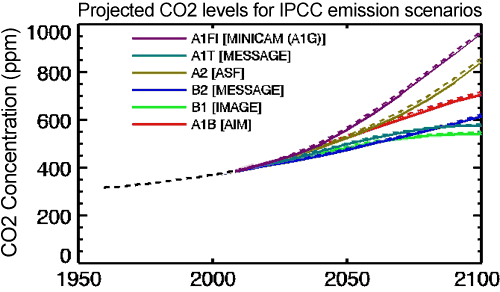
Crick, You cant read a LOG function graph. You and Mathew dont know the difference between EM and photon energy or how they react differently within our atmosphere. Man you two should stop while your behind and you bury yourselves.
For starters, it wasn't a log graph, it was a lin/ln graph (linear on the independent axis, natural logarithm on the dependent axis). If you want us to think I don't know how to read it, you need to point out where you think I demonstrated such a failing. Just saying it doesn't make it so.
For both Matthew and I, the use of the term photon was nothing more than an exercise of literary license. However, I am familiar with the physics of electromagnetic radiation and with photons and unless you're going to bring up the dual nature of light, I don't have the faintest idea what the **** you're talking about. However, nothing you've said has any bearing on the validity of our comments with regard to the topic under discussion (the heating of the oceans). But just to further explore your apparent misunderstandings:
**********************************************************************************************************************************
PHOTON:
A
photon is an
elementary particle, the
quantum of
light and all other forms of
electromagnetic radiation. It is the
force carrier for the
electromagnetic force, even when
static via
virtual photons. The effects of this
force are easily observable at the
microscopicand at the
macroscopic level, because the photon has zero
rest mass; this allows long distance
interactions. Like all elementary particles, photons are currently best explained by
quantum mechanics and exhibit
wave–particle duality, exhibiting properties of
waves and of
particles. For example, a single photon may be
refracted by a
lens or exhibit
wave interference with itself, but also act as a particle giving a definite result when its
position is measured.
The modern photon concept was developed gradually by
Albert Einstein in the first years of the 20th century to explain experimental observations that did not fit the classical
wave model of light. In particular, the photon model accounted for the frequency dependence of light's energy, and explained the ability of
matter and
radiation to be in
thermal equilibrium. It also accounted for anomalous observations, including the properties of
black-body radiation, that other physicists, most notably
Max Planck, had sought to explain using
semiclassical models, in which light is still described by
Maxwell's equations, but the material objects that emit and absorb light do so in amounts of energy that are
quantized (i.e., they change energy only by certain particular discrete amounts and cannot change energy in any arbitrary way). Although these semiclassical models contributed to the development of quantum mechanics, many further experiments
[2][3] starting with
Compton scattering of single photons by electrons, first observed in 1923, validated Einstein's hypothesis that
light itself is
quantized. In 1926 the optical physicist Frithiof Wolfers and the chemist
Gilbert N. Lewis coined the name
photon for these particles, and after 1927, when
Arthur H. Compton won the Nobel Prize for his scattering studies, most scientists accepted the validity that
quanta of light have an independent existence, and the term
photon for light quanta was accepted.
EM RADIATION
Electromagnetic radiation (
EM radiation or
EMR) is a form of
radiant energy released by certain
electromagnetic processes. Visible
light is one type of electromagnetic radiation, other familiar forms are invisible electromagnetic radiations such as X-rays and radio waves.
Classically, EMR consists of
electromagnetic waves, which are synchronized
oscillations of
electric and
magnetic fields that propagate at the
speed of light. The oscillations of the two fields are perpendicular to each other and perpendicular to the direction of energy and
wave propagation, forming a
transverse wave. Electromagnetic waves can be characterized by either the
frequency or
wavelength of their oscillations to form the
electromagnetic spectrum, which includes, in order of increasing frequency and decreasing wavelength:
radio waves,
microwaves,
infrared radiation,
visible light,
ultraviolet radiation,
X-rays and
gamma rays.
Electromagnetic waves are produced whenever
charged particles are
accelerated, and these waves can subsequently interact with any charged particles. EM waves carry
energy,
momentum and
angular momentum away from their source particle and can impart those quantities to
matter with which they interact. Quanta of EM waves are called
photons, which are
massless, but they are still affected by
gravity. Electromagnetic radiation is associated with those EM waves that are free to propagate themselves ("radiate") without the continuing influence of the moving charges that produced them, because they have achieved sufficient distance from those charges. Thus, EMR is sometimes referred to as the
far field. In this jargon, the
near fieldrefers to EM fields near the charges and current that directly produced them, as (for example) with simple magnets,
electromagnetic induction and
static electricity phenomena.
All from Wikipedia
********************************************************************************************************************************
Hell you dont even know why sea water can not absorb IR radiation at 12-16um.. And therefore can not warm the oceans..
.
Here. From someone you trust. Dr Roy Spencer:
http://www.drroyspencer.com/2014/04/can-infrared-radiation-warm-a-water-body/
Your earlier comments about salt and sediment particles was silly.