Zone1 Who is a more righteous man?

Who is a more righteous man? Rank them in order and/or tell us why one is the most righteous

  • Jesus

    Votes: 13 81.3%
  • Mohammad

    Votes: 0 0.0%
  • Joseph Smith

    Votes: 0 0.0%
  • Ghandi

    Votes: 1 6.3%
  • Karl Marx

    Votes: 0 0.0%
  • Buddha

    Votes: 2 12.5%
  • Trump

    Votes: 0 0.0%
  • Hitler

    Votes: 0 0.0%
  • Stalin

    Votes: 0 0.0%
  • Obama

    Votes: 0 0.0%

  • Total voters
    16
Democratic rules on forums.
Racists like forums.
During the USSR time there were no forums.
Harder way of life for Russians and Chinese then and now.
The internet is free.
 
Regime countries are more strict against openness.
 
What does Jesus think about openness? Can anyone Jesus philosophy?
 
What do you think about the return of goodness to earth? Will he come back or will he not? Is Jesus in heaven or in a secret place right now? What is yours greatest dream about Jesus being saved, being a believer, or likes Muhammed and Muslims more?
 
Jesus first
god second
W Bush third
Ramaswamy four
Kasich five
 
Well, for starters both were real. Also both pacifists.
Are you suggesting that Jesus was not real?

Jesus did prove he was not a pacifist as he picked up a whip in the temple, so does that make him less righteous in your eyes?

I have to disagree in regard to Ghandi being a pacifist though as he successfully fought a political battle to be free from the British crown. His tactics were very manipulative. Even though he did not take up arms to fight, he used all other means to fight.
 
Just how righteous was a man like Ghandi?


We all have a dark side it seems

In 1885, Gandhi's father, Karamchand, developed a fistula and grew gravely ill. One night soon after, according to a 2010 biography, Gandhi was sitting up with his father, but eventually left to have sex with his new bride, Kasturba. Karamchand died while Gandhi was away.

Not long after, he went to South Africa, where perhaps his darkest chapter begins...

Before leading his historic push for India's independence from the British Empire, Gandhi famously led civil rights movements in South Africa, another British colony, between 1893 and 1915, when he was in his mid-20s through his mid-40s.

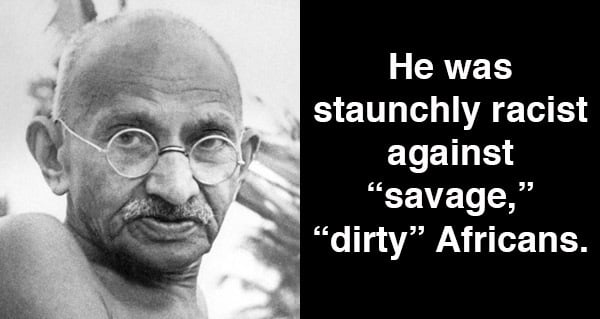
While Gandhi's time fighting for the rights of Indians in South Africa is often now mythologized as the heroic precursor to his later efforts in India, the dark side of this tale reveals that Gandhi's motivations in South Africa included his strident racism against the local black populations there.

"Ours is one continual struggle against a degradation sought to be inflicted upon us by the Europeans, who desire to degrade us to the level of the raw Kaffir [a slur now classified as hate speech and generally considered to be the equivalent of "******" in the United States] whose occupation is hunting, and whose sole ambition is to collect a certain number of cattle to buy a wife with and, then, pass his life in indolence and nakedness," Gandhi said during an address in Bombay in 1896.

"Kaffirs are as a rule uncivilised—the convicts even more so. They are troublesome, very dirty and live almost like animals," he wrote in Indian Opinion in 1908.

An oft-recited turning point in Gandhi's life involves his being thrown off a train for refusing to move out of first class, which was reserved for whites, early on during his time in South Africa. However, during both that incident and the entire civil rights movement that followed, Gandhi wasn't so much campaigning for Indians' rights in and of themselves, but more so that Indians simply be given more rights than the local blacks.

"A general belief seems to prevail in the colony that the Indians are little better, if at all, than the savages or natives of Africa. Even the children are taught to believe in that manner, with the result that the Indian is being dragged down to the position of a raw Kaffir," he said.

When the British moved to placing the Indian and black populations together, Gandhi harshly resisted, writing to the local health officer in 1905, "Why, of all places in Johannesburg, the Indian location should be chosen for dumping down all kaffirs of the town, passes my comprehension. Of course, under my suggestion, the Town Council must withdraw the Kaffirs from the Location. About this mixing of the Kaffirs with the Indians I must confess I feel most strongly. I think it is very unfair to the Indian population, and it is an undue tax on even the proverbial patience of my countrymen."

Yes, when Gandhi wrote to Hitler at least twice in 1939 and 1940, he did so to call for peace and, yes, Gandhi was, by all accounts, an impossibly kind and gracious person who might address anyone as "friend."

Nevertheless, it's quite something to see the 20th century's most revered figures write a "Dear friend..." letter to the century's greatest monster -- and then add things like, "We have no doubt about your bravery or devotion to your fatherland, nor do we believe that you are the monster described by your opponents."

Once again, you've got to account for both Gandhi's peerlessly magnanimous warmth and the perils of historical hindsight, but just as it was with Hitler, it's strange to hear that Gandhi had some kind, admiring words about the brutal fascist dictator that led Italy against the Allies during World War II.

In his 2011 book, Subhash Chandra Bose in Nazi Germany, author Romain Hayes explains that, after the two met in 1931, Gandhi called Mussolini "one of the great statesmen of our time," and went on to write the following in a letter to a friend:

"Many of his reforms attract me. He seems to have done much for the peasant class. I admit an iron hand is there. But as violence is the basis of Western society, Mussolini's reforms deserve an impartial study.”

Although Gandhi is now famous for both his vegetarianism and his historic fasts lasting up to 21 days, his unusual eating behaviors do not at all end there.

For much of his adult life, he would restrict himself to eating only nuts, grains, fruits, and vegetables -- and only in small quantities.

Finally, with his health failing to the point of teeth falling out, his doctors were able to convince him to at least drink some milk, but Gandhi could only be convinced to drink goat's milk. He even traveled around with a goat to be sure that the milk he drank was both fresh and actually from a goat (and not from another animal surreptitiously tapped by someone in his entourage).

And one of the chief reasons for all of these dietary restrictions: He believed it would curb his sex drive.

Gandhi's unusual diet very often left him highly constipated and spending hours at a time in the bathroom.

But where things get weird (at least for most Westerners) -- according to Gandhi: Naked Ambition, a 2010 biography by Jad Adams -- is in how Gandhi dealt with his constipation.

According to Adams, Gandhi would routinely invite one or more of the many female companions he kept around into the bathroom to visit with him while he was on the toilet.

According to Great Soul, a 2011 biography by Joseph Lelyveld, Gandhi happily gave himself enemas that went above and beyond the call of duty, as far as his constipation went -- often giving himself two a day.

However, things get more uncomfortable when you learn that Gandhi also regularly subjected his young female companions to daily enemas as well

Throughout much of his adult life, Gandhi kept plenty of young female companions close to him and allowed these relationships to take several different dark turns.

For starters, he often kept pairs of girls as his daily companions to address his needs right down to basic movement, with Gandhi referring to them, according to Adams, as his "walking sticks."

Moreover, Gandhi made things uncomfortably personal in both routinely bathing with these girls and habitually starting the day by asking them if they'd had a good bowel movement.

What's worse, even if we can believe that these teenage girls had the ability to consent to any of this, it's not clear that there was any consent in the first place.

According to Adams, Gandhi first met one of his most famous companions, Sushila Nayar, when she was just six and was brought to him by her mother. There, with the girl on his lap, Gandhi asked her mother to gift her to him. Nayar didn't become his just then, but did return as a teenager and became Gandhi's close companion.

According to Adams' biography, in addition to tending to his needs regarding bathing and bowel movements, Gandhi tasked his young female companions with regularly giving him massages while he was in the nude. Reportedly, he liked mustard oil and lime juice to be used during these massages.

1778364033948.webp


After Gandhi's father died while Gandhi was off having sex, and once again after coming to the realization that he couldn't serve humanity while also consumed by lust, a thirty-something Gandhi decided that he must take a vow of chastity -- and tested that chastity in some rather odd ways.

Although he forbade men and women (even husbands and wives) from sleeping together while at his ashrams, Gandhi had many women -- some of them teenagers, some of them married -- sleep nude in his bed.

The year before his death, a 77-year-old Gandhi cast a then 33-year-old Sushila Nayar (who Gandhi had asked to be given to him as a gift by her mother when she was just six) out of his bed in favor of a younger woman: Manu, his 18-year-old grandniece.

Gandhi explicitly stated that sleeping with Manu in the nude yet resisting sexual temptation was his most important experiment in chastity, telling her that "[we] must put our purity to the ultimate test."

At that same time, he also pulled Abha, the 18-year-old wife of his grandnephew, into bed with him -- and things quickly became problematic. When Gandhi began publicly speaking about his sleeping arrangement, even those in his inner circle asked that he remove the girls from his bed. He initially refused; finally, after several of his close associates parted ways with him over the matter, he relented.

Nevertheless, he asked that Manu share their sleeping arrangement with the world once he died. When that happened just months later, however, Gandhi's associates, including his son, made it clear to Manu that she should keep her mouth shut.

Given his extraordinary chastity experiments, Gandhi is on record as being particularly concerned about avoiding any kind of ejaculation.

In describing his philosophy of celibacy, he stated that he strove to be "One who never has any lustful intention, who, by constant attendance upon God, has become proof against conscious or unconscious emissions." He thus complained about the nocturnal emissions he suffered and said that, "One who conserves his vital fluid acquires unfailing power."

What's more, he kept none of this to himself, instead making his views on semen and ejaculation part of his sermons, and even asserting that his avoidance of ejaculation was essential in helping India reach independence, stating, "I hold that true service of the country demands this observance."

While Gandhi clearly had his own, deep-seated sexual hang-ups resulting in fervid chastity and experiments designed to test that chastity, what's more problematic is that he acted out similar experiments with others -- specifically, children.

Although husbands and wives weren't even allowed to sleep together at his ashrams, the boys and girls were -- all under Gandhi's peculiar supervision.

First, they would bathe together; "I sent the boys reputed to be mischievous and the innocent young girls to bathe at the same time," Gandhi said, according to Adams' biography. Then, they would sleep, beds very close together, with Gandhi often there himself to act as a watchdog.

If any of the boys or girls succumbed to temptation -- temptation that Gandhi himself all but orchestrated -- they were punished. And to add insult to injury, it seems that the boys didn't get it as badly as the girls, whose hair would be chopped off if they misbehaved.

Although Gandhi married Kasturba Kapadia in an arranged marriage while teenagers, they stayed together all their lives. Nevertheless, even if Gandhi's needs weren't overtly sexual, they did draw him into many inappropriately intimate relationships with other women (aside from the young girls we've already discussed).

There was Madeleine Slade, the daughter of a British admiral who left home to devote herself to Gandhi and his work. The two were inseparable and exchanged countless intimate missives that, many note, read like love letters.

Then there was Saraladevi Choudhurani, a Bengali activist to whom he grew very close, inviting her to his ashram and enraging his wife by spending plenty of time alone with her and allowing her to avoid the chores required of everyone else. In a letter to a friend, he once referred to her as his "spiritual wife."

Although Gandhi and his wife stayed married their entire lives, it's readily apparent that Gandhi's vows of poverty and chastity drove this once well-to-do couple apart, and that Gandhi felt that his wife was never on the same spiritual and intellectual plane as he. He would go on to say some cruel things about her, including:

"I simply cannot bear to look at Ba's face. The expression is often like that on the face of a meek cow and gives one the feeling as a cow occasionally does, that in her own dumb manner she is saying something."
What's troubling about Gandhi's unusual lifestyle choices -- celibacy, poverty, fasting -- is that he forced them upon his family as well. By all accounts, his wife managed to put up with these things, but they (namely, the poverty) eventually helped eat away at her health. In early 1944, when she was stricken with pneumonia, Gandhi once again imposed his choices upon her and refused to allow her to be injected with "alien medicine," i.e. penicillin.

Soon after, she died. And not long after that, Gandhi himself contracted malaria. But this time, he allowed doctors to inject him with quinine and save his life.
Though plenty of ink has been spilled over Gandhi's supposed feminism, there are just too many facts and stories to the contrary to ignore.

According to the Guardian, he: "believed menstruation was a manifestation of the distortion of a woman's soul by her sexuality;" argued that women should be responsible for sexual assaults carried out upon them; contended that fathers are justified in killing daughters that have been sexually assaulted in order to preserve family honor; labelled women who used contraceptives as whores; and once chopped off the hair of two female followers who were being harassed so that the perpetrators would stop.

In the 1930s, Gandhi and Jawaharlal Nehru (his associate and eventually the first prime minister of India) both led campaigns to have all traces of homoerotic tradition removed from displays in India's Hindu temples as part of a "sexual cleansing" initiative.

Though the following may be as trite as it is true, everyone has a dark side.

Whether it's respected founding fathers and presidents, beloved children's book authors and rock stars, or even sanctified religious leaders, there's not a single person without some troubling, or at least bizarre, skeletons in their closet.

And because no one is without skeletons, we needn't necessarily crucify anyone, no matter how deified, over their dark side. But there's no reason to run away from investigating and attempting to understand those dark sides either. Such is the case with Mahatma Gandhi, certainly one of the most universally revered figures in modern history.

With that in mind, above are 19 Gandhi facts and quotes that reveal the dark, bizarre side of the man rightfully revered for leading India to independence and serving as a beacon of hope, peace, and freedom around the world.

Of course, this is true for sinful mortal men like Ghandi or Buddha. That means only Jesus could have escaped these natural flaws of human nature, that is, only if he was God in the flesh.
 
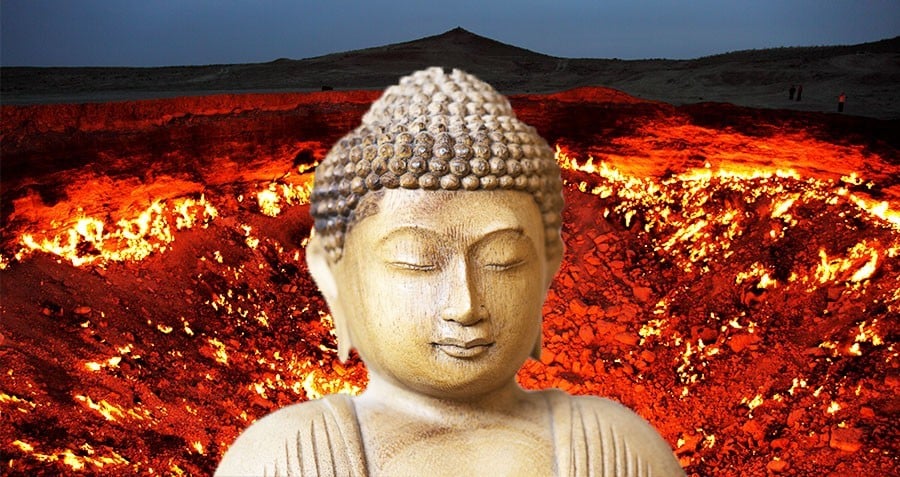
And alas, the dirt on Buddha as well.


The Buddha has become a living personality in Western pop culture, though one that is often but a tissue of romantic projections and postmodern Orientalism. The Buddha long ago joined the likes of Jimi Hendrix, Albert Einstein, and the Dalai Lama as the face of a million Internet memes offering up feel-good bits of wisdom he never actually said and, in many cases, would never say.

Even among Buddhists who read the teachings of the historical Buddha, there isn’t much of a sense of the Buddha’s human personality and pre-legendary biography. This is chiefly because the oldest Buddhist scriptures are massive — thousands of pages long, 40 volumes in one popular edition.

In fact, most followers are only familiar with the Buddhist teachings that are regularly chanted in temples or published in collections of the Buddha’s most important teachings. And as for the biography of the Buddha himself, his legend long ago overtook what the earliest sources actually say.

What’s more, the Buddha’s true personality and opinions would shock many Westerners (and even some Buddhists).

I was able to read most — not all — of the Pali Tipitaka (the original and most complete canon of Buddhist scripture, and the source of the quotations and stories below) during the three years I spent living in a Buddhist monastery. And what I found revolutionized my understanding of both Buddhist teachings and who the Buddha was as a human being.

Far from his cheerful and cherubic depictions today, the Buddha viewed the world as full of ugliness and suffering — a worldview which started from a relatively early age. According to the Buddha’s portrayal of himself, he grew up in great wealth in present-day India sometime between the sixth and fourth centuries BCE but as a young man left home to become a religious wanderer. He did this against the wishes of his parents, who wept and mourned at their son’s decision.

The Buddha tells us that he left home because he was horrified and humiliated by the universal nature of illness, suffering, and death and wanted to seek a reality that transcended such things. It was this quest that motivated him to wander into the Indian jungle with its growing culture of spiritual philosophers and renunciants.

After attaining what he called nirvana (the ultimate state of enlightenment), the Buddha taught others for 45 years. As a teacher in later life his character was stern, ascetic, and possessed of remarkable integrity and clarity of vision. His spirituality was practical: He claimed he was only concerned with leading people to the transcendence he had achieved and the freedom from suffering it offered.

The Buddha was so keen on the transcendence he’d found because he saw the universe as an ultimately meaningless prison and the truths he’d discovered as the escape route. The Buddha compared human life to torture, debt, prison, being burnt alive, and being afflicted with leprous sores. He view eating food as a violent act, akin to cannibalizing your only child — a comparison which likely won’t show up as a Facebook meme anytime soon.

Yet, despite the Buddha’s despair at the human condition, he was a man of deep compassion and humanity who relieved what suffering he could with what wisdom he thought others could absorb. The Buddha tirelessly taught others and developed communities that would practice his ways, gradually setting down a detailed code of monastic rules and etiquette. He remained a poor wanderer until his death.

Contrary to popular Eastern (and, by extension, Western) images of him as a plump, long-haired demigod with a perfect complexion, the Buddha shaved his head, and in his later years was indistinguishable to visitors of his community from any other members of his gang of ragged, wandering monks.

The Buddha was what you might call a staunch puritan. He advised his lay followers not to frequent public festivities or carouse at night or to gamble, and to be exceedingly frugal. He told his monastic followers to wander alone “like rhinoceros horns,” avoiding the conflict and stress of companionship unless there was spiritual insight to be gained from it.

Furthermore, the Buddha was also a critic of the human body itself, calling it “a sack full of impurities” and a “festering boil.” To cure their lust, he taught his monks to meditate on how revolting it was. The Buddha didn’t stop there: He detailed a series of cemetery meditations in which monks would watch human bodies in various stages of decomposition.

In fact, the most marked failure in the history of Buddhist teachings was surely when a large group of monks whom he had taught to meditate on the loathsomeness of their own bodies committed suicide as a result (the Buddha then modified his instructions so that monks would keep their psychic balance while meditating on the body).

In addition, the Buddha compared singing to howling, dancing to lunacy, and laughing out loud to childishness, advising his followers to give up singing and dancing and be content with only moderate smiling.

In one case, the Buddha had harsh words for an entertainer who believed that after death he would be reborn in a heaven of laughing angels. Far from being rewarded for making people laugh, said the Buddha, the entertainer would in fact be reborn in “the hell of laughter” for filling people’s minds with delusions.

And despite the Western view of Buddhist teachings as empirical, practical, and even scientific, he in fact claimed to speak regularly to devatas (spirit beings from a higher plane than the human) and claimed that he and some of his disciples had supernatural powers: ESP, telekinesis, astral travel, flight, and more.

The Buddha’s record with women is complex and contradictory — and not exactly what you may imagine when thinking of tantra. While he affirmed women’s equal potential in the spiritual life by proclaiming that they too could attain nirvana and gave special teachings to laywomen in addition to creating a nun’s order, he’s also on record as saying some pretty vile things about women.

When talking to his monks, the Buddha is quoted comparing women to creepers that entangle and then fell a tree, and to poisonous black snakes on account of their being “impure, foul-smelling, dangerous, traitorous to friends, frightening, wrathful, hostile, and double-tongued.”

The Buddha also warned his monks that it would be better for them to put their penises in the mouth of a cobra or a pit of hot coals than in a vagina. The Buddha was, it should be noted, talking to monks, who are sworn to celibacy and must uphold their vows or suffer the karmic consequences.

All in all, far from the caricature of easygoing, all-accepting blissfulness that has inspired a million head shops to adorn themselves with Buddha statues, the actual Buddha was a complex human being and a stern, sometimes unpalatable spiritual teacher whose views are not as easy to digest as many might think.
 
So, I ask you, where is the dirt on Jesus?

Anyone?
 
Are you suggesting that Jesus was not real?

Jesus did prove he was not a pacifist as he picked up a whip in the temple, so does that make him less righteous in your eyes?

I have to disagree in regard to Ghandi being a pacifist though as he successfully fought a political battle to be free from the British crown. His tactics were very manipulative. Even though he did not take up arms to fight, he used all other means to fight.
Well yeah. That's a pretty well known fact.
 
The inherent problem with people claiming to be Christian is this: They think that by being "good" or doing "good works" will earn them salvation and a place in Heaven. But that could not be further from the truth. The Bible is replete with verses that indict all of mankind with sin, wickedness, and unrighteousness, and that the penalty is death. But Jesus, being G-d Himself (contrary to what Jews claim), states the one and only condition. John 3:3 says: "Unless a man is born again, he cannot see the Kingdom of G-d". This means a Spiritual birth. And the ONLY way to attain that is via a repentant, personal relationship with Jesus Christ Himself vis a vis the Cross.
 
The inherent problem with people claiming to be Christian is this: They think that by being "good" or doing "good works" will earn them salvation and a place in Heaven. But that could not be further from the truth. The Bible is replete with verses that indict all of mankind with sin, wickedness, and unrighteousness, and that the penalty is death. But Jesus, being G-d Himself (contrary to what Jews claim), states the one and only condition. John 3:3 says: "Unless a man is born again, he cannot see the Kingdom of G-d". This means a Spiritual birth. And the ONLY way to attain that is via a repentant, personal relationship with Jesus Christ Himself vis a vis the Cross.
Yes, and Christianity is the only religion that teaches this. All other religions you hope that your good outweighs your bad deeds, in the hopes that you won't go to hell if it exists.
 
Well yeah. That's a pretty well known fact.
Most historians claim that he did exist.

Naturally, someone that good, people tend to say that he did not exist because there is no way any mortal man could be that good.

I get it. Just know you are in the minority here based on other historical texts, not just the Bible showing Jesus really existed.

But at least you agree that if he did exist, he was the most righteous man who ever lived

Baby steps,.
 
What is righteousness? Is there really "good" and "bad"?

Leftists are known for saying that they don't believe in a God, so they claim there is no such thing as sin.........................that is..................until Orange man.

Then all of a sudden, he is the worst human being on the planet, including Hitler himself. In fact, Orange man is soooo bad, Christians should be ashamed of themselves for ever voting for him.

Hilarious.

So, now is your chance to tell us who is righteous and who is not based on your political and/or religious views.

Go!!!

Feel free to add to the list.
For me ... Scripture is the "go to" when discussing the righteous vs. the unrighteous:

Romans 3:10, "As it is written, There is none righteous, no, not one:"
Isaiah 64:6, "But we are all as an unclean thing, and all our righteousnesses are as filthy rags; and we all do fade as a leaf; and our iniquities, like the wind, have taken us away."

Jesus Christ is God in the flesh. Through faith in Him, mankind can find justification and partake in His righteousness.
 
15th post
Most historians claim that he did exist.

Naturally, someone that good, people tend to say that he did not exist because there is no way any mortal man could be that good.

I get it. Just know you are in the minority here based on other historical texts, not just the Bible showing Jesus really existed.

But at least you agree that if he did exist, he was the most righteous man who ever lived

Baby steps,.
Nobody has to claim the other two existed. There is no direct archeological evidence that jesus was real.
 
Nobody has to claim the other two existed. There is no direct archeological evidence that jesus was real.
Wrong

For a long time, there was no evidence of a man called Pontius Pilate as well. He was only known through the Bible and the historians Josephus and Tacitus who also wrote about the life of Jesus.

Read more at: What Archaeological Evidence Proves That Jesus Existed?

Pontius Pilate appears prominently in all four Gospel accounts as the Roman prefect who authorized Jesus’ crucifixion. For many years, historians knew about Pilate only from biblical sources and mentions in ancient writers like Josephus and Tacitus. In 1961, archaeologists working in Caesarea Maritima found a limestone stone bearing an inscription that reads “Pontius Pilate, Prefect of Judea” in Latin. This inscription provides the only archaeological evidence of Pilate’s official title and his role as prefect of Judea. The stone dates to the first century and originally stood in a public building where Pilate would have conducted official business. The discovery of this stone proved that Pilate was a real historical figure with the authority the Gospel accounts attribute to him. The inscription confirms that Pilate held the title of prefect during the time when Jesus was crucified. Before the discovery of this stone, some scholars questioned whether Pilate had actually governed Judea or held the position described in the Gospels. The archaeological evidence of Pilate’s stone removed all doubt about his historical reality and official position. This finding demonstrates that key figures mentioned in connection with Jesus’ death are confirmed as real historical people through archaeological discovery.

Read more at: What Archaeological Evidence Proves That Jesus Existed?

Try again.

Wiki agrees


There is no scholarly consensus concerning the historicity of most elements of Jesus's life as described in the Bible, and only two key events of the biblical story of Jesus's life have been widely accepted as historical, based on the criterion of embarrassment, namely his baptism by John the Baptist and his crucifixion by the order of Pontius Pilate,
 
Most historians claim that he did exist.

jesus existed, and died for the cause of liberation theology, self determination, not the 4th century christian bible jesus, used by the crucifiers for their own purposes of servitude and denial ...

Yes, and Christianity is the only religion that teaches this ...

no -

there is no such religion as christianity - the heavens will never make a messiah to help any particular people over another - jesus never claimed to be a messiah and taught the lessons made through the parable of noah to triumph over evil as the means for judgement and admission to the everlasting.
 
Nobody has to claim the other two existed. There is no direct archeological evidence that jesus was real.
Do you realize that the one person on these boards, Breezewood, that hates the Bible more than you believes Jesus existed?

:auiqs.jpg:
 
Back
Top Bottom