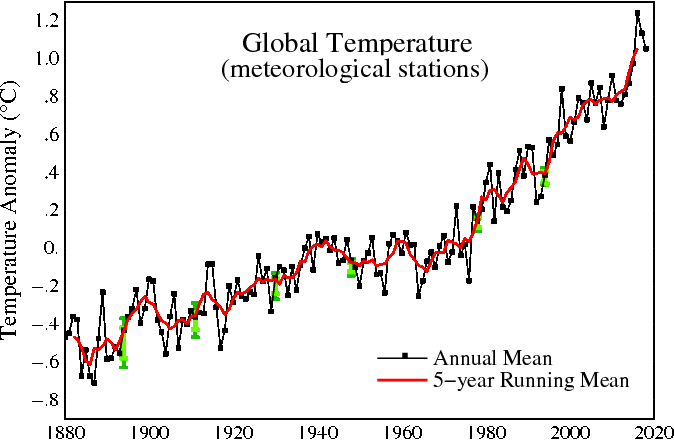
Our deadbeat atheists found RELIGON with gorebal warming. Don't stand for something, fall for anything...and boy howdy did they ever!
Remember the "melting glaciers"? Nothin but a hoax...read em and weep ya angry old hippies:
From 2010:
Millenniums-long melting trend now appears to be changing. No matter how assiduously Mr. Gore tries to ignore it, almost all of the ice-covered regions of the Earth are now gaining mass. (Or, displaying positive values, if you will.)
For starters, let’s look at those Himalayan glaciers. In a great article, entitled “World misled over Himalayan glacier meltdown,” Jonathan Leake and Chris Hastings show that the IPCC’s fraudulent claims were based on “speculation” and “not supported by any formal research.”
As a matter of fact, many Himalayan glaciers are growing. In a defiant act of political incorrectness, some 230 glaciers in the western Himalayas - including Mount Everest, K2 and Nanga Parbat - are actually growing.
•“These are the biggest mid-latitude glaciers in the world,” says John Shroder of the University of Nebraska-Omaha. “And all of them are either holding still, or advancing.”
And get this. Eighty seven of the glaciers have surged forward since the 1960s.
So much for Mr. Gore’s “more than 80 glaciers.”
(I don’t know how many Himalayan glaciers are being monitored, but my guess would be fewer than a thousand, so it’s possible that hundreds more are growing. There aren’t enough glaciologists in the world to monitor them all.)
But we don’t need to look to the Himalayas for growing glaciers. Glaciers are growing in the United States.
Yes, glaciers are growing in the United States.
Look at Washington State. The Nisqually Glacier on Mt. Rainier is growing. The Emmons Glacier on Mt. Rainier is growing. Glaciers on Glacier Peak in northern Washington are growing. And Crater Glacier on Mt. Saint Helens is now larger than it was before the 1980 eruption. (I don’t think all of the glaciers in Washington or Alaska are being monitored either.)
Or look at California. All seven glaciers on California’s Mount Shasta are growing. This includes three-mile-long Whitney glacier, the state’s largest. Three of Mount Shasta’s glaciers have doubled in size since 1950.
Or look at Alaska. Glaciers are growing in Alaska for the first time in 250 years. In May of last year, Alaska’s Hubbard Glacier was advancing at the rate of seven feet (two meters) per day - more than half-a-mile per year. And in Icy Bay, at least three glaciers advanced a third of a mile (one half kilometer) in one year.
Oh, by the way. The Juneau Icefield, with its “positive values,” covers 1,505 square miles (3,900 sq km) and is the fifth-largest ice field in the Western Hemisphere. Rather interesting to know that Gore’s own source admits that the fifth-largest ice field in the Western Hemisphere is growing, don’t you think?
But this mere handful of growing glaciers is just an anomaly, the erstwhile Mr. Gore would have you believe.
Well, let’s look at a few other countries.
•Perito Moreno Glacier, the largest glacier in Argentina, is growing.
•Pio XI Glacier, the largest glacier in Chile, is growing.
•Glaciers are growing on Mt. Logan, the tallest mountain in Canada.
•Glaciers are growing on Mt. Blanc, the tallest mountain in France.
•Glaciers are growing in Norway, says the Norwegian Water Resources and Energy Directorate (NVE).
•And the last time I checked, all 50 glaciers in New Zealand were growing.
But this is nothing. These glaciers are babies when you look at our planet’s largest ice masses, namely, the Antarctic and Greenland ice sheets.
Contrary to what you may have heard, both of those huge ice sheets are growing.
•In 2007, Antarctica set a new record for most ice extent since 1979, says meteorologist Joe D’Aleo. While the Antarctic Peninsula area has warmed in recent years, and ice near it diminished during the summer, the interior of Antarctica has been colder and the ice extent greater.
Antarctic sea ice is also increasing. According to Australian Antarctic Division glaciology program head Ian Allison, sea ice losses in west Antarctica over the past 30 years have been more than offset by increases in the Ross Sea region, just one sector of east Antarctica.
•The Antarctic Peninsula, where the ice has been melting, is only about 1/50th the size of east Antarctica, where the ice has been growing. Saying that all of Antarctica is melting is like looking at the climate of Oregon and saying that this applies to the entire United States.
There was not any evidence of significant change in the mass of ice shelves in east Antarctica nor any indication that its ice cap was melting, says Dr. Allison. “The only significant calvings in Antarctica have been in the west.” And he cautioned that calvings of the magnitude seen recently in west Antarctica might not be unusual.
“A paper to be published soon by the British Antarctic Survey in the journal Geophysical Research Letters is expected to confirm that over the past 30 years, the area of sea ice around the continent has expanded.”
What about Greenland?
Greenland’s ice-cap has thickened slightly in recent years despite wide predictions of a thaw triggered by global warming, said a team of scientists in October 2005.
The 3,000-meter (9,842-feet) thick ice-cap is a key concern in debates about climate change because a total melt would raise world sea levels by about 7 meters.
But satellite measurements show that more snow is falling and thickening the ice-cap, especially at high altitudes, according to the report in the journal Science.
The overall ice thickness changes are approximately plus 5 cm (1.9 inches) per year or 54 cm (21.26 inches) over 11 years, according to the experts at Norwegian, Russian and U.S. institutes led by Ola Johannessen at the Mohn Sverdrup center for Global Ocean Studies and Operational Oceanography in Norway.
Not overwhelming growth, certainly, but a far cry from the catastrophic melting that we’ve been lead to believe.
Think about that.
•The Antarctic Ice Sheet is almost twice as big as the contiguous United States.
Put the Antarctic and Greenland Ice Sheets together, and they’re one hundred times bigger than all of the rest of the world’s glaciers combined.
More than 90 percent of the world’s glaciers are growing, in other words, and all we hear about are the ones that are shrinking.
But if so many of the world’s glaciers are growing, how can sea levels remain the same?
They can’t. The sea level models are wrong.
During the last ice age, sea levels stood some 370 feet (100 meters) lower than today. That’s where all of the moisture came from to create those two-mile-high sheets of ice that covered so much of the north.
And just as the ice has been melting for 11,000 years, so too were sea levels rising during those same years.
But the rising has stopped.
Forget those IPCC claims. Sea levels are not rising, says Dr. Nils-Axel Mörner, one-time expert reviewer for the IPCC.
Dr. Mörner, who received his PhD in geology in 1969, is one of the greatest - if not the greatest - sea level experts in the world today. He has worked with sea level problems for 40 years in areas scattered all over the globe.
•“There is no change,” says Mörner. “Sea level is not changing in any way.”
•“There is absolutely no sea-level rise in Tuvalo,” Mörner insists. “There is no change here, and there is zero sea-level rise in Bangladesh. If anything, sea levels have lowered in Bangladesh.”
“We do not need to fear sea-level rise,” says Mörner. “(But) we should have a fear of those people who fooled us.”
So there you have it. More falsehoods from Al Gore, the multimillionaire businessman who some say is set to become the world’s first carbon billionaire.
Our glaciers are growing, not melting—and the seas are not rising.
Our glaciers are growing, not melting - More falsehoods from Al Gore