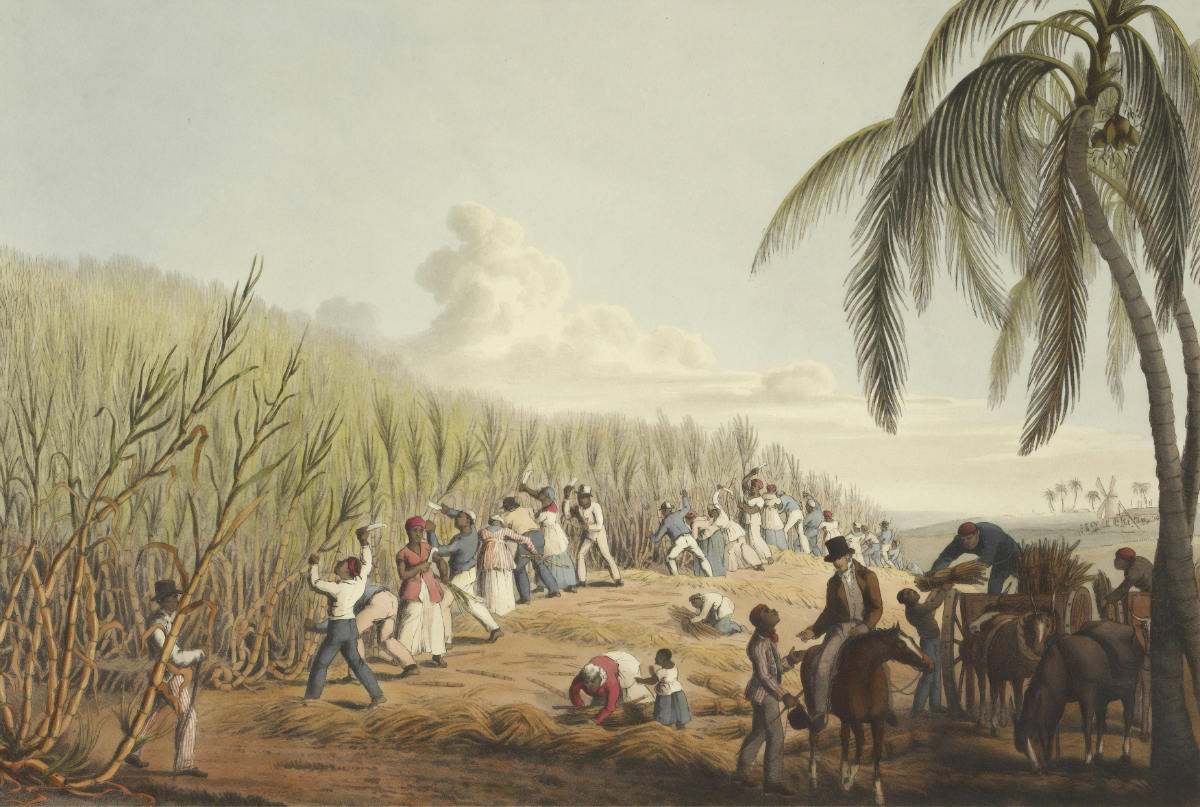
But the part of the equation left out of your argument is that most of the world did not own or want to own slaves. Did not approve of slavery. Did not believe it was morally justified. In Biblical times, in Roman Empire times slaves were a class of people as were the elite. That was cultural influence and nobody ever thought that it needed to be justified. It was just the way things were. Same with our own Native Americans who had no moral qualms about taking and using people as slaves.
What changed all those cultures was primarily development and evolvement of Christianity and Christian conscience that would eventually change most of the world culture and eliminate slavery as a part of that.
Now I'm pretty sure there are no Christian doctrines that would condone or allow slavery and slavery is generally outlawed/unacceptable in most places. Under Islamic law slavery is not condemned or forbidden and still exists though very limited in some Islamic countries or by a few Islamic groups.
And apparently various forms of slavery--it likely isn't called that--still persists in the world. There are some surprising countries on this list. The 'slaves' are mostly those intimidated and threatened into servitude.
Discover population, economy, health, and more with the most comprehensive global statistics at your fingertips.

worldpopulationreview.com
They arrive full of hope - and end up being exploited: the number of victims of human trafficking in Switzerland is increasing dramatically. FIZ offers them protection and a new perspective.

www.bluewin.ch
A study of the subject should give at least food for thought to those who are open minded and capable of thinking differently about something.
You’re not actually responding to what I said. You’re rewriting history to make your current worldview the hero of the past. You claim that “most of the world didn’t approve of slavery” but that’s simply false. Slavery was a global norm for thousands of years. It existed in empires, tribes, democracies, monarchies, and religious institutions alike. The idea that it was always some fringe belief is a comforting revision, not a historical truth.
You then pivot to Christianity as the moral force that ended slavery, but let’s be honest. Christianity also defended it. For centuries. Slaveholders in America quoted scripture to justify ownership. Entire churches blessed the system. Christian conscience didn't suddenly awaken; it split. Some used faith to liberate, yes, but others used it to oppress, and did so with just as much conviction.
You’re trying to rescue the idea of moral certainty by pointing to its eventual evolution, as if that evolution proves certainty was right all along, but it wasn’t. The fact that Christianity, like every other institution, had to change, proves my point, even the most “eternal” truths have had to confront their errors, and yet, instead of asking how we confront those errors, you go back into a familiar pattern.
“That wasn’t real morality.”
“That wasn’t real Christianity.”
“That wasn’t the right kind of certainty.”
That’s the shield that keeps people from growing. Whenever the old view breaks down, it’s dismissed as a fluke or a distortion, never a flaw in the system, never a sign that the framework might need to be interrogated, not just inherited. You want to believe that your current worldview is the fixed point from which all truth flows. That’s understandable. We all want moral clarity, but if your system can’t admit when it was wrong, or needs to rewrite the past to preserve its purity, then it’s not a moral compass. It’s just a security blanket.
You mentioned slavery still exists in the world. You’re right. That should bother all of us, but if it does, ask yourself how many people today are using modern equivalents of “eternal morality” to justify exploitation, exclusion, or cruelty? Will the future look back on those people the way we now look back on the defenders of slavery? History is not proof of moral certainty. It’s a warning about what happens when we think we already have it.