polytheism. Belief in many gods. Though Judaism, Christianity, and Islam are monotheistic (see monotheism), most other religions throughout history have been polytheistic. The numerous gods may be dominated by a supreme god or by a small group of powerful gods.
Which CURRENT religion do you think meets this criteria and why did the Greek religion not continue on to modern times??
I would argue all religions are polytheistic. Its inherent in all religions I can think of. You have 1 main god and other deities all working invisibly to affect your life. Christianity for example has the father the son and the holy spirit. Clearly polytheism even though it will upset some people to hear that.
I dont think any religion has a real clue. I think the religions from the most ancient parts of the world are probably closer to the truth than present day religions. They would inherently be closer to the truth due to their proximity to the creation event.
I keep telling you this is above your pay grade ..................
Trinity
From Wikipedia, the free encyclopedia
"Father, Son, Holy Ghost", "Holy Trinity", and "Trinitarian" redirect here. For the album, see
Father, Son, Holy Ghost (album). For other uses, see
Holy Trinity (disambiguation),
Trinitarian (disambiguation), and
Trinity (disambiguation).
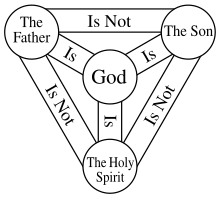
The "
Shield of the Trinity" or
Scutum Fidei diagram of traditional Western Christian symbolism.
The
Christian doctrine of the
Trinity (from Latin
trinitas "triad", from
trinus "threefold")
[1] defines
God as three consubstantial
persons,
[2] expressions, or
hypostases:
[3] the
Father, the
Son (
Jesus Christ), and the
Holy Spirit; "one God in three persons". The three
persons are distinct, yet are one "substance, essence or nature".
[4] In this context, a "nature" is
what one is, while a "person" is
who one is.
[5][6][7]
According to this central
mystery of most
Christian faiths,
[8] there is only one God in three persons: while distinct from one another in their relations of origin (as the
Fourth Lateran Council declared, "it is the Father who generates, the Son who is begotten, and the Holy Spirit who proceeds") and in their relations with one another, they are stated to be one in all else, co-equal, co-eternal and
consubstantial, and "each is God, whole and entire".
[9] Accordingly, the whole work of creation and grace is seen as a single operation common to all three divine persons, in which each shows forth what is proper to him in the Trinity, so that all things are "from the Father", "through the Son" and "in the Holy Spirit".
[10]
Terms such as "monotheism", "incarnation", "omnipotence", are not found in the Bible, but they denote theological concepts concerning Christian faith that are believed to be contained in the Bible. Even the term "Bible" is not found in the Bible. "Trinity" is another such term.
[11]
While the
Fathers of the Church saw even Old Testament elements such as the appearance of three men to Abraham in
Book of Genesis, chapter 18, as foreshadowings of the Trinity, it was the New Testament that they saw as a basis for developing the concept of the Trinity. The most influential of the New Testament texts seen as implying the teaching of the Trinity was
Matthew 28:19, which mandated baptizing "in the name of the Father, and of the Son, and of the Holy Spirit". Reflection, proclamation and dialogue led to the formulation of the doctrine that was felt to correspond to the data in the Bible. The simplest outline of the doctrine was formulated in the 4th century, largely in terms of rejection of what was considered not to be consonant with general Christian belief. Further elaboration continued in the succeeding centuries.
[12]
Scripture does not contain expressly a formulated doctrine of the Trinity. Rather, according to the Christian theology, it "bears witness to" the activity of a God who can only be understood in trinitarian terms.
[13] The doctrine did not take its definitive shape until late in the fourth century.
[14] During the intervening period, various tentative solutions, some more and some less satisfactory were proposed.
[15] Trinitarianism contrasts with
nontrinitarian positions which include
Binitarianism (one deity in two persons, or two deities),
Unitarianism (one deity in one person, analogous to Jewish interpretation of the
Shema and Muslim belief in
Tawhid),
Oneness Pentecostalism or
Modalism (one deity manifested in three separate aspects).