I didn't substitute anything, you are too obtuse to be able to differentiate between natural costs a society incurs (i.e. sanitation) and unnatural costs a society is burdened with.
'As for the polluter thing, with the current set of regulations on pollution'...society incurs a COST of around 4 trillion dollars PER YEAR.
The biggest threat to 'America as we know it' is not too much government, it is ineffective government control of multinational corporations. Entities that have NO allegiance to America, no desire to create or participate in a true free market or any intentions to play by any rules based on morality or ethics.
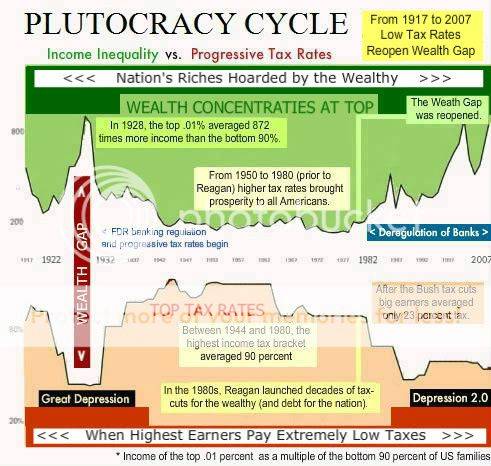
The biggest change the failed Reagan revolution brought about is rampant 'regulatory capture', where teams of corporate lawyers are allowed to WRITE LAWS that solely benefit them, by corrupt legislators. WHY do you think credit card applications went from one or two pages to 30 pages of legalese that even a lawyer has a hard time understanding?
----------------------------------------------------------------------------------
Of the world's largest 100 national governments and corporations in 2002, 76 were corporations. The largest, Wal-Mart, had revenues higher than the expenditures of all but six national governments.
There are two linked problems with such concentrations of corporate power. First, that power increases corporations' ability to influence societal affairs, from fixing prices to altering laws. Second, while corporations and governments may have similar amounts of power, the latter are designed-at least nominally-to serve the public interest, and many are accountable to these publics. Because of shareholder pressures and other demands, most corporations today focus almost entirely on maximizing profits for their shareholders-and they do so primarily by externalizing as many of their social and environmental costs as possible.
In his book Tyranny of the Bottom Line, Ralph Estes examined the extent of this cost externalization in the case of U.S. corporations. Factoring in workplace injuries, medical care required by the failure of unsafe products, health costs from pollution, and many others, Estes found that external costs to U.S. taxpayers totaled $3.5 trillion in 1995-four times higher than the profits of U.S. corporations that year ($822 billion). This sort of externalization toll is routinely evident in hazy skies, injured consumers, and impoverished workers in the United States and elsewhere.
According to a 2004 report released by U.S. Representative George Miller, one 200-employee Wal-Mart store may cost federal taxpayers $420,000 per year because of the need for federal aid (such as housing assistance, tax credits, and health insurance assistance) for Wal-Mart's low-wage employees. Moreover, many corporations fill their labor needs offshore in order to exploit unorganized workers in low-cost and politically friendly countries. Over 40 million people now work in export-processing or "free trade" zones. These areas, often exempt from national legislation, allow manufacturers to demand long hours, pay lower wages, and ignore health and safety regulations.
Corporations have achieved considerable freedom to act in ways that harm the host on which they depend. They have done so primarily by means of regulatory capture, the redesign of societal laws by vested interests for their preferential benefit. This is not new; corporations have always sought to influence lawmakers. TNCs' current levels of power, money, and freedom are unprecedented, however, and regulatory capture has become widespread. The results can be seen in the scores of laws and court rulings that now protect corporations' right to profit, right to pollute, right to patent intellectual property-at the expense of citizens, farmers, workers, consumers, communities, and indigenous peoples. As U.S. President Rutherford B. Hayes once remarked, "This is a government of the people, by the people, and for the people no longer. It is a government of corporations, by corporations, and for corporations." That was in 1884; it's truer now than ever.
When Good Corporations Go Bad
Here is some more education for pea brains...
http://bdp.law.harvard.edu/pdfs/papers/Warren/CH_Middle_Class_Final.pdf




 . They tend to forget how "simple" life actually is these days when they don't even need to lift their butts off their seats in order to dramatically affect just about anything, via the Internet.


